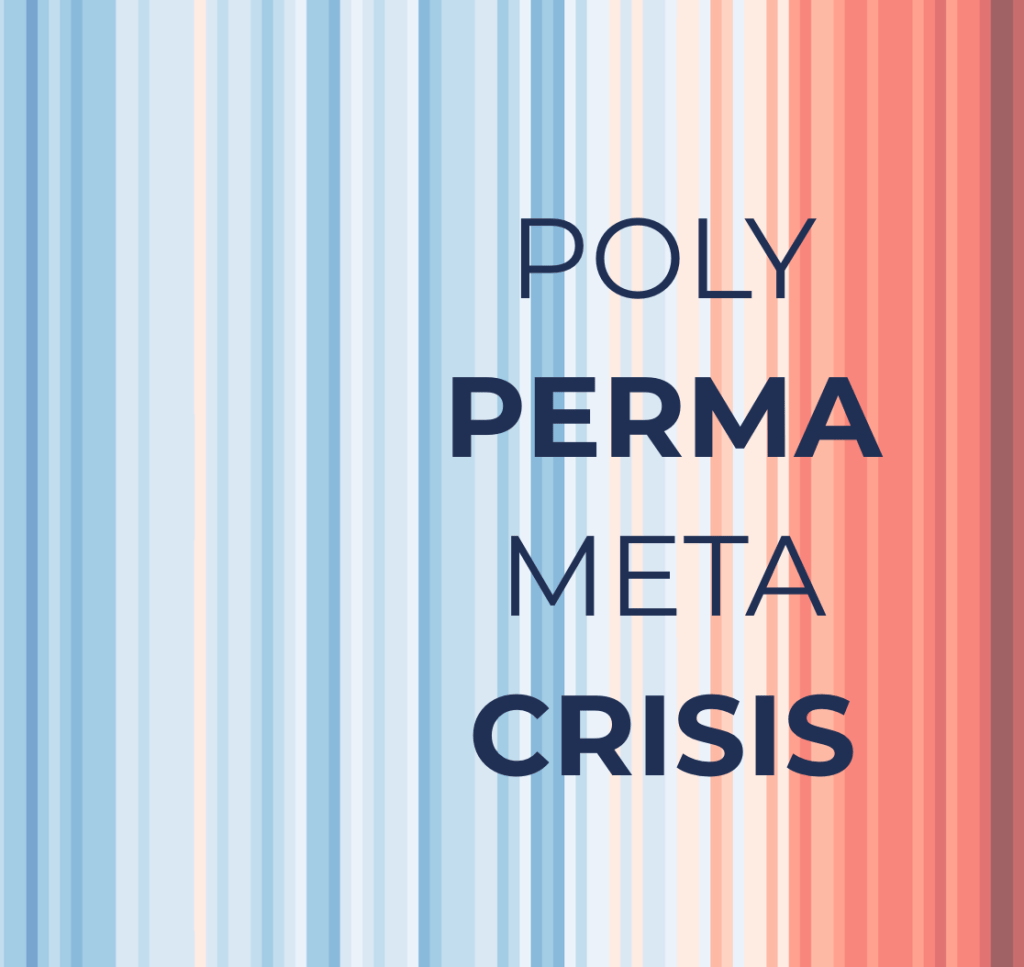
Note: I used this slide in my session at ReimaginED at the fabulous Woodleigh School, Australia last week. Polycrisis and various other terms were used throughout the event, with a wonderful focus on regenerative education, agency, place, time and connection. There is a lot to unpack, and I know they’ll produce report which captures more than my tired brain can process right now.
Over the last couple of years I’ve moved form using polypermacrisis to polypermametacrisis – the post below explains why. Don’t take it too seriously, it’s there to provoke thinking and discussion. Honestly, just showing the image is enough to stimulate good chat, but the heritage of the idea is below if you’re interested.
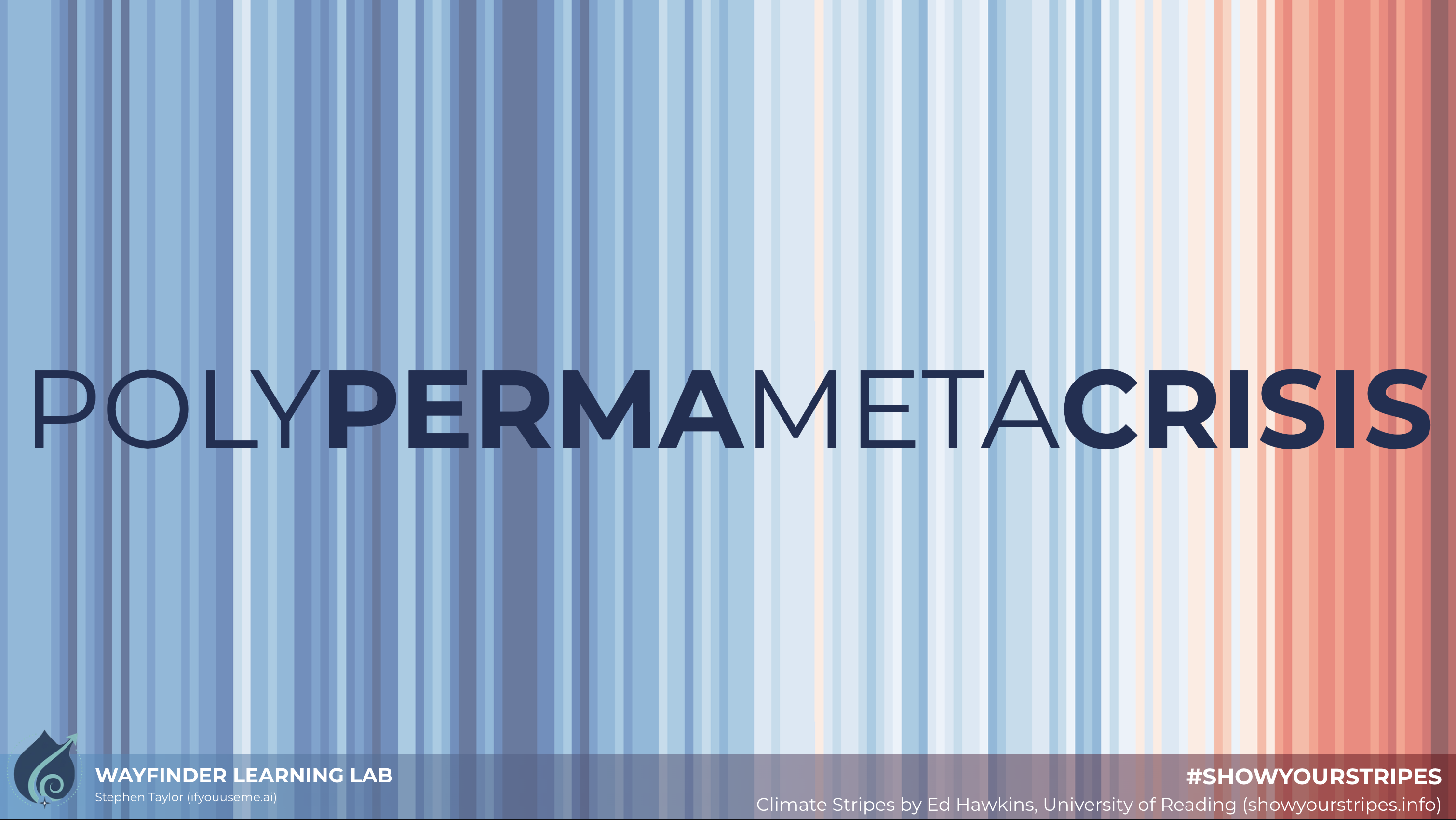
The image above shows Ed Hawkins’ Climate Stripes for the whole planet: one bar per year since 1850, coloured by how much warmer or cooler that year was than the long-term average¹. Blue gives way to red, and the reds get angrier and more intense over time. When I use the stripes in talks, I ask people to read them a second way. Imagine each bar as a year of everything: not just the heating planet, but conflict, economics, academic competition, displacement, information collapse, mental health, and the rise of the machines.
Whatever the issue, it seems to be getting hotter. That’s what I (semi-seriously) call the polypermametacrisis (PPMC*). It’s everything, everywhere, all at once: it’s not going away and it’s within, between and beyond all we do. And we’re educating kids in the middle of it. It’s a bit of daft portmanteau, and deliberately so. I want to raise an eyebrow then stir a thought.
I started saying polypermacrisis in talks around the pandemic (and stirrings of GenAI), mashing together the two words (polycrisis and permacrisis) everyone was reaching for. I added the meta a couple of years later (reasons below). I’m not the only one to use polypermacrisis: Jonathan Rowson at Perspectiva published an essay in 2023 arguing that each prefix corrects the one before it, and in the afterparty section he floats polypermacrisis as a joke, adding that it sounds like a particularly bad haircut³. I like it, even though we got there independently.
At the time of writing, a web search for polypermametacrisis finds it only on my own site². Welding all three together does say something the separate words don’t. So let’s take it apart.
Poly: Many & Tangled
Polycrisis is the oldest and best-travelled of the three. Edgar Morin and Anne-Brigitte Kern used it in Terre-Patrie in 1993, and in the English translation, Homeland Earth, in 1999⁴·⁵. Morin was a complexity thinker, so his point went further than several bad things happening at once: the planet’s problems form a web, and pulling one strand moves the rest⁵. I love a web chart. I don’t love a web of crisis quite so much.
The word sat in the academic corner for two decades, then went mainstream. Adam Tooze picked it up in 2022 for a world where economic and non-economic shocks were, in his phrase, entangled all the way down⁶. By the time Davos built its 2023 meeting around it, polycrisis was the shorthand of choice for ministers and risk consultants⁴.
The tightest definition I’ve found is from the Cascade Institute:
crises in several global systems become causally entangled in ways that significantly degrade humanity’s prospects, doing more harm together than they would apart⁷.
It’s not free from criticism. Daniel Drezner called it a buzzword that makes everything feel so complex that nobody acts⁸. And scholars from the Global South point out that people in the Sahel or South Asia have lived with interlocking crises for generations; what’s new is that the wealthy world has noticed⁹. These critiques should be extended to the PPMC as well.
Still, hold the first idea: many, and tangled. Our students don’t experience climate anxiety, screen time, geopolitics, and AI as separate agenda items, so a school can’t either.
Perma: No End In Sight
Permacrisis was Collins Dictionary’s word of the year for 2022: an extended period of instability and insecurity, especially one resulting from a series of catastrophic events¹⁰. It had been kicking around European policy circles for a while, but a year of war in Ukraine, inflation, heatwaves, and three British prime ministers was when it stopped sounding like jargon¹⁰.
If poly is about structure, perma is about time, and how time feels. Neil Turnbull, writing in The Conversation, points out that crisis once meant a turning point (the Greek krisis), a moment after which things get better or worse. Permacrisis means crises that get managed rather than resolved, and a quiet loss of faith that we’ll ever reach the other side¹⁰.
Teenagers feel this acutely. The adults around them grew up assuming a crisis was an interruption to normal; many of our students have never had a normal to interrupt. Rowson says the polycrisis simply is a permacrisis, because none of the entanglement will resolve itself³.
The stripes keep on striping.
Meta: Within, Between, Beyond
Metacrisis is the most recent and I find it useful in school. It comes from the sensemaking crowd rather than the academy; Jesse Damiani traces it through Tristan Harris, Terry Patten, Jonathan Rowson, Daniel Schmachtenberger, and Zak Stein¹¹. Polycrisis asks what’s going wrong. Metacrisis asks why we keep generating the same trouble.
Rufus Pollock and Rosie Bell put it neatly in a 2025 white paper: polycrisis is the symptoms, metacrisis is the illness, and the illness lives in the worldview of modernity, with its separation of people from nature and its habit of treating everything as a resource¹². We can’t flourish through a worldview that’s extractivist, isolationist, self-centred or disconnected from the natural world.
For Rowson, the metacrisis is the crisis within and between all the major crises: a multifaceted delusion about the nature of reality that shows up in our institutions and culture³. The prefix earns its place because meta points within (what’s going on in our heads and hearts), between (how we relate to each other), and beyond (what comes after crisis thinking).
Polycrisis leaves us as spectators awaiting instructions. Metacrisis implicates us, and so hands us some agency³. Ooh that word again.
This is why I can’t leave meta out. Stein makes the link in an essay whose title I keep coming back to: Education is the Metacrisis¹³. If the deep problem is how a civilisation thinks, values, and pays attention, then the institution that shapes how the next generation thinks, values, and pays attention is right in the middle of it. Add generative AI, now mediating more and more of how young people read, write, and reason, and the stakes go up again.
Meta carries other inferences, too: from Hattie’s influential Visible Learning meta-meta analyses of education (on the useful side), to the insidious sweep of AI in the form of Zuck’s Meta company and perv-specs on the other; via the self-referential “fourth wall break” of social media, film-making and performative irony. Metagaming is also used by gamers as the strategy for optimal play19, which might be useful as we think about how to tackle these issues, and seems to have been “backronymed” to “most effective tactic available“.
*Correlation or Causation?
Everything’s just a bit “meta” these days. And I’ve never meta-phor that I couldn’t squeeze beyond breaking. So let’s squeeze just a little more, as the acronym PPMC is also useful as we turn to statistics and the Pearson Product-Moment Correlation: a measure of the strength of the correlation between two factors. “r” we sure that this is worth mentioning?
Well, maybe. Many elements of the the polypermametacrisis might well be strongly correlated, if not causally so (as the Cascade Institute’s definition might suggest). If you want to have look, check out AXA’s Future Risks Report, or Our World in Data.
Crisis: Stripes of Serious
Crisis is so overused that Rowson wonders whether we should drop it altogether³. He might have a point but I keep it for the same reason Hawkins kept his graphic so simple: it’s recognisable and anyone can read it in a second¹.
Read the stripes twice. First for the planet warming as Hawkins intends. Second, let each stripe stand for a year of the whole convergence: the climate, but also the debt, the wars, the displacement, the fraying trust in institutions, the loneliness of young people, and the arrival of AI, which Rowson calls an accelerating threat multiplier³. The colour still turns from blue to red, and the right-hand edge is where our students are standing. And we don’t know where the right edge will keep going to.
That’s the word in pieces. Poly: the crises are entangled. Perma: they aren’t going away. Meta: they share a root in how we think and what we value, so they’re partly ours to work on. And Crisis, in its old sense of a decision point, says the stripes are a question rather than a verdict.
What Can Schools Do About It?
A school that takes all this seriously but in the wrong direction can end up handing the whole mess to a fourteen-year-old in a unit on global issues and asking them to fix it. Look at those poor polar bears, good luck.
I’ve worried about this since 2014, when I first wrote about educating for hope, not despair, borrowing George Monbiot’s line that if you terrify people they’ll focus on saving themselves¹⁴. In a keynote to our own staff in 2023 I was blunter: it’s not our job to hand learners a broken world and set it as homework. Time and childhood are non-renewable resources, and we spend them on young people’s behalf².
We have to create hope alongside awareness.
Hope, in the sense I mean it, is not blank optimism. Optimism expects things to work out; informed hope acknowledges the difficulty and insists our actions still matter. Rowson suggests action gives rise to hope, not the other way round³. Yuen Yuen Ang’s polytunity reads the same entanglement as an opening rather than a sentence⁴.
For a school, that means hope and agency are inseparable through a cycle of intention, action and reflection. We can’t hand students the polypermacrisis and say “your turn”. We need to show that their actions, words and competencies matter. Read much more here.
In classrooms, it means curriculum that holds problem and response in the same frame: the warming planet and the people decarbonising it; the information mess and the students learning to check a source; the AI tools and the young person learning to direct them rather than be directed¹⁵; the acknowledgement of division and the tools to build connection; the mental health crisis and the strategies to develop resilience and antifragility. It also means effectively including young people in the work as equal partners, not making decisions for them, or assuming they cannot see for themselves.
The Brookings Global Task Force on AI in Education concluded in January 2026, after consulting over 500 people in 50 countries, that for now the risks of generative AI in children’s education outweigh the benefits, because the risks reach foundational development¹⁶. Its recommendations are things schools can actually do: holistic AI literacy, tools that teach rather than tell, and a clear ethical vision centred on human agency¹⁶. For school leaders, that work is protection and direction. Protect the conditions for thinking (attention, relationships, time) against an engagement economy, with a recommendation to break engagement addiction¹⁶. Direct by deciding what AI is for in your school before a vendor decides for you, and saying so in words students and parents can repeat back.
For systems, the frameworks already exist. UNESCO’s Reimagining Our Futures Together calls for a new social contract for education built on cooperation and solidarity, with schools as protected sites of collective learning¹⁷. The OECD’s Education for Human Flourishing, out in November 2025, says that in the age of AI education must strengthen human agency, human meaning, and human security, and that the human capital model behind most curricula prepares young people for yesterday’s jobs¹⁸. As the IB also works towards greater moves for flourishing, and I see the word take centre stage at conferences and with accrediting agencies, I have some informed hope that things can get better, with the optimism that it goes beyond a buzzword and beyond the individual human to the community and planet, learning from regenerative education.
None of these sources use the term polypermametacrisis, but I think they are answering it in their own ways: as interconnected & entwined, simultaneous and symbiotic, rooted in and the results of education.
Back to the stripes one last time. Our students stand at the right-hand edge, where the colour is hottest, and the bars beyond them haven’t been painted or programmed yet. Schools don’t control the climate, the markets, or the models. We do shape, every day, how a generation learns to read that pattern and whether they believe their own hands can change it and whether the role models they have been given are paving a positive path forwards (or just sitting back and panicking).
Could we end up with a polypermametaresolution? Oooh lofty.
So there you go. One long word and an even longer ramble. Feel free to use this with your own staff or conversations if you want; or just stick the image on the wall and see where the conversations take you.
References
- Hawkins E. Show Your Stripes: Globe, 1850–2025. University of Reading. https://showyourstripes.info/s/globe
- Taylor S. 2023. Shining a light on hopeful learning. Wayfinder Learning Lab. https://sjtylr.net/2023/11/15/educating-for-hope-in-an-uncertain-world/
- Rowson J. 2023. Prefixing the world: why the polycrisis is a permacrisis, which is actually a metacrisis, which is not really a crisis at all. Perspectiva. https://perspecteeva.substack.com/p/prefixing-the-world
- Wikipedia contributors. 2026. Polycrisis. Wikipedia. https://en.wikipedia.org/wiki/Polycrisis
- Morin E, Kern AB. 1999. Homeland Earth: A Manifesto for the New Millennium. Cresskill (NJ): Hampton Press.
- Tooze A. 2022. Welcome to the world of the polycrisis. Financial Times. https://www.ft.com/content/498398e7-11b1-494b-9cd3-6d669dc3de33
- Lawrence M, Homer-Dixon T, Janzwood S, Rockström J, Renn O, Donges JF. 2024. Cascade Institute. Global polycrisis: the causal mechanisms of crisis entanglement. Global Sustainability. 7:e6. (https://cascadeinstitute.org/technical-paper/global-polycrisis-the-causal-mechanisms-of-crisis-entanglement/) AND “Global Systemic Stresses: Understanding the drivers of polycrisis (2025) https://cascadeinstitute.org/technical-paper/global-systemic-stresses-understanding-the-drivers-of-polycrisis/
- Drezner D. 2023. Are we headed toward a “polycrisis”? The buzzword of the moment, explained. Vox. https://www.vox.com/23572710/polycrisis-davos-history-climate-russia-ukraine-inflation
- Ruwanpura KN, Cederlöf G, Ramasar V. 2025. Decolonising polycrisis: Southern perspectives on interlocking crises. Environment and Planning A: Economy and Space. 57(6):697–703.
- Turnbull N. 2022. Permacrisis: what it means and why it’s word of the year for 2022. The Conversation. https://theconversation.com/permacrisis-what-it-means-and-why-its-word-of-the-year-for-2022-194306
- Damiani J. 2023. Explaining polycrisis and metacrisis. Reality Studies. https://www.realitystudies.co/p/explaining-polycrisis-and-metacrisis
- Pollock R, Bell R. 2025. From Polycrisis to Metacrisis: A Short Introduction. Life Itself. https://lifeitself.org/research/publications/polycrisis-to-metacrisis-white-paper
- Stein Z. 2019. Education is the metacrisis: why it’s time to see planetary childhood as the gravest threat and greatest opportunity. Perspectiva. https://systems-souls-society.com/wp-content/uploads/2022/01/Education-is-the-metacrisis.pdf
- Taylor S. 2014. Educate for hope, not despair, for a fair and sustainable world. Wayfinder Learning Lab. https://sjtylr.net/2014/10/13/hope/
- Taylor S. 2026. (If You) USEME-AI: Learning for Hope and Agency in an AI World. ifyouuseme.ai. https://ifyouuseme.ai/book
- Burns M, Winthrop R, Luther N, Venetis E, Karim R. 2026. A new direction for students in an AI world: prosper, prepare, protect. Brookings Institution. https://www.brookings.edu/articles/a-new-direction-for-students-in-an-ai-world-prosper-prepare-protect/
- UNESCO. 2021. Reimagining Our Futures Together: A New Social Contract for Education. Paris: UNESCO. https://unesdoc.unesco.org/ark:/48223/pf0000379381
- OECD. 2025. Education for Human Flourishing: A Conceptual Framework. Paris: OECD Publishing. https://www.oecd.org/en/publications/education-for-human-flourishing_73d7cb96-en.html
- ESports Talk. https://www.esportstalk.com/blog/no-meta-is-not-short-for-most-efficient-tactic-available/
- Pearson Product-Moment Correlation. Wikipedia. https://en.wikipedia.org/wiki/Pearson_correlation_coefficient


Thank-you for your comments.