This has been in drafts for ages, pulling together elements of the book, with connections to our work and my lit review for the EdD. Pdf below.
Stephen is Director of Innovation in Learning & Teaching at the Western Academy of Beijing and current EdD Research Student at the University of Bath.
Edit: Just after this post was published, UNESCO’s Digital Learning Week 2026 took place. Annually they release big publications at this event. This year: The Algorithm in the Room: Seeing and confronting the implications of AI for the future of education. It is an excellent collection of essays and research, with a lot of resonance with this post.
Abstract
Learner agency is the core business of progressive international education, a headline theme in AI guidance from UNESCO, the OECD and Brookings, and increasingly under threat from agentic AI and emerging technologies. This article connects those three forces for international school educators and leaders. I examine the evidence on AI’s impacts on learning, dependence, voice, ideas and identity, including homogenisation and WEIRD bias, alongside the economic case for developing agentic young people. Borrowing mitigation, adaptation and innovation from climate action, I outline a balanced approach: protecting integrity through visible thinking and evaluative judgement, adapting assessment and pedagogy, and inspiring agency through innovation, relationships and time outdoors.
Introduction
Learner Agency is one of the enduring ideas of progressive and international education but pinning down what it really means feels like trying to find the end of a rainbow. That is understandable: it feels like an ethereal idea, drawing from a broad spectrum of influences in philosophy, psychology, sociology and neuroscience, dependent on context and always changing. It can appear when we shine a light through learning. We can try to define it and create the conditions for it to emerge dependably, then clouds pass over or the winds of change blow away the magic and we’re starting again.
After many years of work in IB schools, EdD reading and a good deal of arguing with myself, the working definition I use goes something like this:
Agency is the culturally and ecologically situated, relationally constituted, and developmentally progressive capacity of individuals and groups to set goals, exercise judgment, regulate their own learning, think critically and creatively and act with purpose. They shape their own educational experiences and life trajectories in ways that are responsive to context and emerging technologies, sustained by hope, collectively oriented and grounded in both cognitive competence and affective engagement. (Taylor, 2026b)
Or a little more simply:
Learner agency is the capacity to set goals, exercise judgement, regulate your own learning, think critically and creatively, and act with purpose. It is relational rather than solitary, it develops over time rather than arriving fully formed, and it is sustained by hope.
I keep coming back to agency as the focus of my research because it is at the nexus of three powerful, timely forces:
- As the goal of progressive and international education, agency is our core business, helping shape competent, confident, adaptable and resilient young people in a time of accelerating change and uncertainty.
- Protecting and promoting human agency is a core theme and shared thread across all AI-related guidance and competency frameworks.
- Increasingly agentic AI and emerging technologies have moved beyond the simple chatbot towards autonomous decision making and multimodal capabilities, invisibly and (possibly) irreversibly changing the dynamics of learning and action.
Four years on from the release of ChatGPT, a lot has changed. The technology is moving incredibly quickly, vast bodies of (often conflicting) research are emerging on the challenges and opportunities posed by AI, governments and agencies are responding in a whole range of ways, careers are being reshaped and redefined. But in the lived reality of classrooms, little feels different, except perhaps a feeling of increased pressure. Teachers and students are in an extended period of limbo, trying to mitigate the risks of emerging technologies, adapt to within-reach adjustments and (very occasionally) truly innovate new opportunities, all while waiting for the systems in which they work to change substantially enough to rise to the challenge of this new normal.
And it’s a new normal that is beset by mutliple simulteneous and interacting challenges: a polypermametacrisis, if you will.

None of this is new any more; we’ve had enough time to think and to deal with the emotional responses to the challenge. It’s time to take on the mantle of the pragmatic idealist, staying true to our core beliefs around powerful learning whilst tackling challenges with a clear head and the ability to hold multiple, often contrasting and nuanced, viewpoints at the same time. I believe that a deeper focus on protecting, promoting and creating the conditions for learner agency is a clear path forwards. It is a path that can carve through high-tech, low-tech and no-tech environments as we focus our attention squarely on the capacities of our learners to become self-actualised, building reserves of competencies, knowledge and skills that will temper them for new and unpredictable challenges. We don’t need technology to develop agency, and we can’t develop expertise in technology without having a powerful sense of agency.
So let’s go on an adventure.
If we get this right, we just might find that pot of gold at the end of the rainbow.
Agency at the Heart of Progressive & International Education
The international school movement has been built on agency for the best part of a century. Dewey wrote in 1938 that there was no sounder point in progressive education than the learner’s participation in forming the purposes that direct their own work, and no greater defect in traditional education than its failure to secure that participation (Dewey, 1938).
The frameworks we work within say the same thing in different accents, with agency baked into the vision and standards that we are held to. The IB frames agency as voice, choice and ownership, developing from the PYP through the MYP and into the DP (IB, 2018). The OECD Learning Compass defines student agency as the capacity to set a goal, reflect and act responsibly to effect change, and puts co-agency (the supportive relationships with teachers, peers, families and community), right alongside it (OECD, 2019). NEASC’s ACE learning principles describe learners with age-appropriate autonomy over their learning, making informed choices with guidance from within and beyond the classroom (NEASC, 2022). CIS evaluation asks explicitly about student voice and wellbeing. Melbourne’s New Metrics go further and treat Agency in Learning as an observable, assessable competency, with elements such as acting with autonomy, managing ambiguity, generating feedback loops and striving for mastery; it is assessed in the doing, not in the product (Melbourne Metrics, 2025).
Whatever the flavour, the common thread is that agency is not a personality trait some students bring through the door and others do not. It is a potential to be unlocked and empowered through relationships and conditions (Biesta and Tedder, 2007). Brookings call this the agency paradox: the social supports around a young person are what make self-determination possible, rather than what limit it (Walsh and Hoff, 2024). Self-determination theory says much the same from the psychology side, with autonomy, competence and relatedness as the three needs that have to be met before intrinsic motivation takes over (Ryan and Deci, 2000). It takes a village to raise an agent.
Agency is therefore a design problem. Ritchhart’s eight cultural forces (expectations, language, time, modelling, opportunities, routines, interactions and environment), are still the most programme-agnostic and practical map I know for designing it (Ritchhart, 2015). Nothing released since November 2022 has made them obsolete, and they underpinned the development of (If You) USEME-AI.
Protecting Agency in Global Guidance
We aren’t flying blind in our adaptation to AI in education. The first wave of guidance from 2023-24 has gained widespread adoption and adaptation, with agency a strong recurring theme. Updates, position papers and competencies formed the second wave (2024-25), with a third wave of practical implementation and case studies close behind. See them here.
UNESCO’s 2023 guidance on generative AI lists protecting human agency as a headline recommendation, built from data protection, motivation, opportunity, social interaction, reduced academic pressure, consultation and accountability (UNESCO, 2023). Its 2024 competency frameworks for students and for teachers both open with a human-centred mindset before they get anywhere near tools or prompts (UNESCO, 2024a; 2024b).
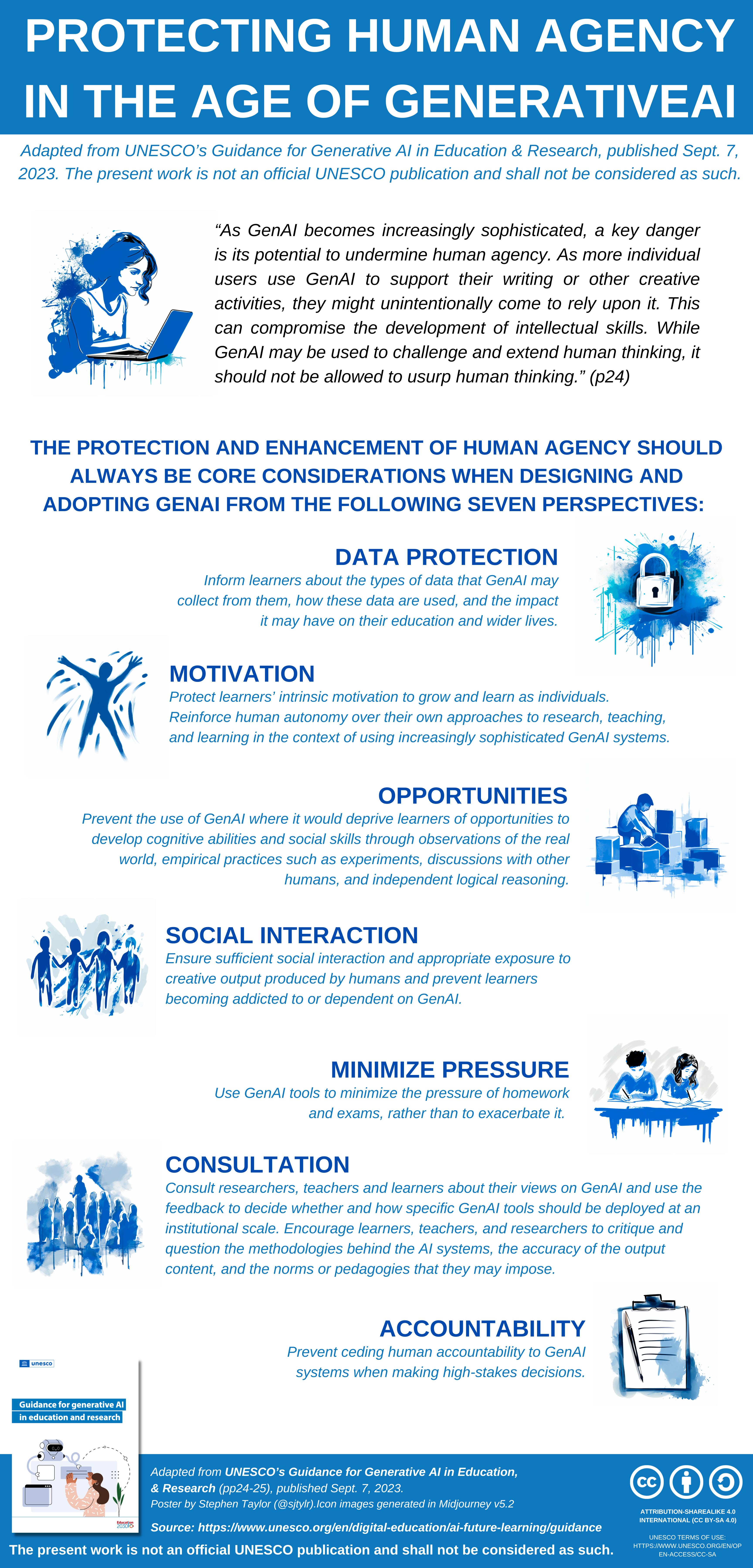
The OECD’s work on human flourishing treats agency as morally guided and socially embedded rather than as simple autonomy or choice (OECD, 2025a), and its AI literacy framework, developed with the European Commission for primary and secondary education, is built around learners who create with purpose and make ethical decisions about use (OECD, 2025b). Kucirkova’s agenda for student agency in the AI era argues that design choices in technology can either strengthen agency, by making options visible and supporting reflective action, or erode it through opaque automation and engagement-driven systems (Kucirkova and Piotrowski, 2025). These are all dense and well-researched documents; far more than can be summarised here, so check them out.
The more recent Brookings report, A new direction for students in an AI world: prosper, prepare, protect (Burns et al, 2026) presents a thorough of Delphi (expert) level panel review of perspectives and research papers, many connected to published guidance and competencies. This year-long study across fifty countries and many interviews is framed as a pre-mortem: an attempt to work out what could go wrong before we spend a decade finding out. It describes two trajectories, AI-enriched learning and AI-diminished learning. In simple terms it concludes that at this point in the technology’s development the risks might outweigh the benefits, because the risks touch children’s foundational development while the benefits are mostly incremental. Of note for this article is the fifth risk: dependence on AI can erode students’ autonomy and agency. The report describes a continuum from mild, situational reliance through moderate use with attempts to preserve effort, to complete dependence and what the authors call a systematic avoidance of effort. It also describes a flywheel, where trust in AI and reliance on AI feed each other until students are using it for everything from homework to friendships to life decisions. Although the framing may appear a bit grim their recommendations include: tools that teach rather than tell; holistic AI literacy; preparing teachers to teach with and through AI; and a clear vision for ethical use that centres human agency. The report also insists that students themselves must be participants in shaping how AI is used in their schools. Sounds a lot like agency to me.
I read this constellation of documents as both guidance and reassurance for school leaders who are determined to create agentic learning futures and to protect the ideals of progressive international education. They are a credible touchpoint for connecting plans and action to publications and they converge on the idea that we can protect and promote learner agency first, before worrying about what to do with AI. In one sense, they are calming, as they might defuse the urgency of technological response. On the other, they might be confronting, as to really set a clear path forwards requires a much deeper interrogation of our systems, curriculum, pedagogies and long-held practices.
The Economic Case for Learner Agency
Although we might be driven by the ideals of progressive international education, we can’t be ignorant to the pragmatic realities of our market. Our schools are a huge investment to our families, whose children’s learning experiences are diverging further and further from their own. Naturally this creates uncertainty and worry about if they are doing the right thing for their children’s future prospects. They face contrasting messages about “what’s best” from marketing and when all school websites look pretty much the same, they might be hanging on to what they know as a reassurance in their school choices.
Thankfully, the economic imperative seems to be pointing in the same direction of developing agentic young people. The World Economic Forum’s (WEF) Future of Jobs surveys ask employers across dozens of economies what skills they need now and what they expect to need next. Between reports, we see skill demands in response to the near-term landscape: in 2025, AI & big data top the list. But when we look at what skills endure, we see the foundations of agency: analytical & creative thinking, resilience, flexibility & agility, curiosity & lifelong learning, leadership & social influence, and technological literacy. Where you might make some decisions about high-school opportunities based on the transient top, these would not be of importance to your early learners; who knows what the 2040 report (when they hit highered or the workplace) might place at the top.
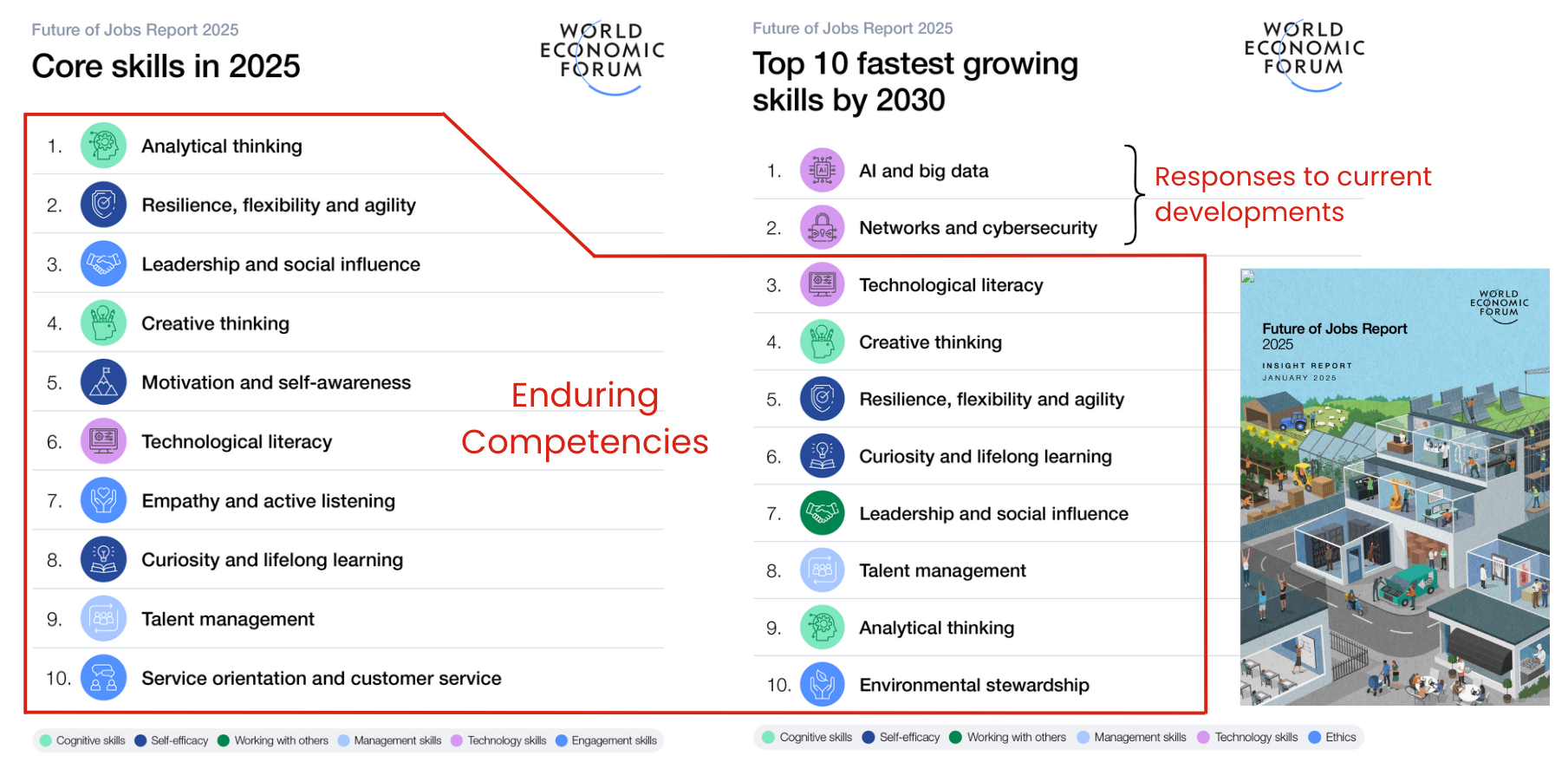
The Forum’s follow-up work with the McKinsey Health Institute (2026) groups the human end of that list under the term brain skills: the higher-order cognitive, interpersonal, self-leadership and technological literacy abilities that let people adapt, relate and contribute. Their point is that knowing a particular workflow is becoming less valuable than being able to rethink the approach when circumstances change, and that these skills are overrepresented in both today’s and tomorrow’s lists. They estimate that 59% of employees will need additional training by 2030 to keep up. If you read the list again you can draw parallels with the description of an agentic learner: someone who sets goals, adapts, persists, works with others and keeps learning. The earlier WEF report on AI and Education 4.0 (2024) makes the same point from the school side, with lifelong and student-driven learning as one of its four experience shifts and a clear statement that AI should enhance, not replace, the teacher.
I have some reservations about starting from employability, but I’m a pragmatic idealist, so here we go. If we prepare students primarily for a job rather than for agency and self-direction, we may be preparing them for the sectors that benefit least from AI, and we risk shrinking education to a talent pipeline. But it is useful to be able to say to a sceptical governor or parent that agency is not the soft option; it is the skill set the labour market is asking for. It is also the thing that contributes to a life well lived, one of personal and community agency and flourishing. Powerful learning now is excellent learning for the future, and the knowledge, skills and competencies developed through deeper learning, with or without AI, are enduring.
The Pull of Increasingly Agentic AI and Emerging Technologies
AI tools have moved quickly from answering questions to doing jobs effectively. They plan, browse, write, test, revise and return with a finished product. The next generation will do more of this with less prompting, fewer errors and little to no user oversight. For a knowledge worker that is welcome (until their job is outsourced). For a learner, every step a tool takes on their behalf is a step they did not take towards their own learning.
Back to Dewey (1938): he drew a distinction that might help here. An impulse becomes a desire when it is obstructed, and a desire becomes a purpose only through foresight: the cognitive work of observing, remembering and judging what will happen if we act. A tool that executes on the learner’s behalf removes that work, and with it the part of learning Dewey thought mattered most. Neuroscience adds a second layer. Our sense of agency, the feeling of being the author of our own actions, depends on predicting the outcomes of what we do and then attributing those outcomes to ourselves. That loop breaks when a system autonomously completes the task (Haggard, 2017). The Brookings interviews put it more bluntly through the voices of teachers and students: when a tool can apparently do everything, doing nothing starts to feel logical (Burns et al, 2026).
Vygotsky (1978) thought similarly: agency develops in the zone of proximal development (ZPD) between what a learner can do alone and what they can do with a more knowledgeable other (MKO). A well-designed AI tutor could be an extraordinary MKO, available at midnight in any language, but only if it stays in the zone with the learner rather than jumping straight to the answer. We need to know what students are able to do independently, what they are doing with AI and what they are doing in the shadows if we are to really empower the development of agency through the ZPD. We can’t let the machines take over, but we can’t be blinkered to their existence (and potential). With roots in Vygotsky, Ritchhart’s cultural forces emerge once more as a pedagogical framework to help create effective cultures of thinking and powerful learning.
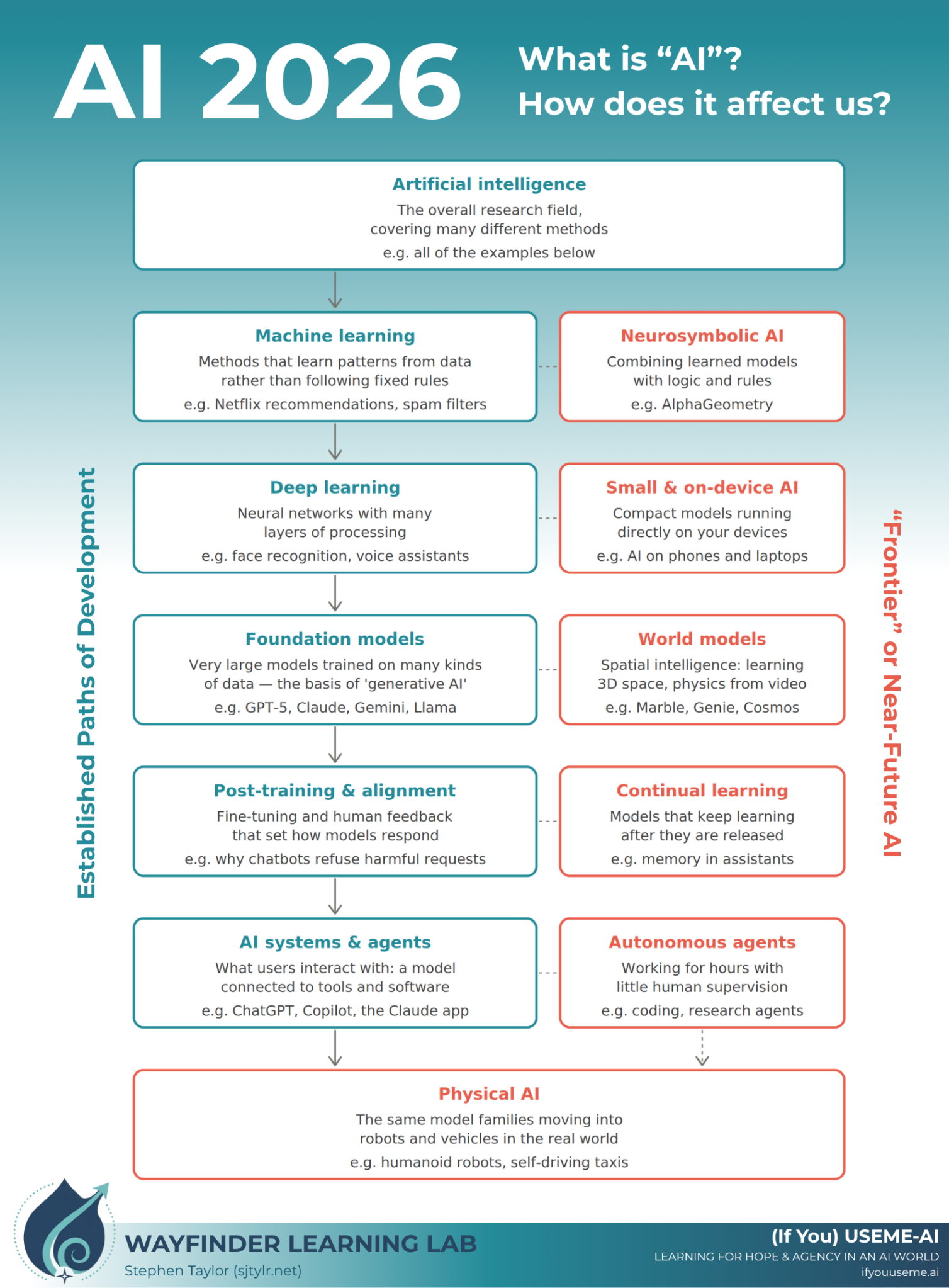
We also need to update our own understanding of what the technology can currently do, and where it might be heading. Just a couple of years ago, large language models (LLM) were the phrase of the day: powerful (for the time) AI systems that could use natural language processing (NLP) to convert text-based inputs into new text-based outputs. Foundation models (e.g. ChatGPT, Claude, Gemini, Kimi) are now more powerful, multimodal and increasingly agentic, able to make decisions, set our reasoning pathways and handle text, image, video, data, coding, voice and much more.
See the image below for one attempt to sketch the landscape.
Impacts on Agency, Voice, Ideas & Identity
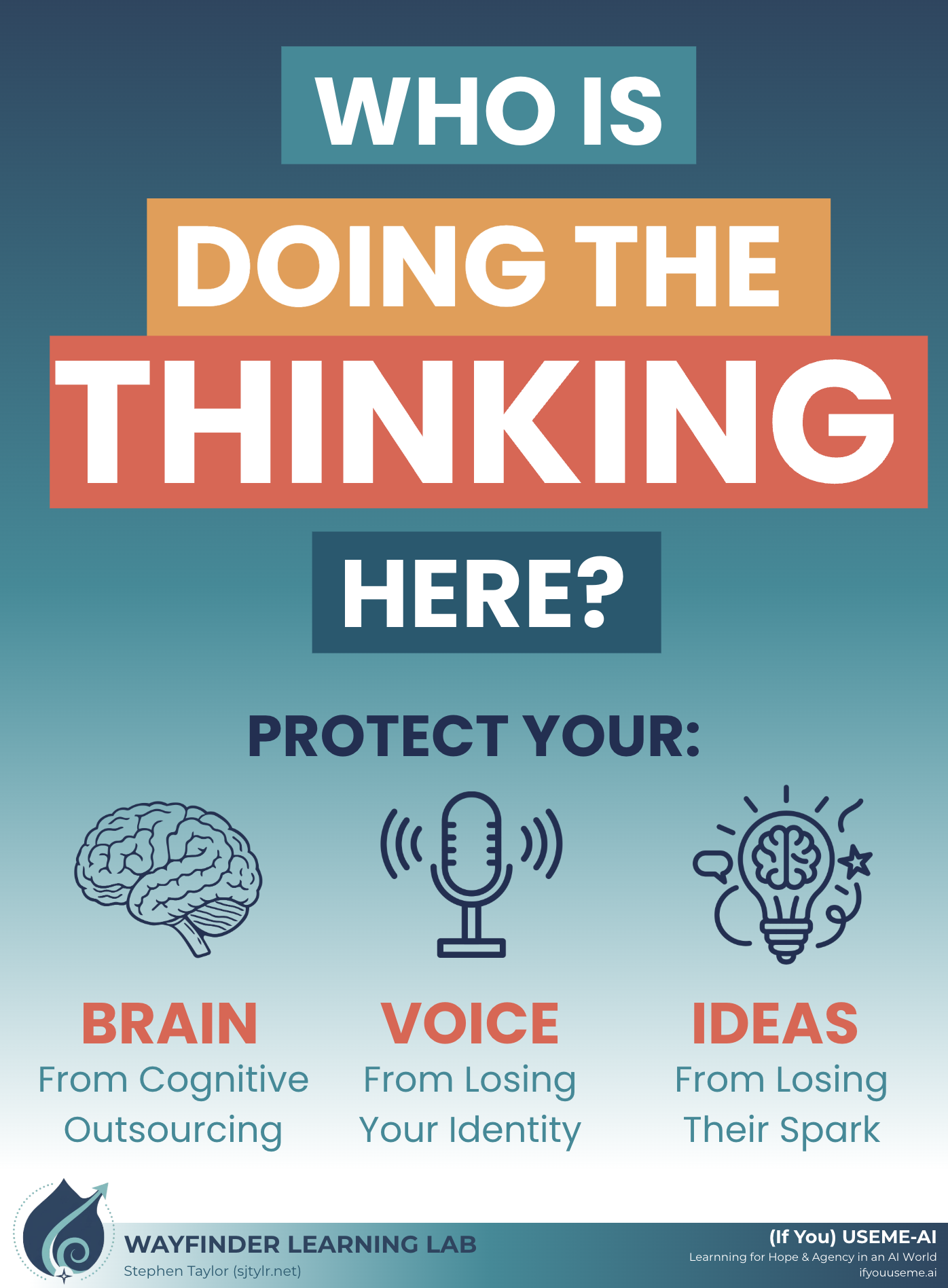
So… there’s more. With AI’s potential to encroach on learner agency, we are starting to see further externalities in the use of the technology. These are worth bearing in mind as another layer to protect and promote: voice, ideas and identity.
Bastani et al’s (2025) field experiment with nearly a thousand secondary students demonstrated that unrestricted access to (now ancient) GPT-4 raised scores during practice and then lowered them once the tool was removed, yet a tutor version built to give teacher-designed hints rather than answers removed the harm. A more recent viral pre-print of a study of over 26,000 Chinese students found similar results, with AI use improving homework scores, reducing homework time and reducing scores on standardised tests (Stromberg, Lei and Wu, 2026). Knowledge workers who trust AI more report less effort in critical thinking, with their role shifting from doing the work to checking it (Lee et al, 2025). Early EEG work on essay writing points to weaker neural engagement and a lower sense of ownership among AI-assisted writers, though it remains a small-sample preprint and should be read with some caution (Kosmyna et al, 2025). Brookings found concern about dependence in every context they studied, public and private, rich and poor, with and without AI policies, and heard the word addiction from teachers describing their students and, sometimes, themselves (Burns et al, 2026).
The findings I find most worrying are about homogenisation of voice and ideas. As foundation models are built on a corpus of training data, they spit back polished and algorithmic responses. Doshi and Hauser found that generative AI raised the creativity of individual writers, particularly the less creative ones, while reducing the diversity of what the group produced as a whole (Doshi and Hauser, 2024). Similar findings were reported by Moon, Green and Kushlev (2025), Anderson, Shah and Kreminski (2024) and more. For emerging English users, these effects can extend to the homogenisation of voice (Agarwal 2025); the same group of learner who may fall foul of false-positive AI detector flagging (Liang et al, 2023; Bassett et al, 2026).
For international schools there is a further twist. Atari et al (2023) at Harvard administered the World Values Survey and a set of classic cross-cultural cognitive tasks to GPT and compared the responses with data from 65 nations. The model’s answers were an outlier compared to humanity as a whole, and the closer a country sat to the WEIRD end of the spectrum (Western, Educated, Industrialised, Rich and Democratic) the more the model resembled its people; the correlation with cultural distance from the United States was strongly negative. On thinking style, GPT clustered with the Netherlands, Finland and Sweden; on self-concept, it assumed the average human defines themselves through personal attributes rather than relationships and roles, which is true of US undergraduates and untrue of most of the world.. Most of our students are not WEIRD. Many come from cultures in which agency looks like diligence, self-cultivation and obligation to family and community as much as individual choice (Li, 2006). When the default voice of the tool is a particular culture’s voice, the risk is that a Grade 10 student from Beijing or Bandung learns to sound like a Californian, and calls it their own work. Identity forms in the struggle to say what you actually think, in your own words, with your own cultural references and schema, to someone who pushes back. Outsourcing learning can hollow-out the human.
These layers of human and learner agency are critical in the development of young people in our schools. We’re not raising robots and we’re not erasing identities.
A Balanced Approach: Skills, Integrity & Room to Explore
I am neither pro- nor anti-AI. It is part of the job and part of our students’ futures, so let’s approach it from a culture-based, learning-focused perspective of a pragmatic idealist, rather than from fear or hype (Taylor, 2025a). Our learners are already AI-augmented consumers, users and creators of knowledge, and the school conversation needs to shift from cheating towards constructive and productive relationships with the technology.
In (If You) USEME-AI I borrow mitigation, adaptation and innovation from climate action to describe the parallel states we live in (Taylor, 2025b, 2026a). Mitigation is reducing harms to agency, integrity, equity and safeguarding where we are bounded by external forces, such as terminal IB assessment: more interactive assessment, closed environments where needed, honest conversations about boundary cases. Adaptation is purposeful modification of what we already do where we have room to move: think-first routines in which students commit to their own ideas before an AI extension, AI-generated alternatives for students to critique, transparent AI use in research processes, student-plus-AI self-feedback. Innovation is the co-creation of approaches that were not possible before: mastery portfolios with ongoing interaction, AI-enabled design challenges, courses that learn about, with and through AI in the open. A teacher may be in all three states in one day, which is fine so long as they know which one they are in. Brookings’ language for the same idea is titration: knowing when to teach with and without AI, and using it only when it adds to student effort and thinking rather than replacing it (Burns et al, 2026).
Academic integrity is a culture of trust and fair use rather than a detection problem. Misuse lives in the invisible middle, the gap between an assignment being set and the work being turned in, and that gap shrinks in classrooms where drafts, conferencing and feedback are part of the process rather than an afterthought. Teacher-librarians and edtech integrators remain a school’s superpower here. A critical competency to develop is evaluative judgement: the ability to judge the quality of work, including AI-generated work, against standards you understand (Bearman et al, 2024). Students who can do that are stepping towards agency in their relationships with technology, whereas those who prompt and paste, or just give up, are not. The classroom culture is essential for developing this traits.
Inspiring Agency: Innovation, Relationships & Getting Outside
Protection is only half the job. Some of the most agentic learning I have seen in the last three years has involved AI directly: a student who created and patented a heart-health device, students who created a company for sports performance analysis, a team who created an AI in Medicine event for younger peers and much more. You can see some examples here: https://ifyouuseme.ai/framework/inspiring.
Beyond the generative tools that keep teachers awake at night, there is a great deal of hard AI at work in medicine, climate science, agriculture and development that students could be exploring, testing and improving, and connecting to the SDGs and to local problems. This is the Inspiring Innovations end of (If You) USEME-AI. It is where agency stops being something we have to protect and becomes something students exercise on the world, developing the skills of responsible and ethical use of emerging technologies. For these students, it is supremely motivating and exciting, and possibly beyond the reach of the adults around them.
Innovation with AI only inspires agency when it is wrapped in human, relational work. Emotion and cognition are inseparable in the brain; learning that lacks emotional significance produces shallow thinking, and the neural systems that support self-reflection and meaning-making switch on for significance, not for task completion (Immordino-Yang, 2016). Agency is built in conversations, in feedback a student trusts because they trust the person giving it, and in role models who show what acting on the world looks like (Walsh and Hoff, 2024). The WEF’s own task analysis (2024) makes the point from the teacher perspective. Those skills with the lowest exposure to automation are interpersonal: face-to-face communication, mentoring, feedback, planning and supervising field trips and experiential activities, and guiding students in learning from them. We don’t need to be the AI experts; we need to be the caring, supportive and empowering humans alongside our learners.
So, get outside, literally. The brain capital report notes that daily outdoor and sports programmes build executive function through movement and that mentorship and project-based learning strengthen persistence and self-direction (WEF and McKinsey Health Institute, 2026). Field work, learning gardens, service in the community, expeditions, connecting with younger learners and the walk to collect water samples are where students experience being the author of an action with visible consequences. Ojala’s work on young people and climate change distinguishes constructive hope from wishful thinking; constructive hope holds a realistic view of the problem alongside the belief that action is possible, and it is that combination that gets people moving (Ojala, 2012). The regenerative education literature makes the same point with more soil under its fingernails: agency grows when learners work together on real social and ecological problems in places they care about (Florez, 2025). In an AI world, time outdoors and in communities can be an antidote to tech fatigue, a way to build trust and an avenue for the real, serious and contextualised work of deep learning and agency.
Teacher Agency & Leadership Clarity
Learner agency is downstream of teacher agency. Teachers, like students, achieve agency through their contexts rather than carrying it around as a fixed quality, and the ecology of a school can enable or shut it down (Priestley, Biesta and Robinson, 2015). Collective teacher efficacy remains among the strongest influences on learning in Hattie’s synthesis (Hattie, 2023). A teacher who feels trusted and clear about the school’s direction will make good AI decisions in the moment but one who feels surveilled and alone will either ban everything or give up, risking the erosion of student-teacher relationships in the process.
There is a workload argument that gets made a lot, and it is half right. Lower secondary teachers across OECD countries spend around 44% of their working time actually teaching, and too much administration is the main source of stress they report (WEF, 2024). If AI takes some of that away, good. But Brookings found teachers describing their own dependence on AI in the same terms as their students’, and warned that a teacher who visibly outsources their thinking signals to students that outsourcing is fine (Burns et al, 2026). The time AI saves has to be returned to relationships, feedback and conferencing, or it is not a gain for agency at all.
This puts a particular demand on leadership: clarity. When ChatGPT arrived we were still in the final stretch of remote learning in Beijing, and the community needed months of interpersonal repair before anyone had bandwidth for AI. So we created, curated, waited and innovated, and listened a lot. The lesson from that period is that a forty-page policy written in a hurry helps nobody. What helps is a short, shared statement of what we are protecting, what AI is for in this school and where the boundaries sit for different programmes, followed by time and permission for teachers to try things, share them and occasionally fail. Guidance should be co-created with students, teachers and librarians, and revisited as the tools change. Leaders also need to understand the technology well enough to tell hype from substance, and to understand learning well enough to know what good teaching looks like with or without it. Culture is more powerful than technology, and culture is a leadership responsibility.
Learning for Hope & Agency
If this seems like a lot, well it is. Sorry. That’s the life of the pragmatic idealist, carrying competing ideas whilst centring the needs of our young people.
But don’t let it breed despair; there’s enough of that in the world. There is no pre-determined future of learning. An agentic vision of learning in the age of AI is one of informed hope, possibility and community. It’s mitigation, adaptation and innovation, paired with deep cultures of thinking and powerful relationships with each other, communities and the natural world. It’s one where we co-create the conditions to thrive so that learners’ agency can bloom, and with that develop the mindsets, competencies and skills to adapt to whatever the next stage of their life throws at them. In short, it’s time to be teachers.
References
Agarwal, D., Naaman, M. and Vashistha, A., 2025. AI suggestions homogenize writing toward western styles and diminish cultural nuances. Proceedings of the 2025 CHI Conference on Human Factors in Computing Systems [Online], CHI 2025: CHI Conference on Human Factors in Computing Systems, Yokohama Japan. New York, NY, USA: ACM, pp.1–21. Available from: https://doi.org/10.1145/3706598.3713564 [Accessed 28 September 2025].
Anderson, B.R., Shah, J.H. and Kreminski, M., 2024. Homogenization effects of large language models on human creative ideation. In: Proceedings of the 16th Conference on Creativity & Cognition (C&C ’24), Chicago, 23–26 June 2024. New York: ACM, pp.413–425. Available from: https://doi.org/10.1145/3635636.3656204 [Accessed 5 September 2026].
Atari, M., Xue, M.J., Park, P.S., Blasi, D.E. and Henrich, J., 2023. Which humans? [Online]. PsyArXiv preprint. Available from: https://doi.org/10.31234/osf.io/5b26t [Accessed 26 August 2026].
Bassett, M.A., Bradshaw, W., Bornsztejn, H., Hogg, A., Murdoch, K., Pearce, B. and Webber, C., 2026. Heads we win, tails you lose: AI detectors in education. Journal of Higher Education Policy and Management [Online], pp.1–16. Available from: https://doi.org/10.1080/1360080X.2026.2622146 [Accessed 30 January 2026].
Bastani, H., Bastani, O., Sungu, A., Ge, H., Kabakcı, Ö. and Mariman, R., 2025. Generative AI without guardrails can harm learning: evidence from high school mathematics. Proceedings of the National Academy of Sciences [Online], 122(26), e2422633122. Available from: https://doi.org/10.1073/pnas.2422633122 [Accessed 26 August 2026].
Bearman, M., Tai, J., Dawson, P., Boud, D. and Ajjawi, R., 2024. Developing evaluative judgement for a time of generative artificial intelligence. Assessment & Evaluation in Higher Education [Online], 49(6), pp.893–905. Available from: https://doi.org/10.1080/02602938.2024.2335321 [Accessed 26 August 2026].
Biesta, G. and Tedder, M., 2007. Agency and learning in the lifecourse: towards an ecological perspective. Studies in the Education of Adults [Online], 39(2), pp.132–149. Available from: https://doi.org/10.1080/02660830.2007.11661545 [Accessed 26 August 2026].
Burns, M., Winthrop, R., Luther, N., Venetis, E. and Karim, R., 2026. A new direction for students in an AI world: prosper, prepare, protect [Online]. Washington, DC: Center for Universal Education, Brookings Institution. Available from: https://www.brookings.edu/articles/a-new-direction-for-students-in-an-ai-world-prosper-prepare-protect/ [Accessed 26 August 2026].
Dewey, J., 1938. Experience and education. New York: Macmillan.
Doshi, A.R. and Hauser, O.P., 2024. Generative AI enhances individual creativity but reduces the collective diversity of novel content. Science Advances [Online], 10(28), eadn5290. Available from: https://doi.org/10.1126/sciadv.adn5290 [Accessed 26 August 2026].
Florez, I.R., 2025. The end of education as we know it: regenerative learning for complex times. Gabriola Island: New Society Publishers.
Haggard, P., 2017. Sense of agency in the human brain. Nature Reviews Neuroscience [Online], 18(4), pp.196–207. Available from: https://doi.org/10.1038/nrn.2017.14 [Accessed 26 August 2026].
Hattie, J., 2023. Visible learning: the sequel. A synthesis of over 2,100 meta-analyses relating to achievement. London: Routledge.
IB, 2018. Learning and teaching: agency [Online]. Geneva: International Baccalaureate Organization. Available from: https://www.ibo.org/programmes/primary-years-programme/curriculum/learning-and-teaching/ [Accessed 26 August 2026].
Immordino-Yang, M.H., 2016. Emotions, learning, and the brain: exploring the educational implications of affective neuroscience. New York: W.W. Norton.
Kosmyna, N., Hauptmann, E., Yuan, Y.T., Situ, J., Liao, X.-H., Beresnitzky, A.V., Braunstein, I. and Maes, P., 2025. Your brain on ChatGPT: accumulation of cognitive debt when using an AI assistant for essay writing task. arXiv [Online], 2506.08872. Available from: https://arxiv.org/abs/2506.08872 [Accessed 26 August 2026].
Kucirkova, N. and Piotrowski, J., 2025. An agenda for student agency in the AI era [Online]. Available from: https://www.linkedin.com/feed/update/urn:li:activity:7398644392464617472/ [Accessed 26 Jan 2026].
Lee, H.-P., Sarkar, A., Tankelevitch, L., Drosos, I., Rintel, S., Banks, R. and Wilson, N., 2025. The impact of generative AI on critical thinking: self-reported reductions in cognitive effort and confidence effects from a survey of knowledge workers. In: Proceedings of the 2025 CHI Conference on Human Factors in Computing Systems, Yokohama, 26 April–1 May 2025. New York: ACM, pp.1–22.
Li, J., 2006. Self in learning: Chinese adolescents’ goals and sense of agency. Child Development [Online], 77(2), pp.482–501. Available from: https://doi.org/10.1111/j.1467-8624.2006.00883.x [Accessed 26 August 2026].
Liang, W., Yuksekgonul, M., Mao, Y., Wu, E. and Zou, J., 2023. GPT detectors are biased against non-native English writers. Patterns [Online], 4(7), 100779. Available from: https://doi.org/10.1016/j.patter.2023.100779 [Accessed 5 September 2026].
Melbourne Metrics, 2025. Assessing agency in learning: competency kit (sample) [Online]. Melbourne: University of Melbourne. Available from: https://education.unimelb.edu.au/__data/assets/pdf_file/0008/5199092/2025-Competency-Kit_AGENCY-IN-LEARNING_generic_Sample.pdf [Accessed 26 August 2026].
Moon, K., Green, A.E. and Kushlev, K., 2025. Homogenizing effect of large language models (LLMs) on creative diversity: an empirical comparison of human and ChatGPT writing. Computers in Human Behavior: Artificial Humans [Online], 6, 100207. Available from: https://doi.org/10.1016/j.chbah.2025.100207 [Accessed 5 September 2026].
NEASC, 2022. ACE learning principles guide and ecosystem 2.0 [Online]. Burlington, MA: New England Association of Schools and Colleges. Available from: https://www.neasc.org/sites/default/files/2024-05/ace_ecosystem_and_guide_doc_252_r2024-04.pdf [Accessed 26 August 2026].
OECD, 2019. OECD Learning Compass 2030: a series of concept notes [Online]. Paris: OECD Publishing. Available from: https://www.oecd.org/en/data/tools/oecd-learning-compass-2030.html [Accessed 26 August 2026].
OECD, 2025a. Education for human flourishing: a conceptual framework [Online]. Paris: OECD Publishing. Available from: https://doi.org/10.1787/73d7cb96-en [Accessed 26 August 2026].
OECD, 2025b. Empowering learners for the age of AI: an AI literacy framework for primary and secondary education [Online]. Paris: OECD Publishing. Available from: https://ailiteracyframework.org [Accessed 26 August 2026].
Ojala, M., 2012. Hope and climate change: the importance of hope for environmental engagement among young people. Environmental Education Research [Online], 18(5), pp.625–642. Available from: https://doi.org/10.1080/13504622.2011.637157 [Accessed 26 August 2026].
Priestley, M., Biesta, G. and Robinson, S., 2015. Teacher agency: an ecological approach. London: Bloomsbury Academic.
Ritchhart, R., 2015. Creating cultures of thinking: the 8 forces we must master to truly transform our schools. San Francisco: Jossey-Bass.
Ryan, R.M. and Deci, E.L., 2000. Self-determination theory and the facilitation of intrinsic motivation, social development, and well-being. American Psychologist [Online], 55(1), pp.68–78. Available from: https://doi.org/10.1037/0003-066X.55.1.68 [Accessed 26 August 2026].
Stromberg, D., Lei, V. and Wu, Y., 2026. The generative AI learning penalty: evidence from Chinese secondary education [Online]. SSRN preprint. Available from: https://doi.org/10.2139/ssrn.6868618 [Accessed 5 September 2026].
Taylor, S., 2025a. (If You) USEME-AI (v1.4). Wayfinder Learning Lab [Online]. Available from: https://sjtylr.net/if-you-useme-ai/ [Accessed 26 August 2026].
Taylor, S., 2025b. Mitigation, adaptation, innovation. Wayfinder Learning Lab [Online]. Available from: https://sjtylr.net/2025/12/03/mitigation-adaptation-innovation/ [Accessed 26 August 2026].
Taylor, S., 2026a. (If You) USEME-AI: learning for hope and agency in an AI world [Online]. Wayfinder Learning Lab. Available from: https://ifyouuseme.ai/book [Accessed 5 September 2026].
Taylor, S., 2026b. What do we mean when we say agency? Wayfinder Learning Lab [Online]. Available from: https://sjtylr.net/2026/03/24/what-do-we-mean-when-we-say-agency/ [Accessed 26 August 2026].
UNESCO, 2023. Guidance for generative AI in education and research [Online]. Paris: UNESCO. Available from: https://unesdoc.unesco.org/ark:/48223/pf0000386693 [Accessed 26 August 2026].
UNESCO, 2024a. AI competency framework for students [Online]. Paris: UNESCO. Available from: https://unesdoc.unesco.org/ark:/48223/pf0000391105 [Accessed 26 August 2026].
UNESCO, 2024b. AI competency framework for teachers [Online]. Paris: UNESCO. Available from: https://unesdoc.unesco.org/ark:/48223/pf0000391104 [Accessed 26 August 2026].
Vygotsky, L.S., 1978. Mind in society: the development of higher psychological processes. Cambridge, MA: Harvard University Press.
Walsh, J. and Hoff, K., 2024. The agency paradox: how social support enables the freedom to act [Online]. Washington, DC: Brookings Institution. Available from: https://www.brookings.edu/articles/the-agency-paradox-how-social-support-enables-the-freedom-to-act/ [Accessed 26 August 2026].
WEF, 2024. Shaping the future of learning: the role of AI in Education 4.0 [Online]. Geneva: World Economic Forum. Available from: https://www.weforum.org/publications/shaping-the-future-of-learning-the-role-of-ai-in-education-4-0/ [Accessed 26 August 2026].
WEF and McKinsey Health Institute, 2026. The human advantage: stronger brains in the age of AI [Online]. Geneva: World Economic Forum. Available from: https://www.weforum.org/publications/the-human-advantage-stronger-brains-in-the-age-of-ai/ [Accessed 26 August 2026].
Cite this document: Taylor, S. 2026. Why Learner Agency Matters Now More Than Ever. Wayfinder Learning Lab [Online]. Available from: https://sjtylr.net/2026/09/05/why-learner-agency-matters-now-more-than-ever/.


Thank-you for your comments.