Available from April 1 2026 on Kindle, including Kindle Unlimited subscriptions. Print version is out Now too!
In the space between EdD phases, I’ve been working on a special project… writing my first full book. This has been a real labour of love over the last many months of weekends and evenings, and it’s finally out.
(If You) USEME-AI: Learning for Hope & Agency in an AI World is is a love-letter to education in a time of accelerating change. It builds on 20 years of experience in IB schools, the last 15 years on this blog, ten years of engagement with Cultures of Thinking, four years of work on AI and three years of EdD studies, all pointing in the same direction: a focus on hope, agency and co-creating futures of education that might possibly shine a light on something better. I’ve been writing about this since about 2014 and feel that we need this now more than ever. To do that we need to understand much more than the clicky-click of AI tools.
It frames the reader as a pragmatic idealist, someone who holds onto their values and vision whilst recognising the pressing challenges of now, approaching them with a level head and focus on workable solutions. Across 12 chapters it works through the elements of (If You) USEME-AI, with SideQuests on Mitigation, Adaptation & Innovation, Assessment & Feedback and the TEMPERed Learner along the way. Explore the chapters here.
As we go through the book, it connects learning theories and approaches, aiming to ensure strong foundations so that we can engage with AI with intentionality, purpose and a strong focus on protecting powerful thinking, learning, ethics and the capacities that make us uniquely human in an increasingly automated world. It challenges us to think deeply about what is important, connect new ideas and hold onto a vision of learning that is optimistic, informed and grounded. It makes many connections to UNESCO & OECD guidance and competencies. It aims to balance caution and ethical approaches with suitable applications of AI that might inspire students to do something special and help teachers develop their own practices.
Throughout the book, we spend a year at “Wayfinder International School“, with vignettes from fictional characters Ziggy, Izzy, Ozzy & Jazz, teachers and students approaching the challenges of AI from different perspectives. Meet them here.
Each chapter across the (approximately) 350 pages goes from the balcony of big ideas to the dancefloor of practical strategies, calling at the DJ booth of research. I’ve written it to be as conversational and approachable as possible, whilst connecting it to current research. There are hundreds of references across the book; pretty much everything useful I’ve read in recent years. Each chapter includes a lot of reflective questions, “try this” moments, and prompts to help model your learning as you go.
There is also an extensive, open-access support site for the book. This includes materials for each chapter, a reflective journal (hosted locally), buckets of resources, downloads and a large library of Poes and Prompts to try. The Environmental Impacts Estimator lives here too, with lessons, research and workshop materials. A few more surprises and resources are scattered across the site. The site will be updated as new research emerges or ideas pop into my head. The blog page curates posts from here related to the topics of the book.
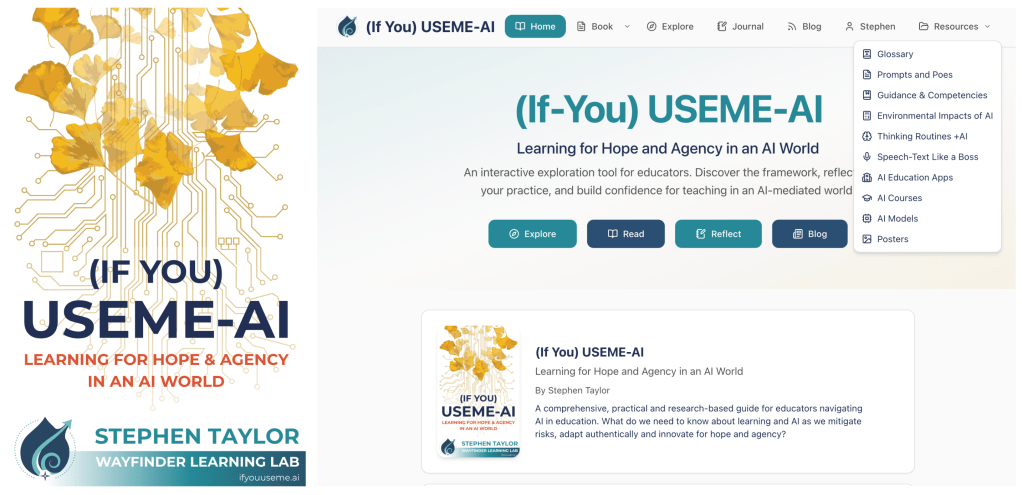
The book cover is human-created, by my daughter Anya. It has a swirl of Ginkgo leaves over circuitry, representing connections between the enduring past (Gingko is a ‘living fossil’), the natural world and technology-mediated futures.
My fingers are aching, my brain is mush and my heart is full (I think). It exists! I hope you like it even just a fraction of how much I’ve enjoyed creating it. I think I’ve left everything on the page.
Huge thanks to my friends, family, colleagues and researchers who have inspired and supported this work.
The book will be published first on Amazon Kindle. Links here. It’s available to buy for GBP 8.99 or equivalent. That’s less than the coffee and tiramisu I ordered while writing this post. If you have Kindle Unlimited, it will be free on there for 90 days. The print version will be available very soon.


 Wayfinder Learning Lab - Stephen Taylor
Leave a reply to Dr. Christian Vatchkov Cancel reply