Cognitive Offloading, Cognitive Outsourcing, Cognitive Surrender, Never-skilling, Mis-skilling and De-skilling… and a hopeful view that being informed means becoming competent if you remember that Attention is (almost) All You Need. A post to share some conversations we’re having with students, based on current research and a new review from Stanford.
In recent weeks, we’ve been engaging with students in sessions about protecting powerful thinking in the age of AI. Not as a judgement on anyone’s current behaviours, but as a language toolkit that can help name and notice what is going on, and then take action to become more personally agentic. So far it has been large-group introductions with Grades 9 & 10, and smaller focused workshops with Grade 11.
Avoiding the Slip & Slide
I posted a bit about these issues before, but these sessions are more concise and student-facing. I loved doing these as a way to connect with students, reconnect with my IBBio teaching roots and build new connections with students to research in AI. I was careful to note that these aren’t ‘student issues’, they are happening all over the place. But by being aware, they can become resilient to it, and learn to shine in their knowledge and competencies.
We learned about:
- Cognitive load, effort and how memories are made.
- Emotion and attention as drivers of learning.
- The power of hand-writing notes and using structures like Cornell Notes to organise thinking and voice-typing to break the static friction of getting started on an assignment.
- Cognitive Offloading, Outsourcing and Surrender and noticing what’s happening as we engage with learning.
- Never-skilling, de-skilling and mis-skilling, from recent research in medical education.
- Homogenisation of voice and ideas, and the noticing that AI is changing some people’s thinking and writing… even if they don’t use it.
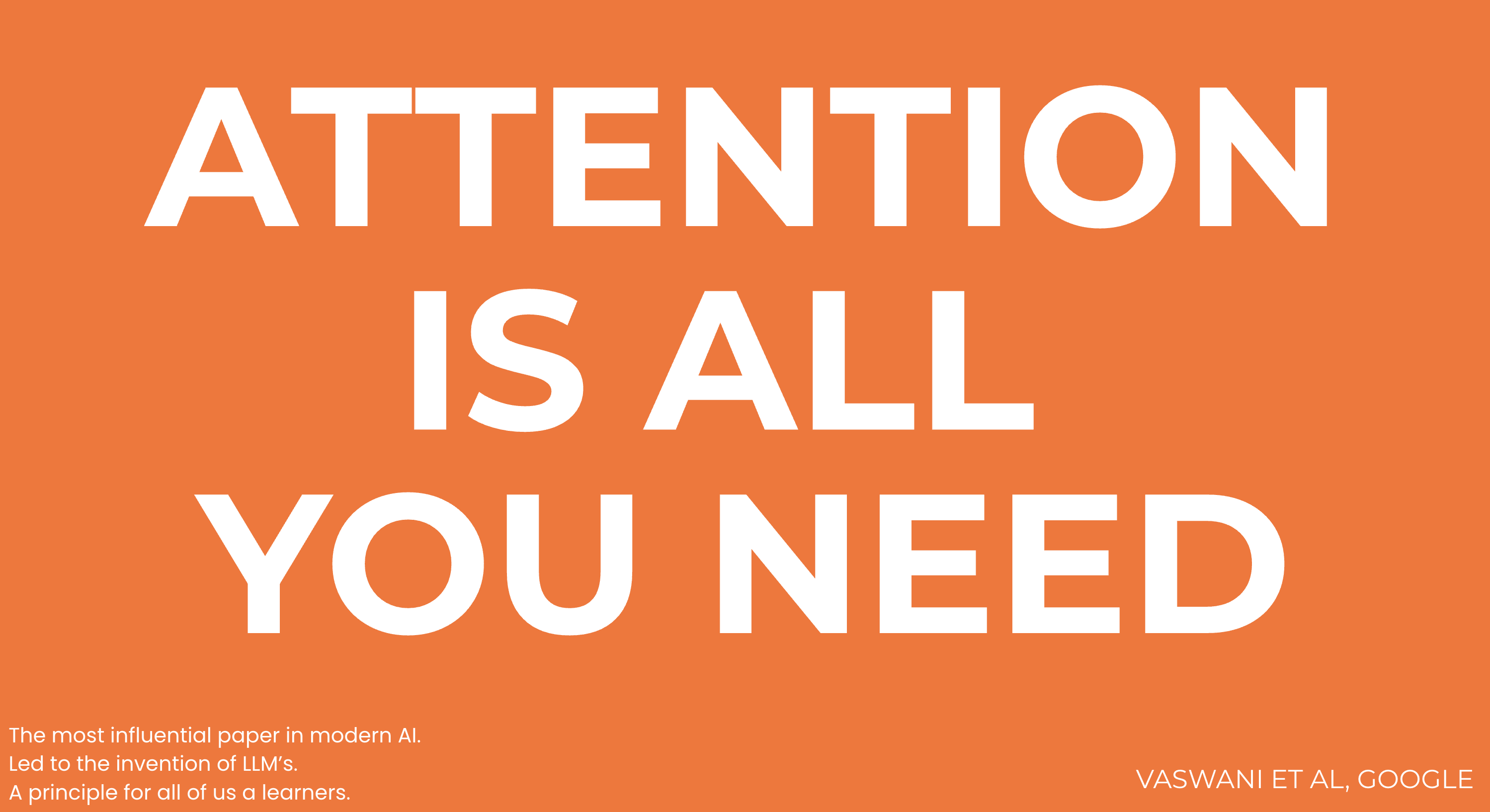
- Coming back to Attention Is All You Need as the foundation of LLM’s and a philosophy for becoming super-learners.
There was a lot to unpack, with some great student questions, notes and conversations. We’ll keep this thread going; it seems to have sparked some interest. A summary poster with references is below.
Skilling Me Softly
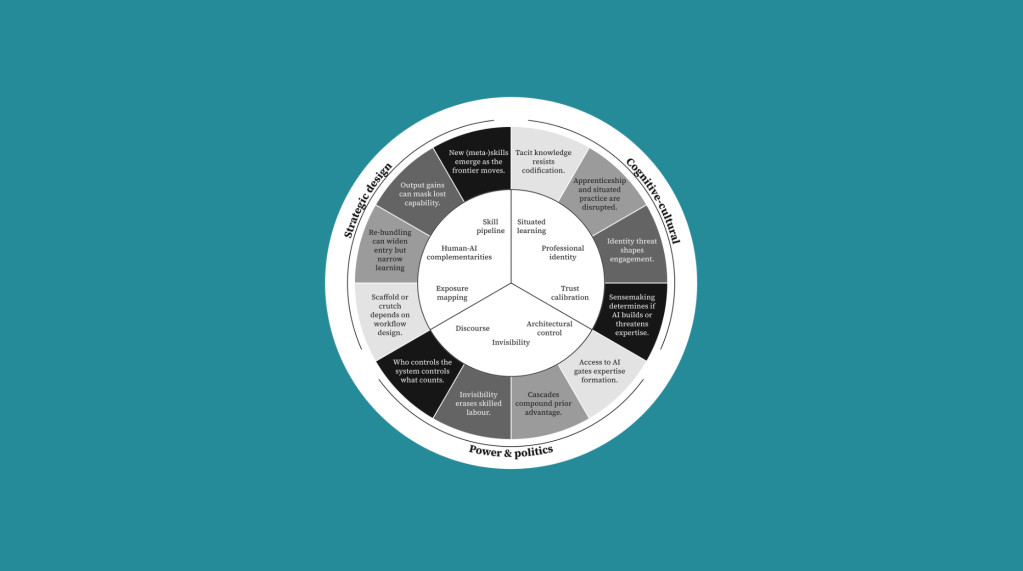
A timely new paper from researchers at Stanford is useful in these discussions. As they note, research on this is disconnected, though it is converging on similar ideas. Academics love to get in a silo, yet in education we need to connect the dots. Read the paper here, it is open-access. In it, they unpack never-skilling, de-skilling and mis-skilling, and go further into what organisations can to to ensure up-skilling and re-skilling are effective.
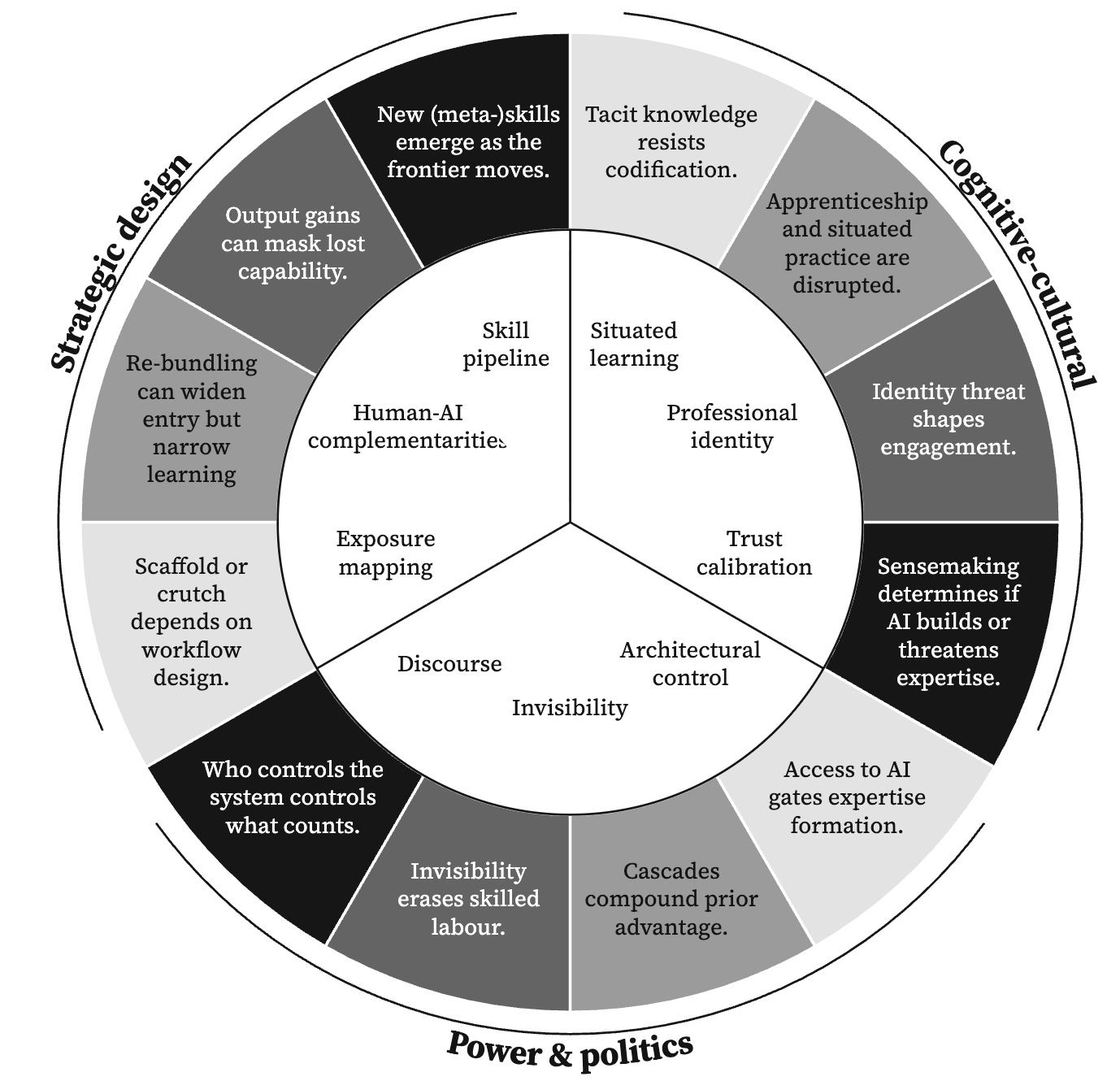
You’ll probably see this graphic doing the rounds on the socials. They propose three domains to ensure competent skilling.
Strategic Design: exposure mapping, human-AI complementarities, skill pipeline. It treats the organisation as something people design on purpose.
Cognitive-Cultural: situated learning, professional identity, trust calibration. It treats the organisation as a system of meanings and norms.
Power & Politics: architectural control, invisibility, discourse. It treats the organisation as a negotiated order where groups compete for control.
Using examples from research across fields, including law and medicine, they unpack each segment and claim. Go into the paper to find out more.
Applying their conclusions to education, we find affirmation of what we’ve been saying (and doing) for years, but worth summarising and noticing where we can get better:
- Assess with tools removed, to avoid an “AI fluency trap.”
- Guardrails matter more than whether or not AI is used. Think of AI tutors that support thinking, and don’t give answers. Are our guidance and expectations clear?
- Attempt first, before using AI. Like ‘think first” thinking routines, avoiding AI influence or bias that might shortcut students’ ideation, creativity, voice or critical thinking.
- Teach the task, not the tool. Develop the actual competencies in the actual human, not the AI proxies for them. AI can come later, maybe, if they’re appropriately skilled.
- Ensure productive struggle. Obviously. Effort is where the learning is.
- Teach trust calibration directly. We need to learn how judgement works, based on strong skills and knowledge. Then we need to learn when to override or critique AI outputs. Asking students, particularly novices to ‘check the output’ is too vague to be useful.
- Measure what matters. If we value a competency, but only assess the final (AI-vulnerable) product, are we really assessing what we intend?
- Plan access for equity. Those with greater access and skill will likely get better outputs and learning impacts. Who else needs support in using any tool more effectively?
- Transparency, trust & safety. Create a culture of open disclosure and intentional use, without judgement or penalisation. Keep it out of the shadows.
- Treat “future skills” claims critically. These tend to be short-horizon market demands. Focus on the enduring competencies for most, and the short-term technical for those interested.
AI in education, skills and employment is fast-moving and although the convergence of ideas is encouraging, it will still take years to get solid data on long-term effects. The good thing is the convergence is heading towards what we’ve been trying to do in international schools and cultures of thinking for many years. The science and art of teaching are more important now than ever, connected through attention: to learning, design and impact.
Quality Thinking: The Skiller Queen
Anyone who knows Melbourne Metrics, knows that one of Prof. Sandra Miligan’s mantras is “Agency is the Queen of Competencies.” Maybe then in Brainland, Quality Thinking is the “Skiller Queen”: elements that show what it looks like to really develop competence as a self-directed and sophisticated learner.
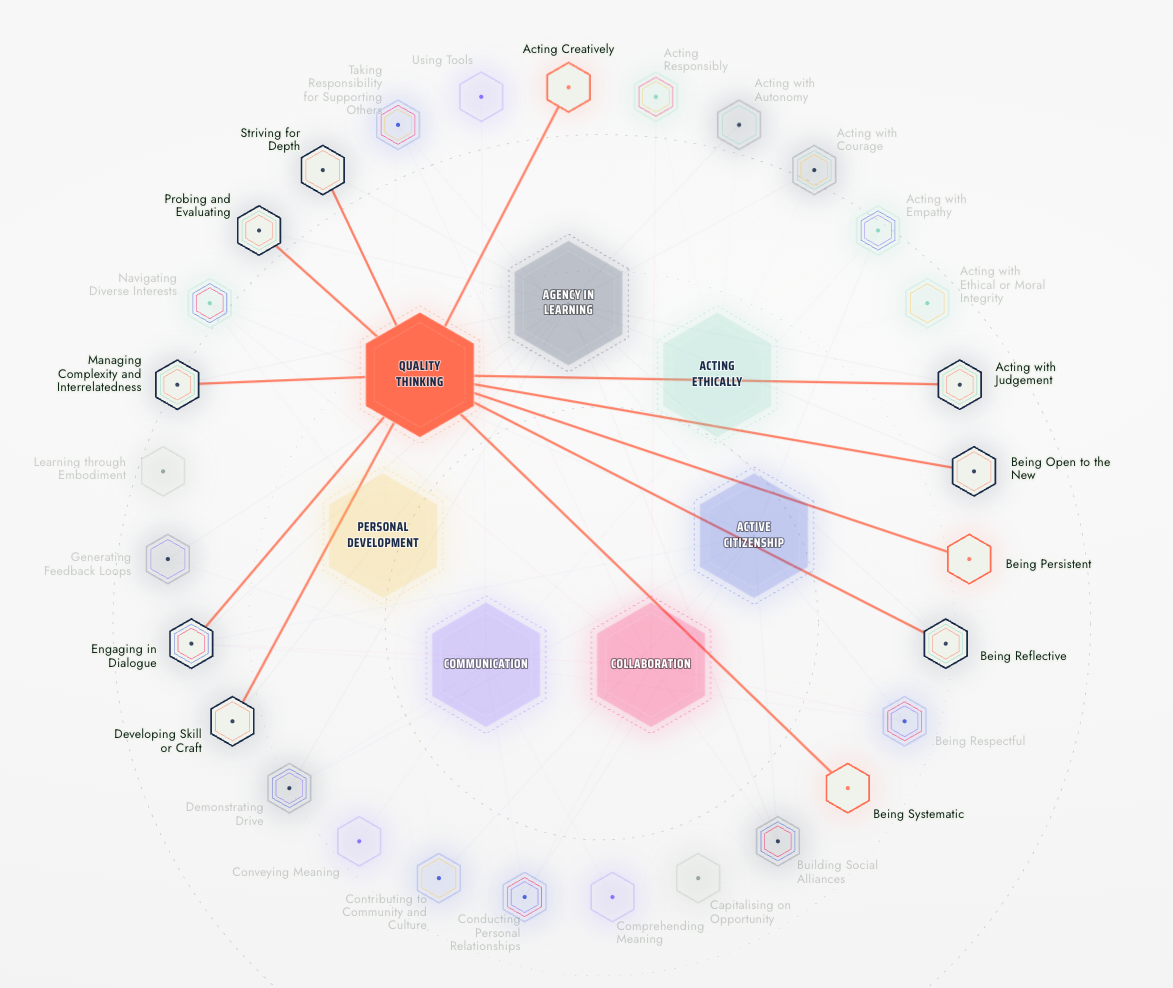
What does it look like to pay close attention to planning for, noticing, naming and nudging the moves that lead to Quality Thinking? And how can interaction with or around AI influence or be influenced by them? These are some of the questions we’re asking students, as they dive into the descriptors and progressions in follow-up workshops.
We talk a lot about vague skills like creative thinking, reflection and so in schools. With New Metrics, it is great to have a clear, research-based and accessible toolkit to unpack what they mean and how we can practice and observe them in action.
Attention Is (almost) All You Need
A slide I like to leave students with, is this. I share how Vaswani & team’s paper helped build genAI, but more importantly how attention is a resource that we can control in ourselves. What we pay attention to is what we value and how we direct our brains to the right places at the right time, for the right learning and the right results.
All of this work is connected to chapters in (If You) USEME-AI: Learning for Hope & Agency in an AI World (2027) and AI, The Future & Your Family: Explanations, Conversations & Activities to Spark Hope in Uncertain Times. Both available now in print and ebook.


Thank-you for your comments.