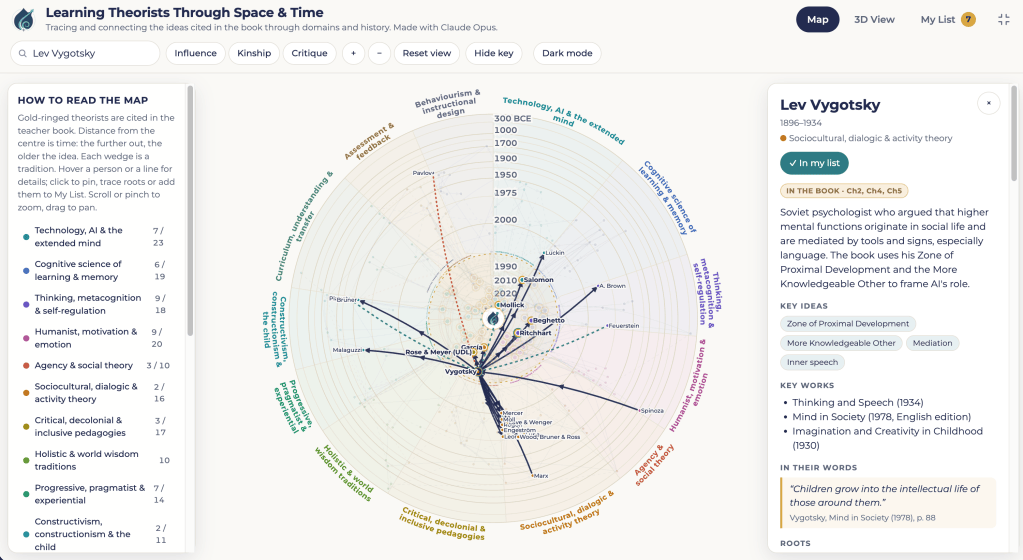
Quick post to share a new resource on the support site for (If You) USEME-AI. The book has over 500 references, based on more than 15 years of reading and study. AI in education is not a single-issue problem; it permeates all elements of education. So I wanted to create a way to visualise the connections and roots of ideas cited in the book, that educators could use as a jumping-off point for their own research or study.
- Try it here: https://ifyouuseme.ai/learning-theorists
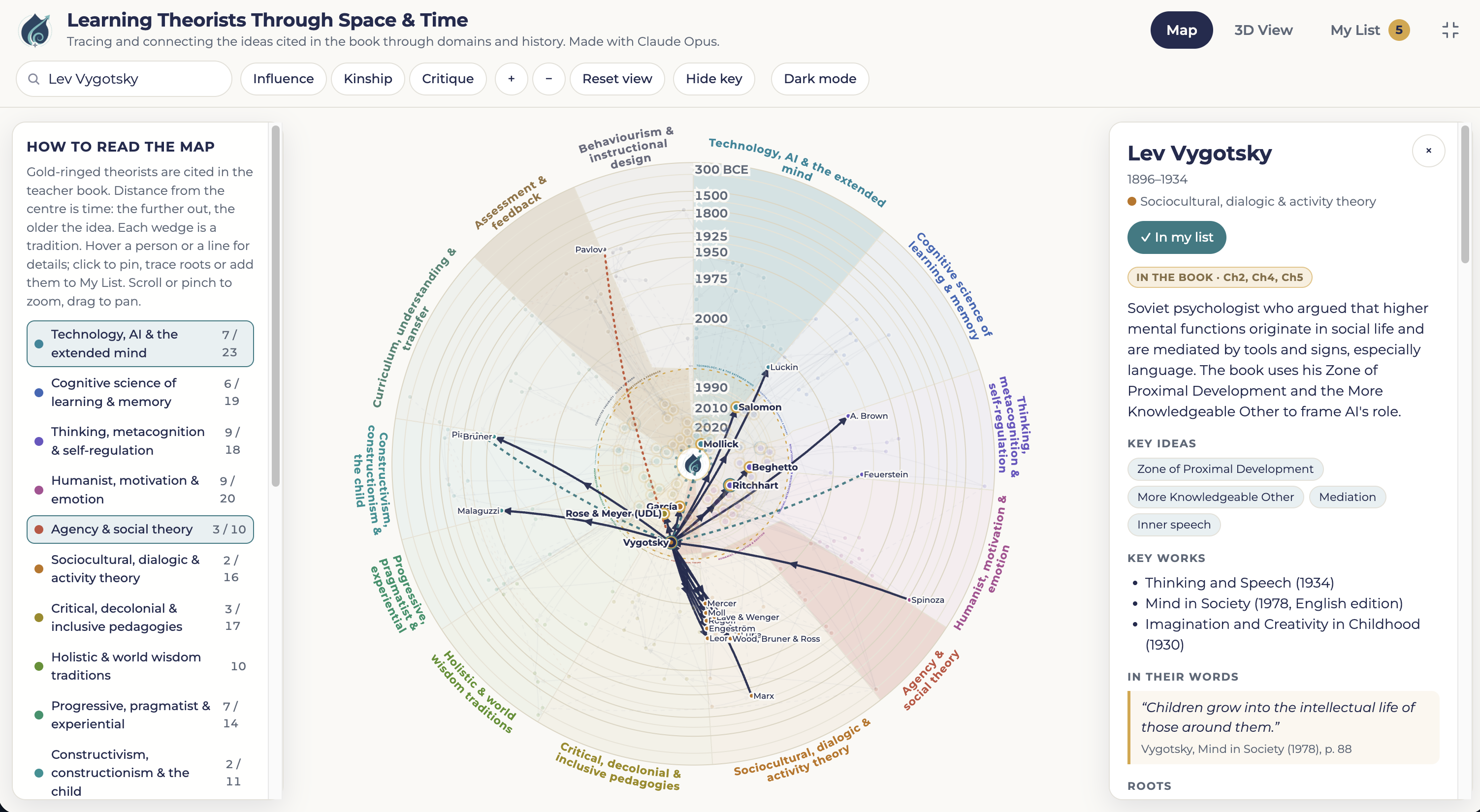
Using Claude Opus, I uploaded an md file of the book and my notes and asked it to create an interactive map of the sources used and their connections to each other and ideas that came before. With deep research, a lot of edits and checking, the final product came out as an html file of about 1.2MB. That’s a lot of information packed into one small file. Features include:
- Book sources at the centre
- Segments for different domains or schools of thought
- Concentric circles that go back in time
- Connections between ideas and theorists/writers/researchers
- Search by theorist or idea
- Click on a person’s “Big Ideas” to show more connections
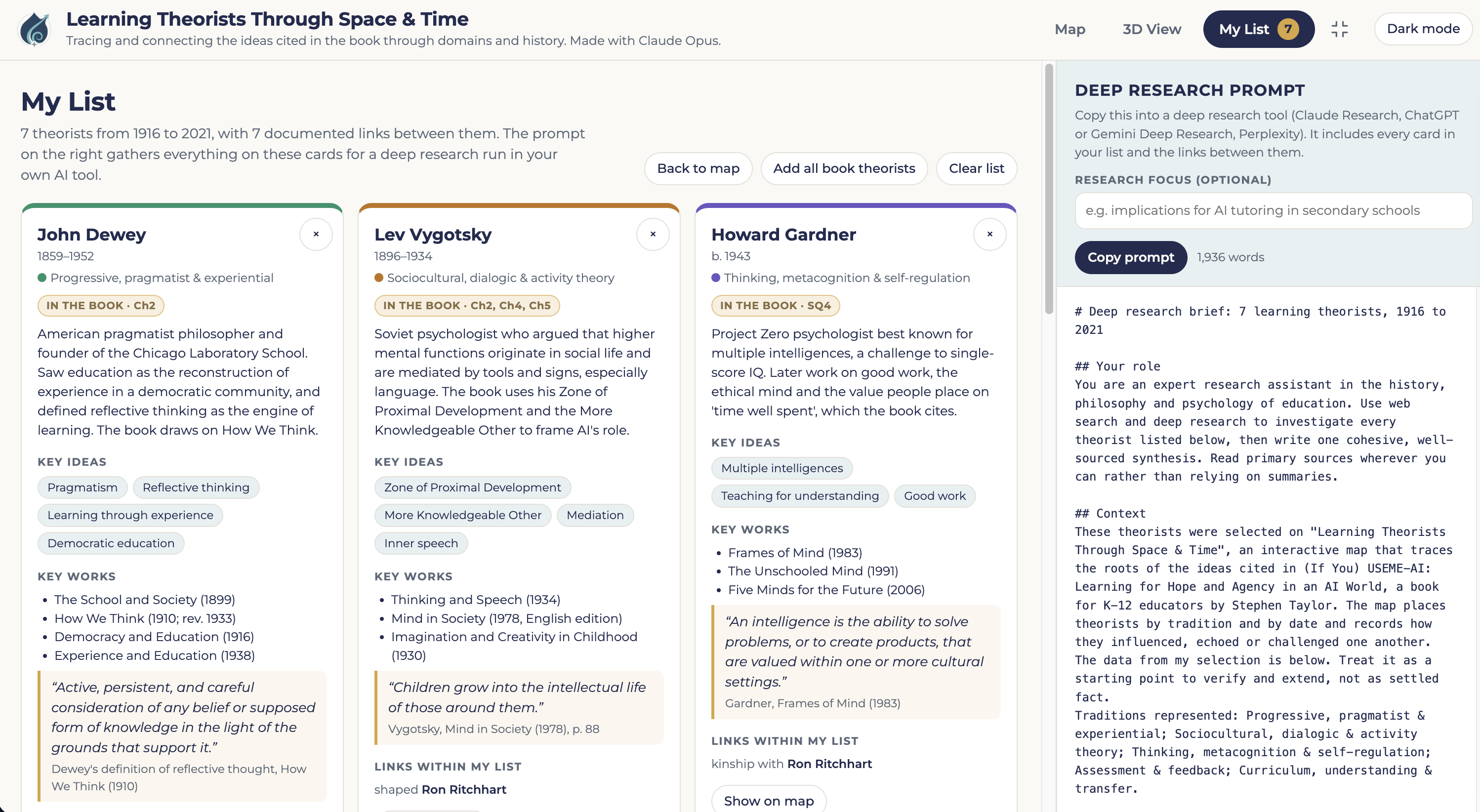
- Save theorists to My List (saved locally only)
- Full-screen mode for clearer views
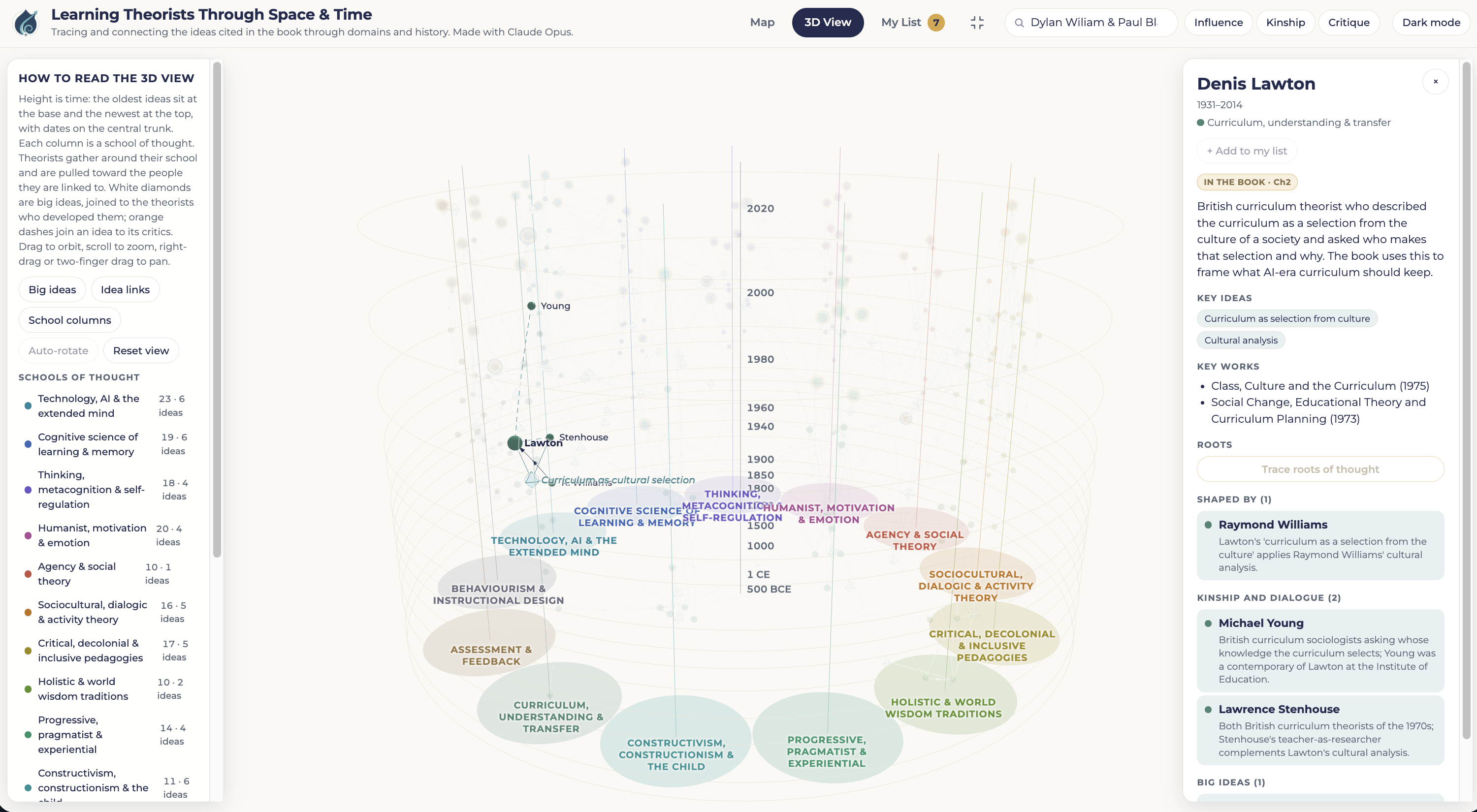
- 3D view looks ropey, but disconnects the theorists from the book and maps connections through domains and time.
My List can be used to frame a research question and generate a deep-research prompt for your own AI, to go much further into the literature.
There is a lot of AI in this work, so there will be mistakes and you should always chase your own research to double-check. The final product (like everything else on the site) is pure html and does not use any AI itself, unless the user takes their prompt and runs the research.
For a simpler (and printable) view of learning theories, this concept-map version from HoTEL (Holistic Approaches to Technology-Enhanced Learning), by Richard Millwood, has been around since 2013.
Some limitations/considerations:
- The domains and connections are centred around what is referenced in the book and about AI in education in general. Although there are a lot of theorists in here, there might be some related to your own area of interest who are missing.
- You can disconnect from the book in the 3D view, but it’s currently a bit hard to navigate.
- The cards for each theorist contain a lot of information but no links. You’ll need to use your own research or library for those.
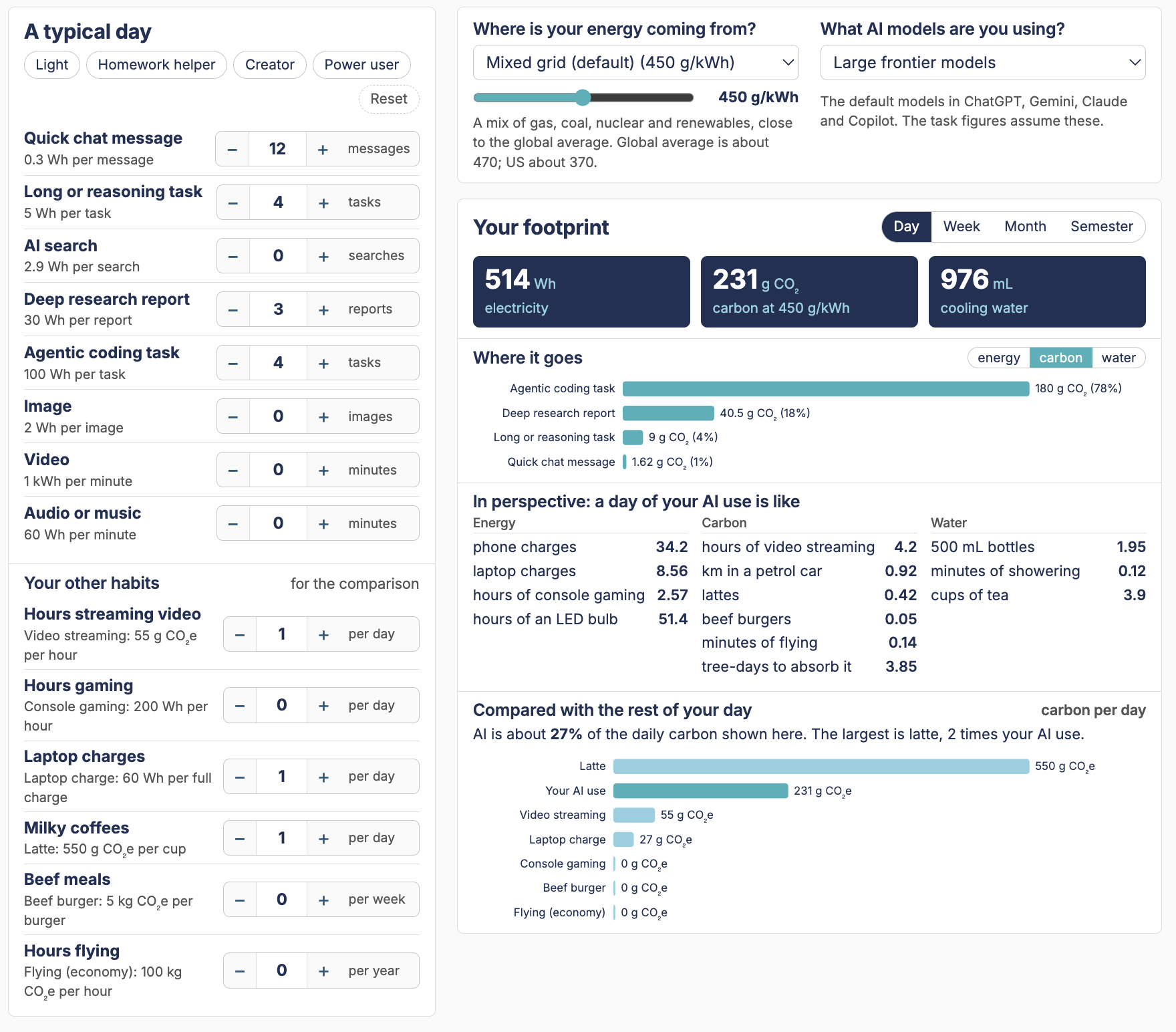
Was it worth the cost? I think so, if it gets used. A few hours of work to visualise the connections with one well-organised Claude task has produced something that might help researchers in their own work, without replicating hours of clicking, energy and resource use. The main build was set up with Claude and I left it for an hour while I did other things. Then editing and hosting on Lovable took another while. This same task, done manually, would have taken weeks of search, coding, resource use and production.
An estimate of the footprint and the the equivalents of my other activities during the same time are below.


Thank-you for your comments.