Although this post is published, I will edit and re-write a bunch of times.
A quick post to test some ideas on where we might be right now in AIEd, with the converging forces of accelerating technological disruption, “Mass Intelligence” (Mollick, 2025), the release of multiple sets of AI policy guidlines, literacies & competencies (e.g. UNESCO, OECD), influences on society & career pathways, national & international AI strategies and emerging studies on critical AI research. Conversation on AIEd has (thankfully) matured a lot since the panic-demic following the release of ChatGPT in 2022. Three years on, impacts and implications are becoming clearer, even though more continue to evolve and emerge as new superpowers are released, seemingly weekly.
This post is connected to my EdD research at Bath, as I move from early work on pre-UNESCO ethical AI frameworks to the wider competency-based approaches, via policy analysis and participatory approaches. I’m heading into the final stages, drawing a throughline from reactionary approaches to AI to culturally-embedded competency development and alternative pathways to student success in a time of dynamic change. It’s adventurous and interesting, closely connected to my job and an ever-moving target. At least it’s never boring.
So what’s the point?
In a word… agency.
At the heart of most AIEd policy guidelines, ethical approaches, AI literacy & competency frameworks and national strategies (see China’s here), lies the notion of protecting and promoting human agency* with and around the use and impacts of AI on society. Similarly, the leading edges of progressive international education are geared towards creating learner agency, where students can drive their own learning, success and flourishing.
With growing concerns about AI’s potential for cognitive offloading, “brainrot”, the shallowing of learning, bias, ethical and environmental impacts, deepfakes and polarisation, we need to work harder than ever to protect powerful thinking, engaging critical literacies whilst being agile to the developments, opportunities and emergent innovations that will set up our students for success as the world around them shifts. And we have to do all this whilst protecting a sense of optimism and hope in our young learners. None of these challenges are their fault, but this is the world we have created for them.
Educating for agency can give learners power over their own futures, but demands some pretty complex thinking.
Converging developments on alternative assessment and recognition, including the Mastery Transcript, Melbourne New Metrics and the ETS & Carnegie partnership for Skills for the Future, present increasingly viable and scalable competency and portfolio-based alternatives to increasingly AI-vulnerable traditional assessment and recognition pathways. Future skills frameworks from agencies such as WEF highlight the rising core skills that are embedded within agency and transcend (but don’t throw out) disciplinary knowledge and technological aptitudes.
With all this going on, we can’t consider singular problems and singular solutions and expect them to be successful. Life is too complex for that, and schools are too busy to absorb everything. We need to take an ecosystem view.
Where does Activity Theory come into this?
CHAT refers to cultural-historical activity theory, which has a non-linear evolution from Vygotsky to Engëstrom, via Leontiev, Cole and more. For an excellent overview of the evolution of activity theory, check out Clay Spinuzzi’s open-source book Triangles & Tribulations here, which goes deep into the evolution of these models using metaphors of generations, strands and waves; translations and betrayals.
In this work, I interpret CHAT as an umbrella term for activity theories, based on Engeström’s triangle models and generations.
In a very loose nutshell:
- First-generation activity theory (1GAT). Vygostky proposed a basic triangle of individual action: subject-object-tool. Individual action is mediated by cultural tools and signs and thinking is socially formed.
- 2GAT. Leontiev shifts from individual action to collective activity systems organised by a division of labour, distinguishing activities (motive), actions (goals), and operations (conditions). This was represented graphically by Engeström in 1987 with the well-known triangle model (below).
- 3GAT. Engeström expands to activity networks, where two or more activity systems interact.
- 4GAT. Engeström & Sannino expand further to heterogeneous coalitions tackling runaway objects (societal, cross-institutional problems), emphasising multi-level, public-facing transformation. It’s complicated, but as so much becomes decentralised through peer and social networking, this paper by Spinuzzi is worth reading.
An activity system can be used to analyse how people, tools, norms, and roles come together to pursue a shared purpose and how tensions (contradictions) in that system drive change. They can also be used in a predictive or interventionist sense; to create or plan for change through analysis.
An activity system has six interacting nodes. See the adapted triangle, based on Engeström’s work below. I have added the label of mediational workspace to try to describe what happens within the triangle.
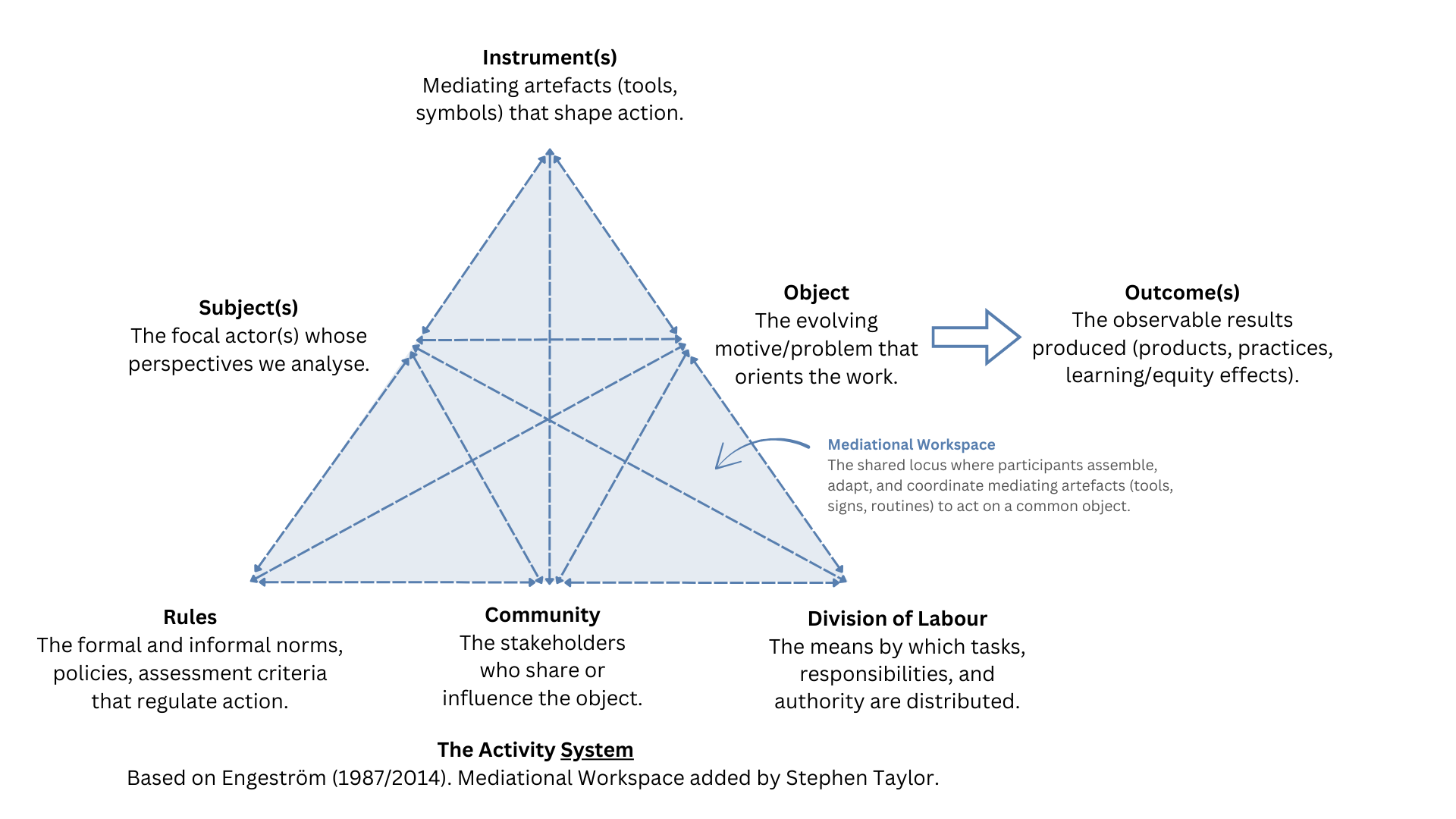
A key part of activity theory is the contradictions as engines of change. Again in simple terms we might consider these a problems to solve, or historically accumulated tensions within or between nodes
- Primary: within a single node (e.g., a tool is powerful but opaque).
- Secondary: between nodes (e.g., tool capabilities clash with policy rules).
- Tertiary: old model vs. new model of the activity.
- Quaternary: tensions between neighbouring activity systems.
Using the activity system diagram, think about an object (e.g. developing learner agency in a classroom, or protecting thinking under the influence of AI):
- What would you identify under the six nodes?
- What would you look for in terms of outcomes?
- What contradictions (or problems) shape the work?
- What would be happening within the mediational workspace?
- Where might AI be influencing, shaping or creating contradictions in an between each of the nodes?
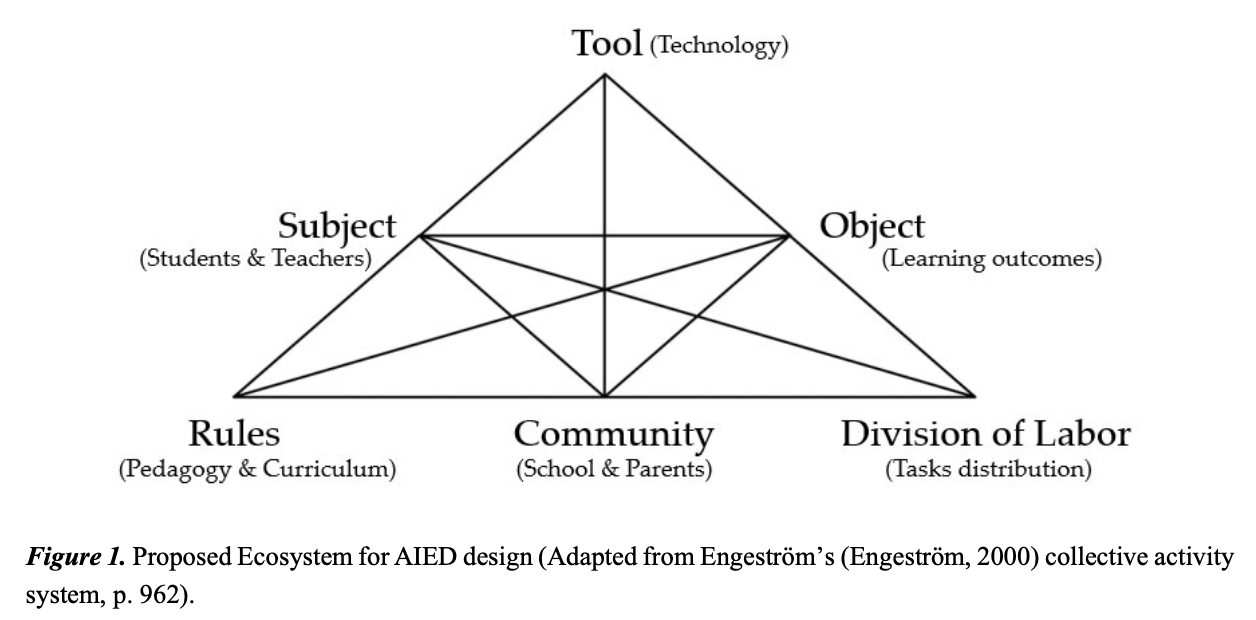
Although activity theory has been applied to computer-based learning (and even AI) since the 1980’s, the first example I can find of applying activity theory to current AIEd comes from Uden & Ching (2024). This paper is also well worth reading, and they present one approach in this diagram, proposing an ecosystem-based approach to AI adaptation.
This example might be used to consider how AI influences a specific learning objective in a classroom or community: how would each of the nodes interact in this case?
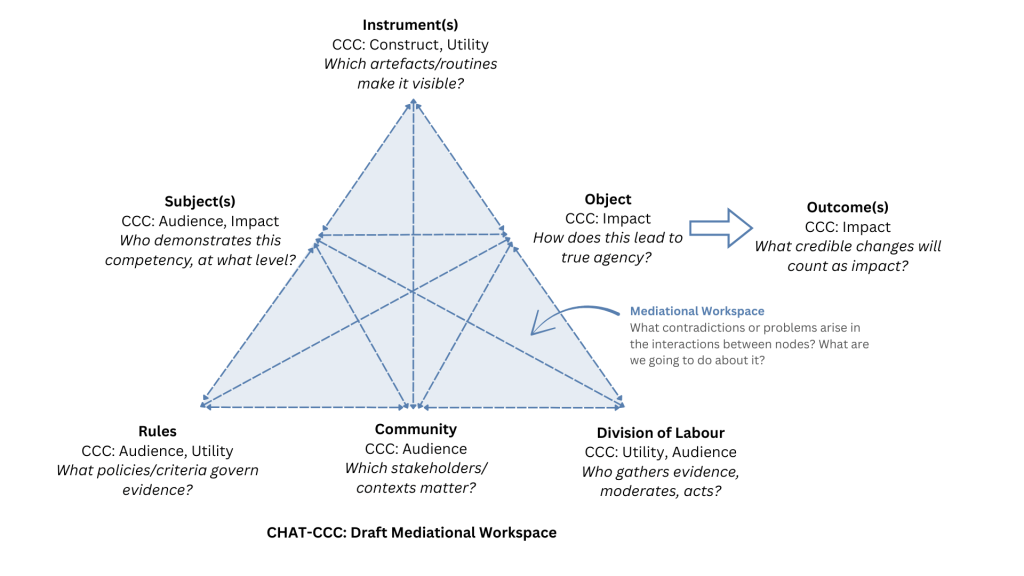
AIEd is a massive source of contradictions/problems. You can try this out with any use or impact of AI in your school or classroom. Teachers familiar with Creating Cultures of Thinking might find alignment here with the application of many Visible Thinking Routines, including Circle of Viewpoints.
Now we go a step further, into 3GAT. AIEd and the development of learner agency are such complex, decentralised ideas that many activity systems might be working towards (or contesting) shared objects. This is where Engeström’s activity network comes in:
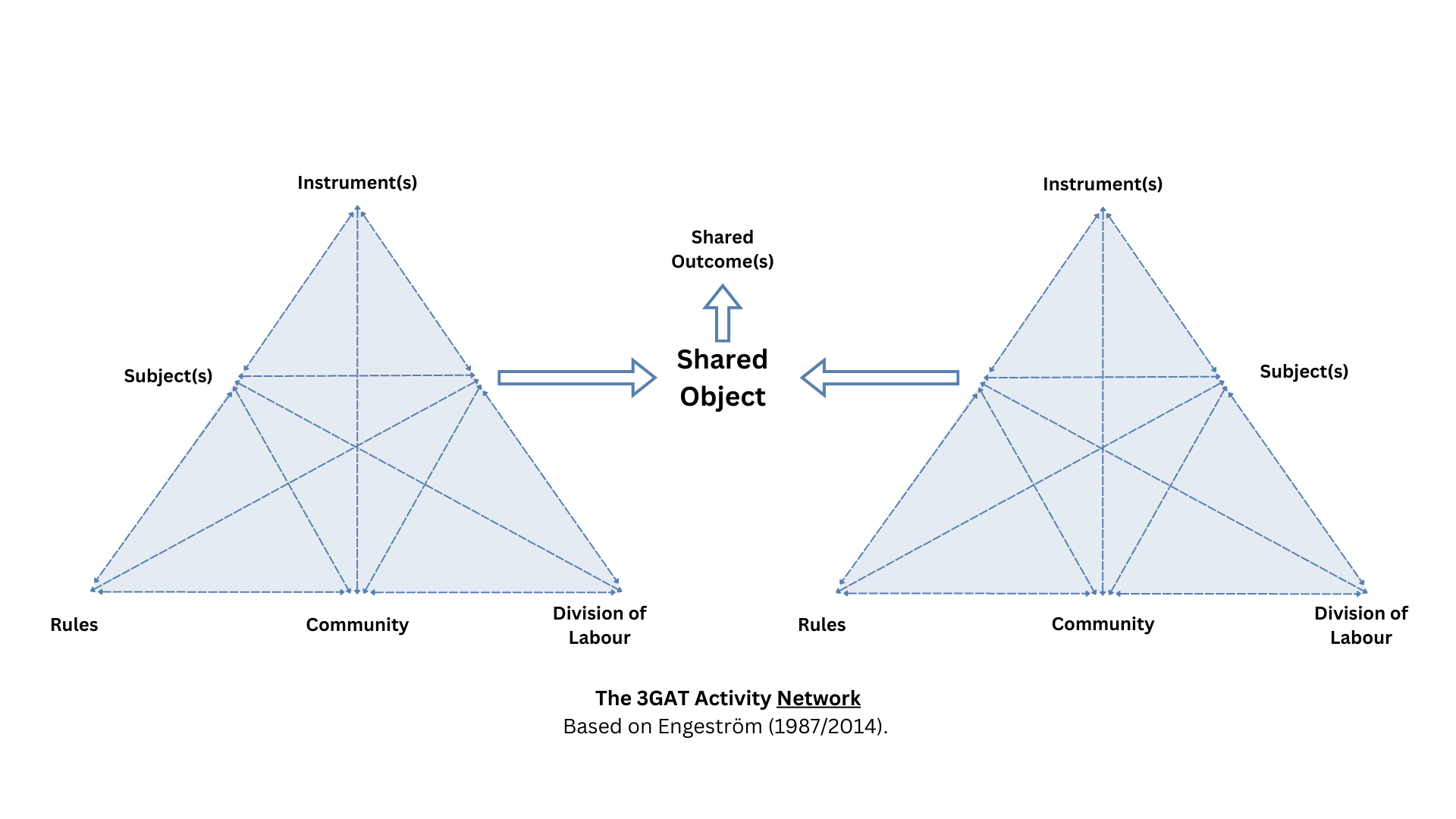
Going back to the object of your own example, consider how different activity systems might be working towards – or contesting – the same goal (e.g. school vs state, teachers vs edtech companies):
- What would you identify under the six nodes of each system?
- How might the interactions between the systems in the network influence the object and the outcomes?
- What new tensions or contradictions might arise from the interactions?
Hopefully through this exercise, we see that tackling problems like AIEd require systematic, interconnected, ecosystem thinking. Activity theory provides one set of tools to look at the problem from multiple perspectives. However, a lot of current discourse still situates AI as a singular problem, with schools flooded by marketing and insta-fluff on ready-made solutions.
We can do better than that, and so…
Where do competencies come in?
Now we return to agency and the adoption, implementation, application and implications of literacy/competency sets. In my role, we are working towards adventurous profiles of alumni, competency-based approaches and alternative pathways. This means drawing together expertise and analysing competency sets from across domains and disciplines. To that end, we need to know if competencies are any good, if they’re workable and if they fit the wider ecosystem.
In the last year, organisations like UNESCO and OECD have released student-facing competency/literacies for AIEd. Where do they fit? Can they be meaningfully implemented in already-overworked schools?
In 2024, Mikeladze et al published a useful critical review of AI competency frameworks for educators. Their approach used the work of Child & Shaw at Cambridge (2023) to consider Competency Construct Claims (CCC), looking at competencies through four lenses:
- Construct Claims: What the competency is. Its definition, scope, internal structure/components, boundaries, and intended progression.
- Audience Claims: Who it is for and in which contexts. The target populations, settings, and stakeholder perspectives/values the framework represents.
- Utility Claims: How it should be used. The intended applications and decisions (curriculum, assessment, reporting, PD), the evidence/tasks required, and the conditions for appropriate, fair use.
- Impact Claims: What difference it should make. The expected consequences of adoption (benefits and risks), including effects on learning, teaching, systems, and equity, with evidence to support those claims.
This approach is really practical for a busy school. It can be used to evaluate competencies under development from different perspectives and I find it useful when creating alignments between competency sets.
As we strive towards agency as the goal of progressive education in AI age, we can use CCC to help construct our competency portfolios and plan for action, ensuring valid outcomes. There is still a lot of work to do here, but so many opportunities.
So what’s the point of CHAT-CCC?
At this point, CHAT-CCC is my own attempt to combine a sociocultural theoretical view of AI, competencies and agency with a practical tool for evaluating competencies and proposed changes. It’s an intellectual toy that still needs a lot of work and is based on a few key assumptions:
- AI can no longer be considered an “over there” discrete issue in education (or society). It is everywhere, is getting stronger and is not going away.
- Within and between all learning situations (or activity systems), there are contradictions or challenges that drive change.
- AI might now be considered a part of our cultural fabric; a mediating artefact or tool in education & society or a source of contradiction at each of the nodes.
- Agency is the object, or goal, of AI adaptation and of progressive education, with outcomes taking many forms, including demonstration of validated competencies.
- The development of learner agency and competencies are not a simple task. They are emergent properties of a complex learning ecosystem and so:
- The development and implementation should be part of an interconnected ecosystem (not just AI or a singular problem)
- Any set of competencies are unlikely to be effective if they are not thoughtfully worked through in terms of their implications within or between activity systems.
CHAT-CCC involves placing the proposed competencies at the heart of the mediational workspace and:
- Zooming out to the activity system to uncover contradictions and implications.
- Zooming in to the competencies and evaluating them for construct, audience, utility and impact.
- Considering the role the competencies play in the development of learner agency and taking appropriate action.
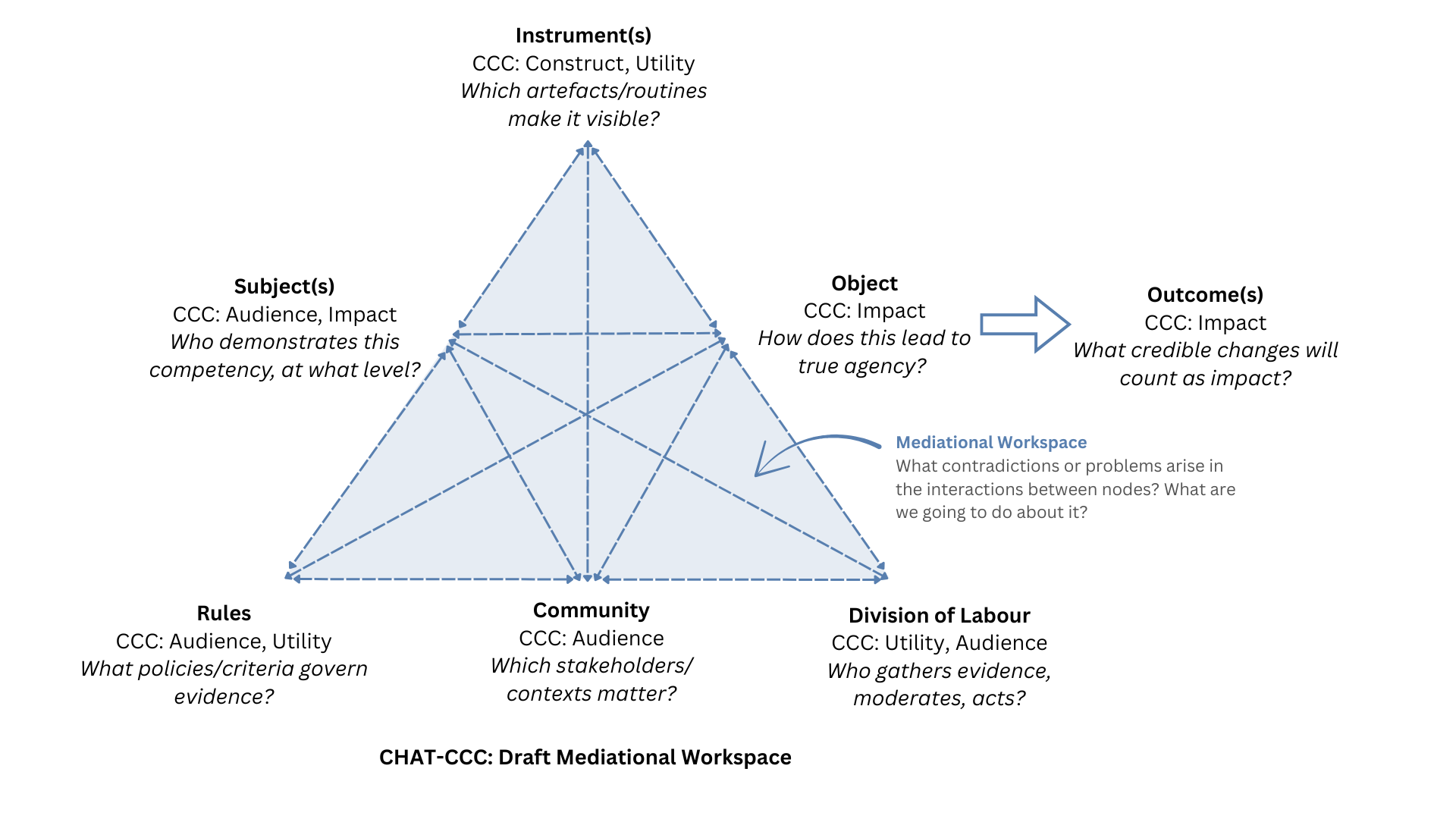
In the simplest possible terms:
- CHAT: How does it fit our context?
- CCC: Does it work?
Working it through, as you consider adopting/adapting/including competencies, chuck them into the mediational workspace and think:
- What is the object of the competencies: Agency plus…?
- Who are the subjects and how does this affect their learning?
- What real-world outcomes or impacts are we looking for?
- How do rules, tools, community & division of labour (responsibilities) come into play?
- What contradictions are surfaced as a result of identifying the nodes? What solutions are possible?
- Are there competing or complementary activity systems in play? What can contribute to its success? What is working against it?
When we consider these angles and sources of contradictions:
- How is it additive to the development of student agency?
- Where might there be tensions or confusions to resolve?
- How will we leverage or develop competence, capactity, conceptual understanding and commitment to make it work? (NEASC)
- Where can the architects of the change reduce friction through shared language, integration with existing practices, delineation of responsibilities, community engagement…?
Maybe CHAT-CC is making things more complex than they need to be. Or maybe it can provide another set of lenses to tackle the sticky problems of today.
I still have a long way to go with this, but hopefully we’re getting somewhere.
References
Active resources are linked throughout the text. Additionally, these references were of significance:
- Spinuzzi, Clay. 2025. Triangles & Tribulations. Translations, Betrayals, and the Making of Cultural-Historical Activity Theory. MIT Press. https://mitpress.mit.edu/9780262552172/triangles-and-tribulations/
- Spinuzzi, Clay & Guile, David. 2019. Fourth-Generation Activity Theory: An Integrative Literature Review and Implications for Professional Communication. UCL Discovery. https://discovery.ucl.ac.uk/id/eprint/10090672/3/Guile_ProComm2019-4GAT-synthesis-v2.pdf
- Engeström, Yrvo. 2014. Learning by Expanding: An Activity-Theoretical Approach to Developmental Research (2ed) https://www.cambridge.org/core/books/learning-by-expanding/6D0648C3DEDE20157B359E464AFDB8C1
- Mollick, Ethan. 2025. Mass Intelligence. One Useful Thing. https://www.oneusefulthing.org/p/mass-intelligence?r=i5f7 (just subscribe to his site, it is all great).
- Child, Simon & Shaw, Stuart. 2023. A conceptual approach to validating competence frameworks. Cambridge University Press. https://www.cambridgeassessment.org.uk/Images/research-matters-35-a-conceptual-approach-to-validating-competence-frameworks.pdf
- Mikeladze, Tamar, et.al. 2024. A comprehensive exploration of artificial intelligence competence frameworks for educators: A critical review. European Journal of Education. https://onlinelibrary.wiley.com/doi/10.1111/ejed.12663
- Uden, Lorna & Ching, Gregory. 2024. Activity Theory-based Ecosystem for Artificial Intelligence in Education (AIED). International Journal of Research Studies in Education. https://doi.org/10.5861/ijrse.2024.24000
Thank-you to Clay Spinuzzi for feedback & encouragement on this post.
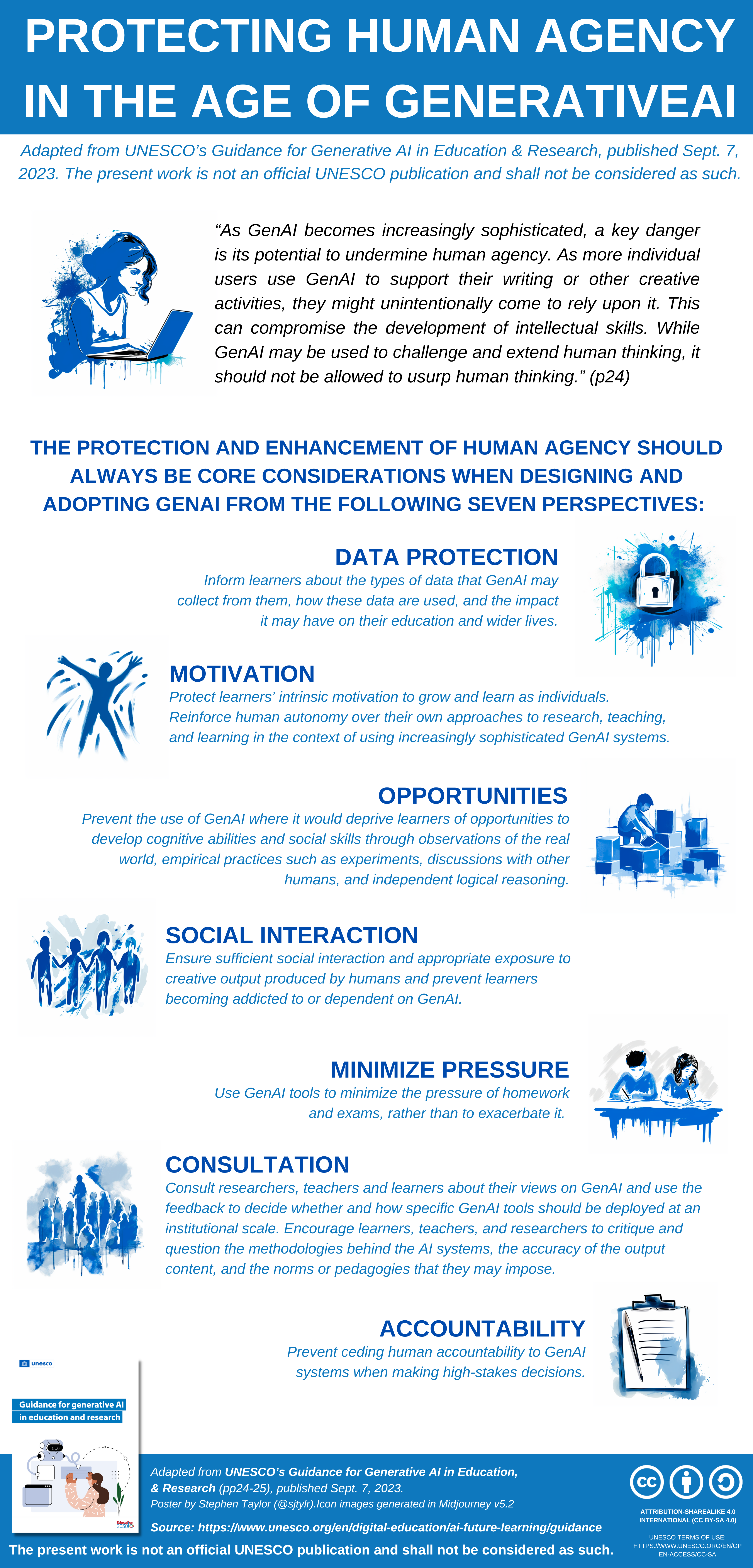
*Graphical excerpt from UNESCO’s Guidance on Generative AI in Education & Research (2023). Graphic by me. Post here.


 Wayfinder Learning Lab - Stephen Taylor
Thank-you for your comments.