I went down a rabbit-hole of AI research for some students and my studies. All of these texts are freely available to download MIT Press. A huge list of Open Access books from experts at MIT. Feed your brain!
I’d kinda forgotten about MIT Open Press for a while, then came across Clay Spinuzzi’s Triangles and Tribulations when researching Cultural-Historical Activity Theory.
- And here are all the OA books, most recent first.
General Intelligence
- What Is Intelligence? Lessons from AI About Evolution, Computing, and Minds by Blaise Agüera y Arcas (2025) What intelligence really is, and how AI’s emergence is a natural consequence of evolution. This book opens as a readable site with interactive graphics.
- Unlocking Artificial Intelligence From Theory to Applications, edited by Christopher Mutschler, Christian Münzenmayer, Norman Uhlmann, Alexander Martin (2024). This open access book provides a state-of-the-art overview of current machine learning research and its exploitation in various application areas. [From Springer Nature, not MIT].
Large Language Models & Language Processing
- Foundations of Large Language Models Tong Xiao, Jingbo Zhu (2025) This is a book about large language models. As indicated by the title, it primarily focuses on foundational concepts rather than comprehensive coverage of all cutting-edge technologies.
- Foundation Models for Natural Language Processing Pre-trained Language Models Integrating Media by Gerhard Paaß , Sven Giesselbach (2023) [Springer Nature] This open access book provides a comprehensive overview of the state of the art in research and applications of Foundation Models and is intended for readers familiar with basic Natural Language Processing (NLP) concepts.
Machine Learning
- Mathematics for Machine Learning by Marc Peter Deisenroth, A. Aldo Faisal, and Cheng Soon Ong (2020) A foundation of mathematical concepts that lead into machine learning.
- Foundations of Machine Learning by Mehryar Mohri, Afshin Rostamizadeh, and Ameet Talwalkar (2018) Page contains link to the pdf book and lecture slides.
- Machine Learning in Production: From Models to Products by Christian Kästner (2025) A practical and innovative textbook detailing how to build real-world software products with machine learning components, not just models.
Deep Learning
- Understanding Deep Learning by Simon JD Prince (2025) Page has the link to the full book as pdf, as well as *many* Python notebooks to cover the whole text.
- Deep Learning (Advanced) Ian Goodfellow and Yoshua Bengio and Aaron Courville (2016) This book is very comprehensive and is available as html, not a pdf.
- Dive into Deep Learning: Zhang, Lipton, Li & Smola (Open Source, not MIT) (2025). Excellent interactive deep learning book with code, math, and discussions.
Algorithms
- Algorithms for Optimization, Decision-Making and Validation (Three Books, 2019) Page has three books linked. Each page has the book and codeblocks for GitHub linked.
Reinforcement Learning & Agents
- Reinforcement Learning: An Introduction (2ed) by Richard S. Sutton and Andrew G. Barto (2018) The significantly expanded and updated new edition of a widely used text on reinforcement learning, one of the most active research areas in artificial intelligence.
- Distributional Reinforcement Learning by Marc G. Bellemare, Will Dabney and Mark Rowland (2023) The first comprehensive guide to distributional reinforcement learning, providing a new mathematical formalism for thinking about decisions from a probabilistic perspective.
- Multi-Agent Reinforcement Learning: Foundations and Modern Approaches (2024) by Stefano V. Albrecht, Filippos Christianos, Lukas Schäfer. The first comprehensive introduction to multi-agent reinforcement learning, an area of machine learning in which multiple decision-making agents learn to optimally interact in a shared environment.
Computer Vision
- Foundations of Computer Vision by Antonio Torralba, Phillip Isola, and William Freeman (2024) This book covers foundational topics within computer vision, with an image processing and machine learning perspective.
- The Perception Machine: Our Photographic Future between the Eye and AI by Joanna Zylinska (2023) A provocative investigation of the future of photography and human perception in the age of AI.
Robotics
- Cognitive Robotics Edited by Angelo Cangelosi and Minoru Asada (2022) The current state of the art (2022) in cognitive robotics, covering the challenges of building AI-powered intelligent robots inspired by natural cognitive systems.
- Person, Thing, Robot: A Moral and Legal Ontology for the 21st Century and Beyond by David J. Gunkel (2023) Why robots defy our existing moral and legal categories and how to revolutionize the way we think about them.
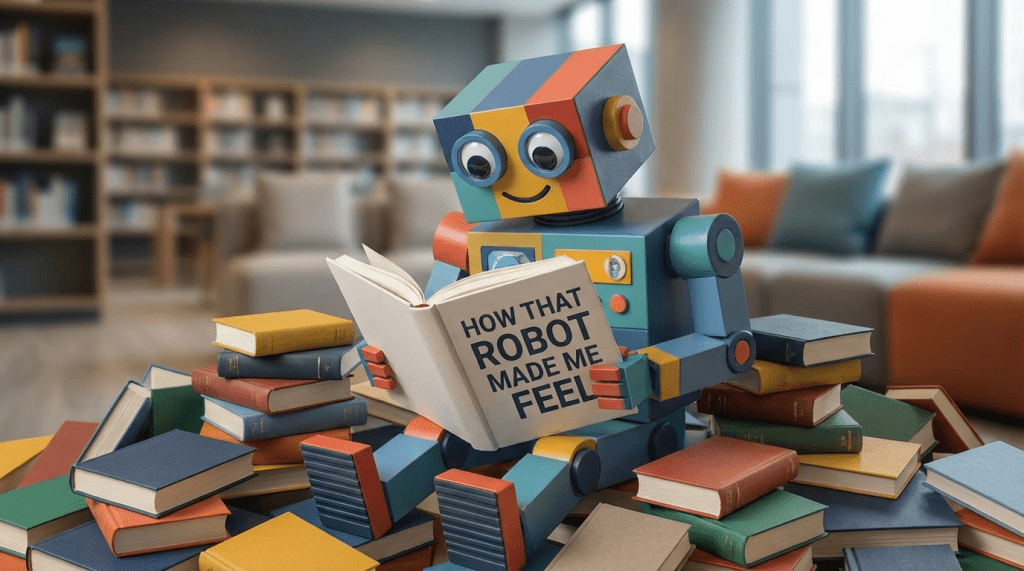
- How That Robot Made Me Feel Edited by Ericka Johnson (2025) An edited collection that explores what emotions we have when encountering robots, how we react emotionally to them in different contexts, and why these emotional responses are so important.
- Robophilosophy: Philosophy of, for, and by Social Robotics Edited by Johanna Seibt, Raul Hakli, Marco Nørskov (2026) A comprehensive introduction to robophilosophy, the new field that explores the deep and far-reaching implications of social robotics.
- Introduction to Autonomous Robots: Mechanisms, Sensors, Actuators, and Algorithms by Nikolaus Correll, Bradley Hayes, Christoffer Heckman and Alessandro Roncone (2022) A comprehensive introduction to the field of autonomous robotics aimed at upper-level undergraduates and offering additional online resources. This one is actually a link to a GitHub repo, which you can compile yourself into a book. Check it out.
- Degrees of Freedom: On Robotics and Social Justice by Tom Williams (2025). Why the field of robotics tends to reinforce white patriarchal systems of power—and how roboticists can work to change these systems.
AI Fairness & Ethics
- Fairness and Machine Learning: Limitations and Opportunities by Solon Barocas, Moritz Hardt and Arvind Narayanan (2023) An introduction to the intellectual foundations and practical utility of the recent work on fairness and machine learning.
- Agents in the Long Game of AI: Computational Cognitive Modeling for Trustworthy, Hybrid AI By Marjorie McShane, Sergei Nirenburg, Jesse English (2024) A novel approach to hybrid AI aimed at developing trustworthy agent collaborators.
- AI Fairness: Designing Equal Opportunity Algorithms by Derek Leben (2025) A theory of justice for AI models making decisions about employment, lending, education, criminal justice, and other important social goods.
- Data Feminism by Catherine D’Ignazio and Lauren F. Klein (2023) A new way of thinking about data science and data ethics that is informed by the ideas of intersectional feminism.
- The Theory of Deliberative Wisdom By Eric Racine (2025) From a leading ethicist, a workable and inspiring model of ethics, showing not only why ethics matters but also how it can be used to improve human welfare.
AI and Society
- Inventive Minds: Marvin Minsky on Education By Marvin Minsky, Xiao Xiao Edited by Cynthia Solomon, Xiao Xiao (2019) Six essays by artificial intelligence pioneer Marvin Minsky on how education can foster inventiveness, paired with commentary by Minsky’s former colleagues and students.
- The Sound of Innovation: Stanford and the Computer Music Revolution By Andrew J. Nelson (2015) How a team of musicians, engineers, computer scientists, and psychologists developed computer music as an academic field and ushered in the era of digital music.
- Modeling Neural Circuits Made Simple with Python by Robert Rosenbaum (2024) An accessible undergraduate textbook in computational neuroscience that provides an introduction to the mathematical and computational modeling of neurons and networks of neurons.
- Neuroethics: The Implications of Mapping and Changing the Brain By Walter Glannon (2025) An examination of ethical issues in recording and intervening in the brain, and the neurobiological basis of moral decision-making.
- Appropriating Technology: How We Make Digital Tools Our Own by Pierre Tchounikine (2025) How we use digital technologies and make them our own.
- The Coevolution: The Entwined Futures of Humans and Machines, by Edward Ashford Lee (2020). Should digital technology be viewed as a new life form, sharing our ecosystem and coevolving with us?
- On the Brink of Utopia: Reinventing Innovation to Solve the World’s Largest Problems, by Thomas Ramge, Rafael Laguna de la Vera (2023). A new and coherent framework for fostering the breakthrough innovations that we urgently need to confront our collective future.
- The Microeconomics of Artificial Intelligence by Joshua Gans (2025). A comprehensive treatment of the microeconomics associated with the adoption and use of artificial intelligence.
- Moral Codes: Designing Alternatives to AI by Alan F. Blackwell (2024). Why the world needs less AI and better programming languages.
- Frankenstein: Annotated for Scientists, Engineers, and Creators of All Kinds By Mary Shelley Edited by David H. Guston, Ed Finn, Jason Scott Robert (2017) The original 1818 text of Mary Shelley’s classic novel, with annotations and essays highlighting its scientific, ethical, and cautionary aspects.
A few bonus texts:
- Computational Thinking Education in K–12: Artificial Intelligence Literacy and Physical Computing, edited by Siu-Cheung Kong and Harold Abelson (2022). A guide to computational thinking education, with a focus on artificial intelligence literacy and the integration of computing and physical objects.
- Movement Matters: How Embodied Cognition Informs Teaching and Learning, edited by Sheila L. Macrine, Jennifer M.B. Fugate (2022). Experts translate the latest findings on embodied cognition from neuroscience, psychology, and cognitive science to inform teaching and learning pedagogy.
- Climate Imagination: Dispatches from Hopeful Futures, edited by Joey Eschrich, Ed Finn (2025). A clarion call for visions of vibrant, hopeful climate futures, bringing together global voices to share stories of resilient communities based in real science.
- Artificial Intelligence for a Better Future: An Ecosystem Perspective on the Ethics of AI and Emerging Digital Technologies by Bernd Carsten Stahl (2021). This open access book introduces a new ethics framework viewing AI as interconnected ecosystems, proposing practical ways to shape them for human flourishing while balancing AI’s benefits with its potential ethical risks.
- Explainable Artificial Intelligence Editors: Riccardo Guidotti, Ute Schmid, Luca Longo (2025). [Springer Nature,]. This open access five-volume set constitutes the refereed proceedings of the Second World Conference on Explainable Artificial Intelligence, xAI 2025, held in Istanbul, Turkey, during July 2025.
- Royal Society: Science in the Age of AI (2024). This report explores how AI technologies, such as deep learning or large language models, are transforming the nature and methods of scientific inquiry. It also explores how notions of research integrity; research skills or research ethics are inevitably changing, and what the implications are for the future of science and scientists.
If you’re interested in more reading, here’s my post of Chinese Science Fiction.


Thank-you for your comments.