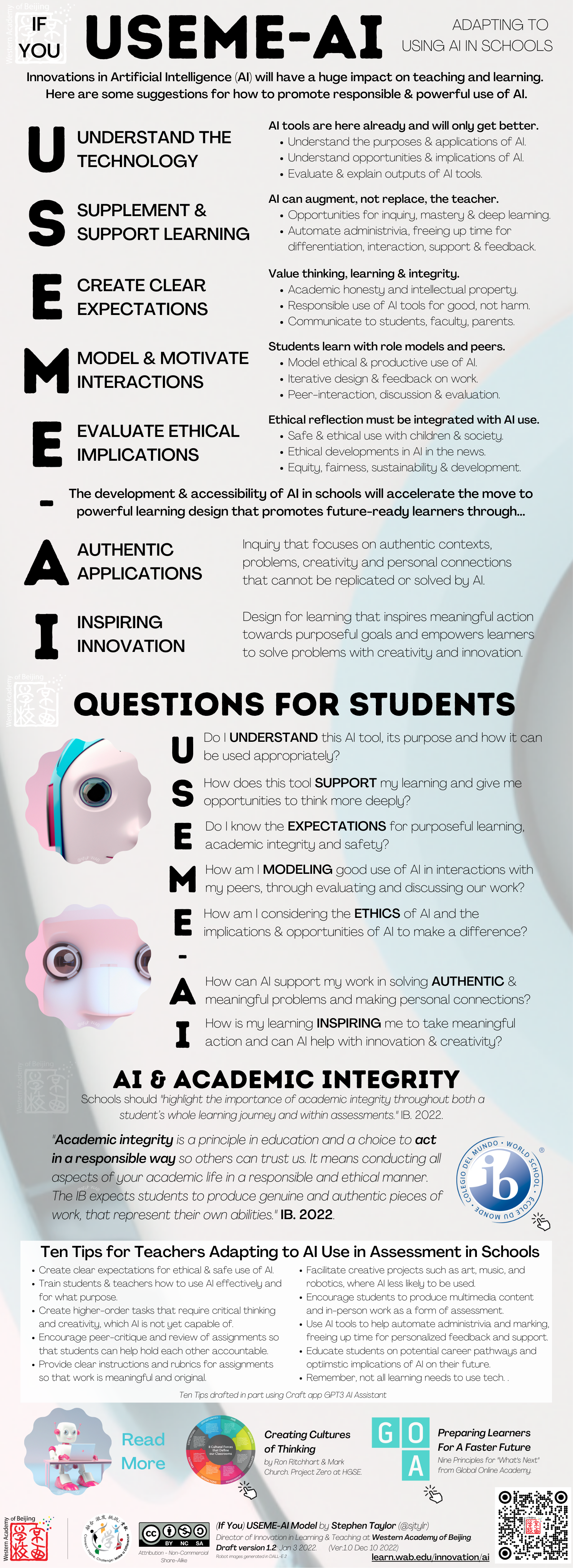
What can schools do to adapt to rapidly developing AI technologies and their potential implications for teaching, learning and assessment? (If You) USEME-AI is a structure to support conversations and actions and actions in a school that focus on protecting and promoting learner agency.
Post: Version 1.4 (Dec 11 2025). (If You) USEME-AI three years on.
(If You) USEME-AI 1.4
Version 1.4 of (If You) USEME-AI is below. Older versions are linked under the image.
It is licensed under Creative Commons, Non-Commercial, Share-Alike, Attribution. I’d love feedback on how to make this better, particularly from teacher-librarians.
For citation, please use: Taylor, S. 2025. (If You) USEME-AI (v1.4). Wayfinder Learning Lab [Online]. https://sjtylr.net/if-you-useme-ai/
Version Histories – Click to see older versions
- Version 1.3 Feb 2025
- Version 1.2 Jan 2023
- Version 1.1 Dec 11 2022
- Version 1.0 Dec 10 2022
- A version has been published in International School Magazine (Summer 2023).
The world of AI is having big impacts on teaching, learning and our students’ futures. Back in Oct’22, I started this thread on Twitter. It began before ChatGPT was released, and since then we have seen week-after-week of major innovations and developments. If you scroll back, you’ll see some experiments, news, ideas, tools and discussions. Now there are even discussions of ‘sparks of AGI‘ and layer upon layer of new tools and developments causing major shifts in technology companies and education.
Adapting to this unprecedented pace of change, hot off the heels of a global pandemic, is a real challenge to education and educators.
Culture is more powerful than technology. I believe that schools that create a culture of thinking and powerful learning opportunities will be better able to benefit from these impacts than more traditional schools. In a class where there is an ‘invisible middle’ between and assignment being set and the work being turned in, there is more opportunity for misuse of technology – something that can easily be mitigated in classes where there is ongoing feedback, conferencing and discussion of the processes of creating, analysing, writing, editing and evaluating.
Now we are three years post-ChatGPT, a lot has changed. Conversations around AIEd are maturing and we are learning more about the implications of and opportunities for AI in terms of agency, thinking, integrity and ethics.
How might understanding our learners as AI-augmented consumers, users and creators of knowledge shift the focus away from ‘cheating’ and towards constructive and productive relationships with technology?
Stephen is Director of Innovation in Learning & Teaching at the Western Academy of Beijing and an EdD student at the University of Bath, currently focusing on GenAI in education. To find out more about WAB, visit our news page. To connect with Stephen, please use LinkedIN.
May 2023: A slide-deck to work though (If You) USEME-AI:
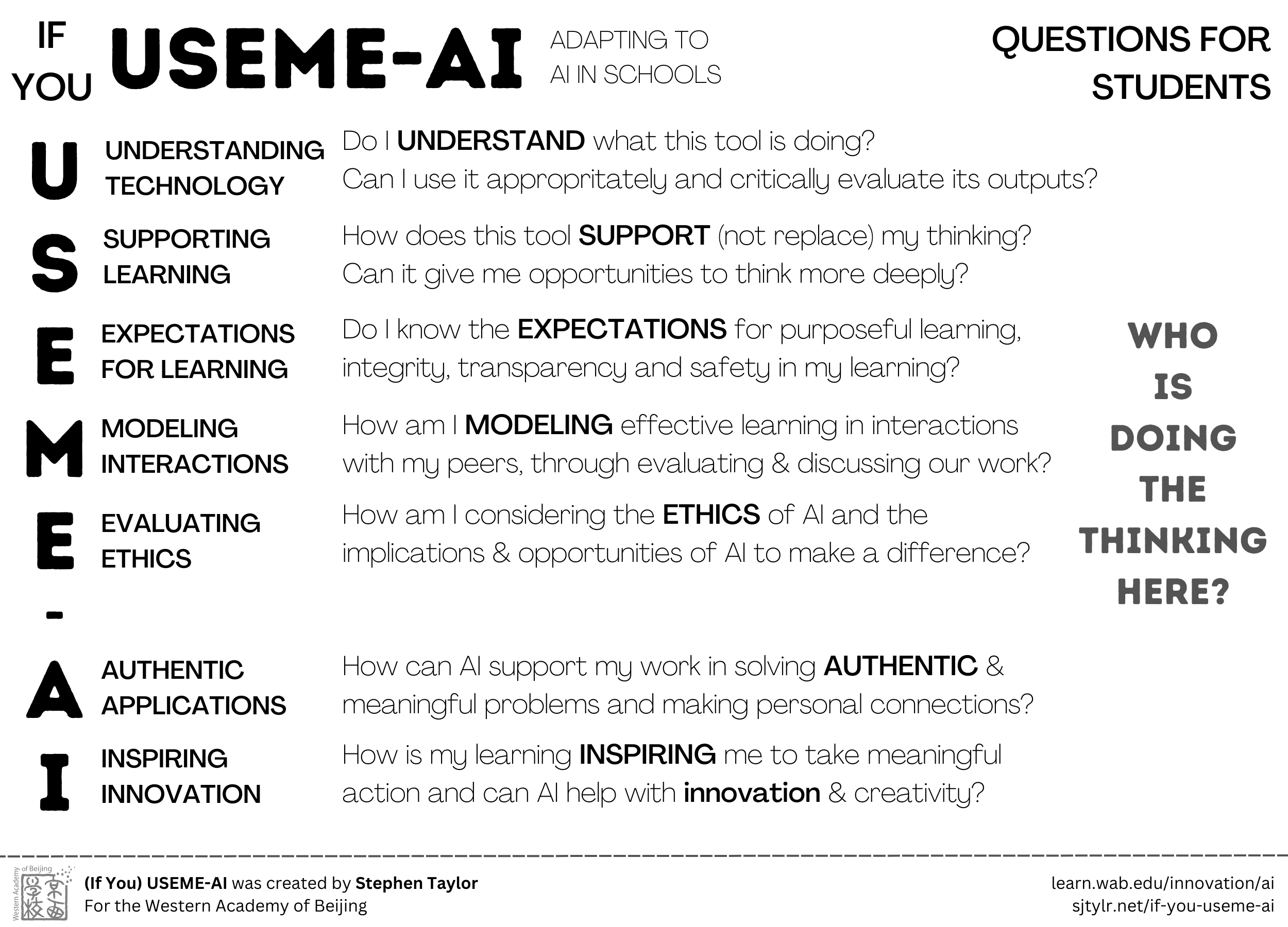
(If You) USEME-AI Questions for Students:
Here’s my presentation on (If You) USEME-AI during one of the University of Kent’s Digitally-Enhanced Education webinars. At the peak, over 1,000 people joined the sessions, and there are some wonderful talks in the playlist from across the HE sector.
Academic Integrity in an AI World
“Academic integrity is a principle in education and a choice to act in a responsible way so others can trust us. It means conducting all aspects of your academic life in a responsible and ethical manner. The IB expects students to produce genuine and authentic pieces of work, that represent their own abilities.” IB. 2022.
See the IB’s response to AI in education here.
Academic integrity is about building a culture and practises of trust, ethics and fair use. We should move beyond “gotcha” and suspicion and support students in how to be mindful and creative in their use of any tech tools.
Teacher-librarians & EdTech integrators are your school’s super-power for adapting to new technologies, literacies and academic integrity. See this post by Kay Oddone. Another great post on academic integrity is by Dr. Sarah Heaton: “Six Tenets of Postplagiariasm: Writing In The Age Of Artificial Intelligence.”
Innovation at the Western Academy of Beijing
At WAB, we’ve been researching AI for a while, curating resources and discussions, and looking for applications or adaptations of value.
Visit the WAB Learns AI Libguide for:
- Quick-starts and overviews for teachers, with tools and suggestions for:
- Leaning-in to the new AI reality
- Example prompts and ideas
- Academic Integrity in an AI World
- Resources for Students
- Resources for Parents
- AI Ethics & Integrity
- How AI is being used towards the UN’s SDG‘s
- Tools to try and how they work
Related Posts:
- This Post Was Written By AI (Oct 2022)
- This Post Was Also Written By AI (Dec 2022, adapting to GPT3)
- (If You) USEME-AI Original Blogpost by Stephen, (Dec 10 2022).
- “We Don’t Need An AI Policy”, (Jan 2023).
- What are Universities thinking about AI? (March 2023)
- Is our Culture ready for the AI Change? (April 2023)
- Is “Prompt Engineering” really the Future? (May 2023)
- Thread of experiments with AI (200+ posts)
- Have we reached the tipping point of ‘invisible AI’? (May 2023)
- Can AI Help With Academic Research? (Sept 2023)
- School Leadership in Age of GenAI (Sept 2023)
- Unpacking UNESCO’s Guide to GenAI: What Could It Mean For International Schools? (Oct 2023)
- AI, The Future & You: Student Workshop on careers intelligence, using AI tools (Oct 2023, including analysis of student thoughts)
- Create, Curate, Wait, Innovate (Dec 2023)
- What’s the Problem Represented to Be (WPR) in UNESCO’s GenAI Guidance for Education & Research? (Sept 2024)
- AI Footprint Estimator (Jan 2025)
- Content & Inquiry in an AI World (Feb 2025)
- The Spark (Feb 2025)
- UNESCO & OECD AI Competencies Spreadsheets (Apr 2025)
- Draft AI Competencies for Educational Leadership (Apr 2025)
- Tracking AIEd Policies (Nov 2025)
- Mitigation, Adaptation, Innovation (Dec 2025)
Related Resources:
 Wayfinder Learning Lab - Stephen Taylor