
A quick post to share a big job, on exporting the UNESCO AI Competencies for Students Framework from the original pdf publication to a spreadsheet.
- Update: I’ve added the teachers’ competencies too (original pdf here).
- Update: I’ve added the OECD Student AI Literacies as well (original here).
- Jump to the sheet here.
The source documents are excellent, and you should read them before using this.
I was aiming to get the whole framework as an accessible spreadsheet, as part of wider competency alignment in my own work, mapping out our Profiles of WAB Alumni, but I figured it was worth its own Saturday side-quest.
With some AI help and a lot of thinking and editing, I wanted to take the Domains (Human-Centred AI, Ethics of AI, AI Techniques & Applications, and AI System Design), at the Understand, Apply & Create levels, and present the content as a spreadsheet to include the Competencies, Curricular Goals and Suggested Pedagogical Approaches.
I have added a column alongside each competency at the Understand, Apply and Create levels that includes example “I can…” statements. These are derived from the Curricular Goals connected to each Competency.
- The Teachers’ competencies already include an equivalent of these in the form of Learning Objectives.
Unpacking these descriptions to actionable items makes for quite the aspirational set of statements for students. This would be a lot to cover if embedded into a regular curriculum, though I could see potential for a dedicated MYP Design stream, or even a full IB Diploma Course. Looking through the suggested pedagogical methods, you can see how some engagements could be woven into disciplinary and interdisciplinary studies, or special interest events or courses.
- The Teachers’ competencies, learning objectives and contextual activities make some good suggestions for professional development.
- Scroll down below the teachers’ competencies to see some example resources and people to follow.

Here is the spreadsheet as a view link (Google Sheets):
- https://docs.google.com/spreadsheets/d/1YjIHs2XBNTnMondhCeyX6sEg6QJyHOV0le8Nfb13EBQ/edit?usp=sharing
- To make your own copy, replace /edit?usp=sharing on the URL with /copy
- Teachers’ competencies are on the second tab.
These graphics are quick posters to summarise the key points from the competency sets as “I” statements for students and teachers:


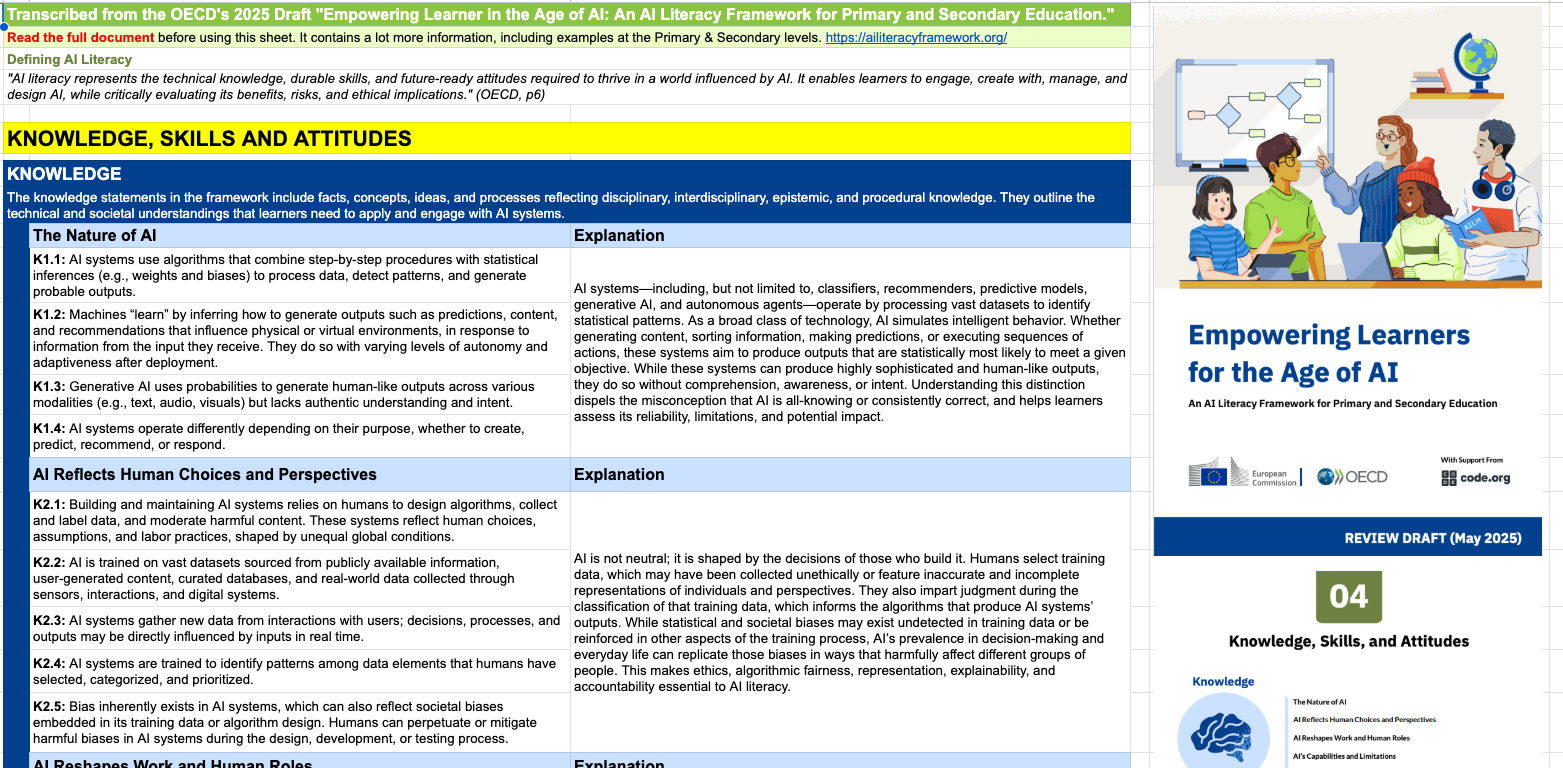
OECD AI Literacies for Students
I’ve added the OECD Student AI Literacies as well (original here). These are a great student-facing set of literacies, explanations & learning engagements.
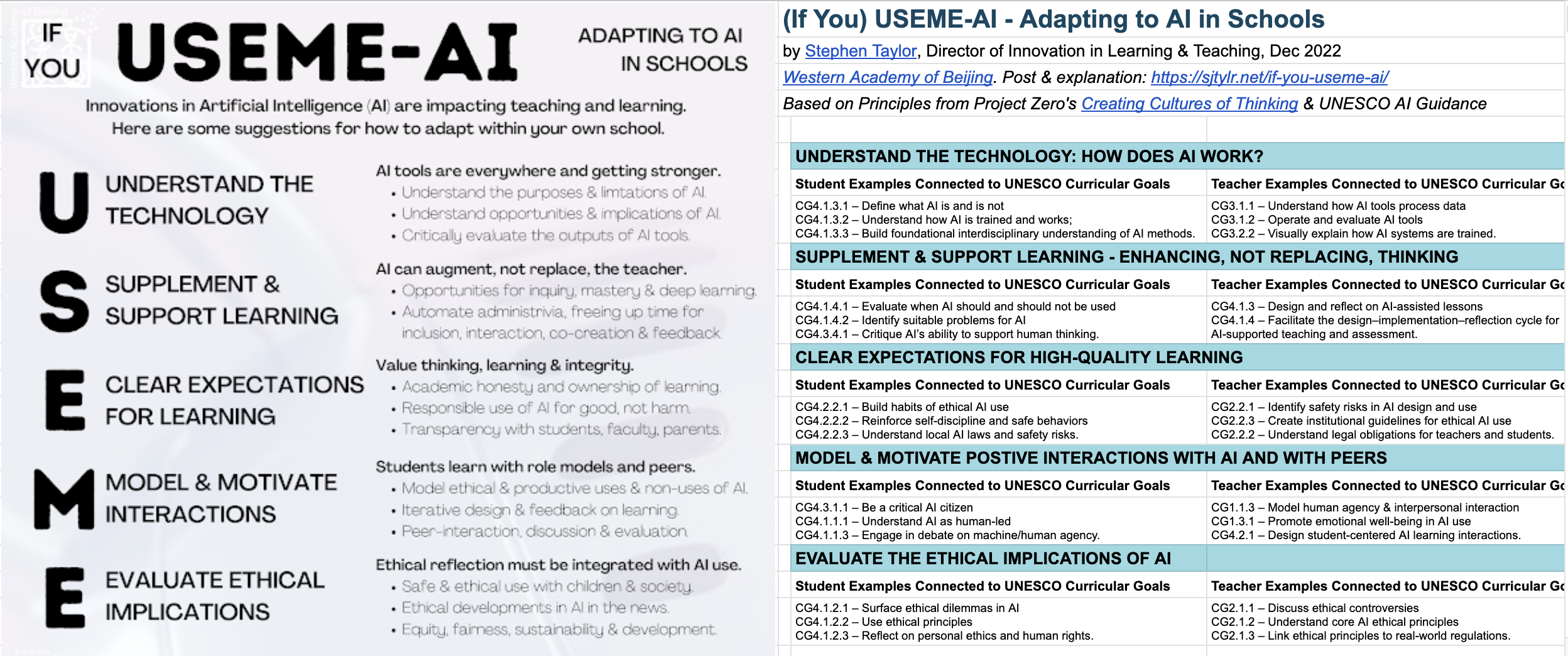
(If You) USEME-AI: Adapting to AI in Education
There is a tab on the sheet that unpacks the (If You) USEME-AI model to align with the UNESCO Competencies. I created this in Dec 2022 (updated Feb 2025) with a strong basis in Project Zero’s Creating Cultures of Thinking and earlier drafts of UNESCO guidance. Find out more about it here.
AI Competencies for Leaders
Using UNESCO’s Guides and ISTE Standards for Leaders, I have added a sheet to draft some competencies for Leaders in the AI Era. Find out more on this post.

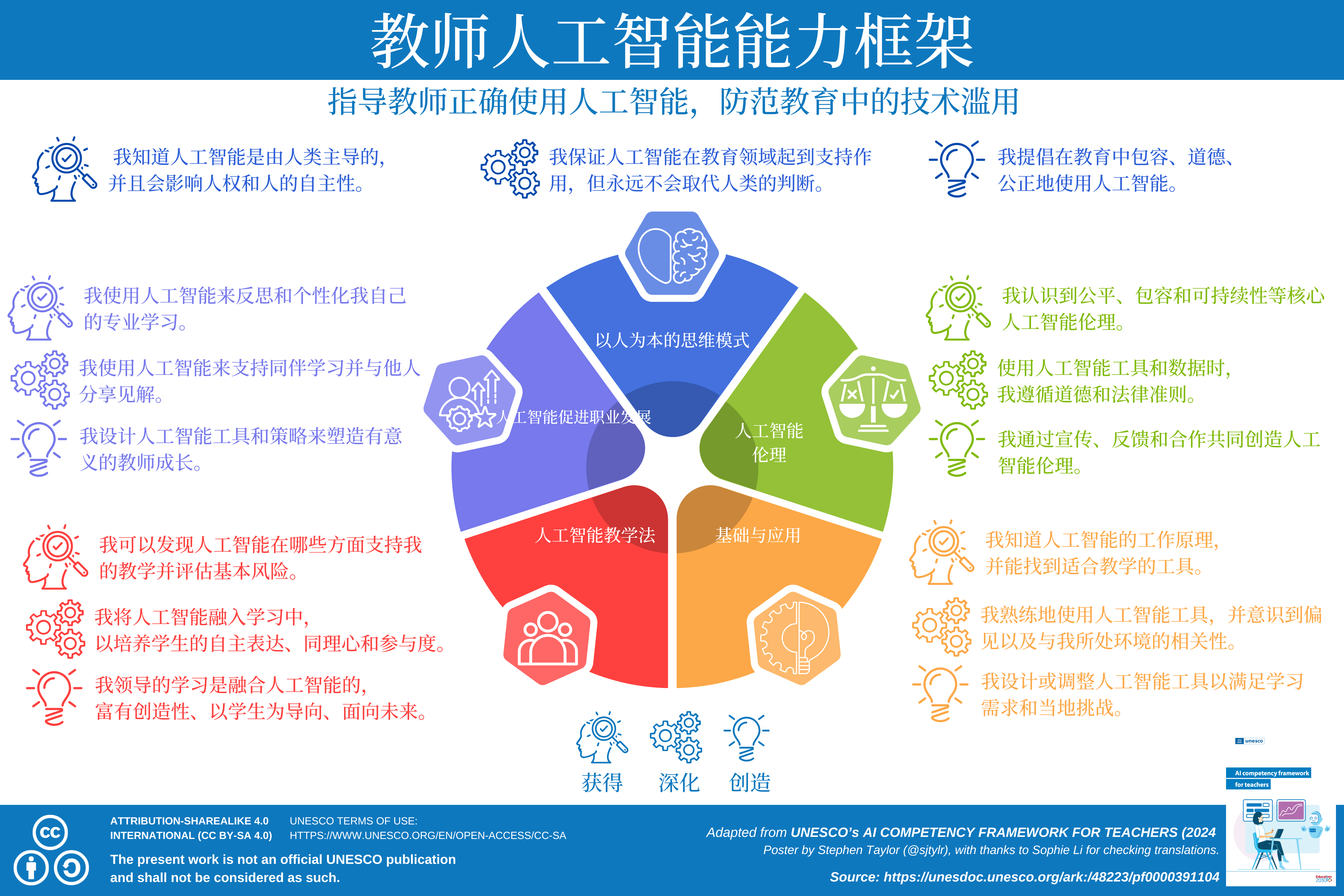
Graphics in Chinese
Thank-you to our fab colleague Sophie for helping check & improve the Canva translations 🙂

AI competencies for teachers and students: Regional seminar for G77+China countries in Asia and the Pacific
- Link to join or find out more (28, 29 April).
- Day 1 Recording (Teachers)
- Day 2 Recording (Students)
Here are a couple of graphics adapted from slides shared by Prof. Fengchun Miao, on the competencies for teachers:


And for students:

UNESCO AI Competencies for Students: Hexagonal Thinking Workshop Cards
These are designed to help with teachers and students as they apply the competencies to their work. Print on A3, double-sided.
AI Transparency Statement
I used ChatGPT-4o for help with a few tasks:
- Extracting text from the original document to paste into the spreadsheet.
- Getting started on breaking the Curricular Goals from long(ish) paragraphs into command-term based “I can…” statements.
- Suggesting simple “I” statements to summarise the Competency descriptors for each Domain at the Understand, Apply and Create levels.
At each stage, I checked and refined the outputs, and there was a lot of human work and thinking. All-in, this took about twelve hours of work.


 Wayfinder Learning Lab - Stephen Taylor
Leave a reply to Nadine Bailey Cancel reply