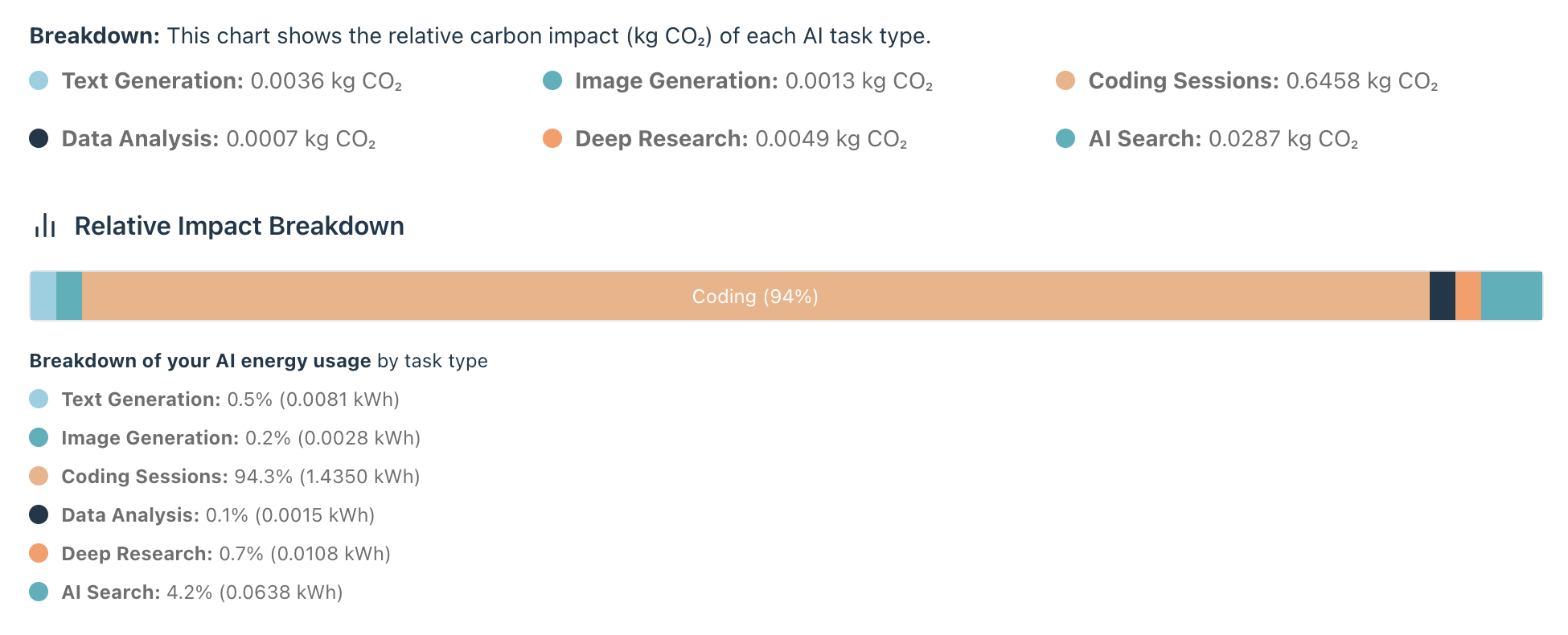
In Jan 2025, using some of the new AI coding apps, I designed a simple app for students to estimate the environmental impacts of their AI usage. This is the updated version.
Now in 2026, there is more data available, and the AI coding apps have become better. I rebuilt the app, using updated research (including some from my EdD), and testing out Z.AI‘s “full stack” coding assistant. This allowed me to make a much more complex app that could be embedded. It required ReactJS and hosting with GitHub and Vercel. The GitHub repository is saved here.
I updated the website to include the new app, references and lesson ideas (with Visible Thinking routines and Our World in Data.
- See the full site here: https://sites.google.com/i-biology.net/ai-footprint-estimator/home
- Or jump to the app here: https://sjtylr-ai-eco-footprints-students-2.vercel.app/
Even though this used a lot of AI, it still took many hours of personal time. But… I learned a *lot* about coding, hosting, troubleshooting and managing an AI coding assistant.
The main site has my methods and an estimation of the environmental impacts of making the app.
The original post from Jan 2025 is here. https://sjtylr.net/2025/01/27/ai-footprint-estimator/
A more detailed technical paper is here:
Cite this document: Taylor, S. 2026. AI Environmental Impact Estimator for Students: Technical Paper. Wayfinder Learning Lab [Online]. Available from: https://sjtylr.net/2026/01/29/ai-impact-estimator-2026/ .
The following poster might be of use in your classes, connected to BE HUMAN, part of the Evaluating Ethics section of (If You) USEME-AI.
This work is connected to my EdD studies (more on this site), and my job role. Environmental Impacts are one part of the Evaluating Ethics section of (If You) USEME-AI. Find out more here. To see more about connecting PZ’s Cultures of Thinking with AI, see here. To see more resources around Factfulness and Our World in Data, see here. And generally a lot more about AI here. Some of my papers are on Academia here.


 Wayfinder Learning Lab - Stephen Taylor
Leave a reply to AI Impact Estimator 2026 – Wayfinder Learning Lab – Stephen Taylor Cancel reply