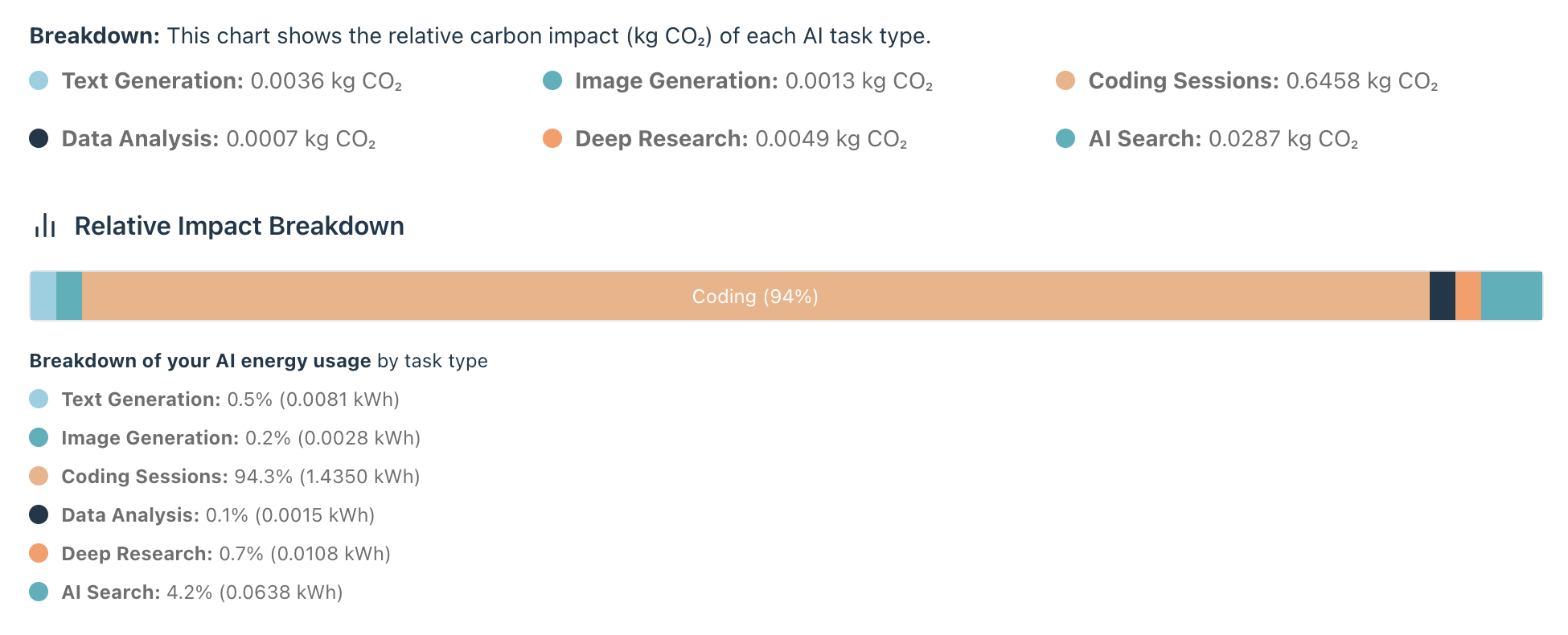
What’s the environmental footprint of our AI use? In this experiment, I have tried to scratch an itch that has been bugging me since the release of ChatGPT.

The Goal: Create a simple web-app that can be embedded into our AI guides, so that students can try to visualise the environmental impacts of AI use.

Outcomes:

Update 26 Feb, 2025: Poe’s new App Creator feature just recreated a better version of the app in about 1-2mins. Example here, with prompt at the bottom of the page.

Research & Development Methods (updated here)

This project has been on my mind for ages, but I don’t have the coding know-how to make it work. I first raised issues of environmental and ethical implications of AI in Education (AIEd) in 2022 & 2023, with the creation of (If You) USEME-AI and presentations to educational leaders. But of course… people were in panic mode and it was just out of the pandemic. Now we’re a couple of years in, we should be able to engage with these issues in our adaptations to AI in schools.

Enter DeepSeek-R1

I wanted to put DeepSeek-R1 through its paces as a more efficient, open-source local AI model. Using DeepSeek-R1 with Search and R1-Reasoning enabled, I asked it to walk through the process of research and developing a simple, embeddable app that can be used for students in a school to estimate the energy use, carbon footprint, water use and illustrative equivalencies of using various types of AI. Through an iterative process of conversation, testing and refining, the first version of the app was created and deployed on our AI guides. This took about one hour. 

But there was a problem… 

Although the app worked and some sources were cited, there were many hallucinated links and some of the numbers seemed off. So during the break, I set a 4-hour limit to track down more reliable figures, re-create the app and ensure the sources all pointed to reliable information. This required further chats with DeepSeek-R1 and an extensive thread with Perplexity Pro as a research assistant, as well as a lot of reading and manual calculations. 

Eventually we got to a liveable solution. Overall I think the results are skewing high, but the huge variability in energy grid efficiencies and the energy needs of different models made it difficult to produce simple parameters that would still be useful in a school context. As a result, the app has high-conservative estimates (I think), but it serves as an illustration of the different types of impacts of AI usage. 

Using DeepSeek for this task was really interesting. Watching it reason through the problem and second-guess itself felt like how I might work through a problem myself I learned a lot about how to approach the problems by scrolling through its “thought” patterns. Here’s a cute example as it was trying to work out energy intensity for video generation: 

“If each frame is an image, then 1800 *4.51 Wh = 8,118 Wh or 8.118 kWh per minute. That’s 8,118 Wh, which is 8.118 kWh. But this seems too high. Alternatively, maybe video generation is more optimized. Alternatively, the initial estimate of 3.5–5.0 kWh per minute could be used, but without a citation. Since the user provided grid intensities, perhaps calculate CO2 based on that energy, but without the energy data, it’s impossible. Therefore, I’ll have to exclude video generators from the table due to lack of data in the provided search results. Alternatively, include them with a note that the data is estimated from related tasks. But the user might not like that. Hmm.”

In the end, I went down a research rabbit-hole and still couldn’t get to a good number, so went with the high estimate of frames per minute, as if they were image generations on a reasonably efficient model. 

Getting Backup From Claude

Once DeepSeek went super viral, it would hit “high traffic” limitations more often. To double-check the coding, make the app responsive to screen size adjustment, I copied the project over to Claude-3.5 Sonnet on Poe.com. I then asked it to create an interactive infographic to help students visualise their AI footprint, using the inputs we had previously determined. It looks OK. 

Organising The Research

As a site intended for students, I am aware that this can get overwhelming pretty quickly. The references on the main page have been arranged by topic, and linked to sources that they can follow-up if they need to. 

How about my own footprint in this task? 

Across different models, this task took 27 text queries and 17 coding tasks (in DeepSeek) and 22 AI searches (in Perplexity Pro), as well as about 4 hours of personal research and work. Using the app’s own logic, that is about: 

  • O.4 kWh of electricity
  • 0.145 kg COemissions, 
  • 0.7L water, 

Or the equivalent of: 

🔋 33.0 smartphone charges

💻 5.7 laptop hours

🚗 1.2 km car equivalent

🌳 0.01 trees needed for offset

In this case, the footprint is somewhat justifiable as the task would be impossible (to me) without AI assistance. Research, validation, coding, testing and everything else that went into this would take me at least 20-30 hours of intense laptop use. 

How could you use this app? 

This is only for estimation and illustration in a school context, and not an industry tool. It is designed to raise awareness and questions about the environmental impacts of AI, and could form the basis for lines of inquiry and discussion. If you try it out with students, please let me know what discussions they bring up. 

  • What do they notice? What do they wonder? 
  • What types of AI have bigger impacts? 
  • What do they want to know more about? 
  • What do they learn from the sources? 
  • How might they be more mindful in their AI use? 
  • How might they mitigate or offset their AI footprints? 

Anyway – don’t take this too seriously, I’m no engineer. Might be worth a play though. You can also try to copy the project and make it better.

Stephen Avatar

Published by

One response to “AI Footprint Estimator”

  1. Mitigation, Adaptation, Innovation – Wayfinder Learning Lab – Stephen Taylor Avatar

    […] of course, the irony of applying a climate action framework to a contributor to climate change is not lost on […]

Thank-you for your comments.