Change, change, change. International schools are beautiful, dynamic places and there is always so much going on, so much forward development, that choosing and managing improvement projects can be equal parts joyful and exhausting.
Across all of education and school life, there are a million propositions to make things “better”. Some are big, some are small. Some are quick and some require intensive development and investment. So how can we choose what to take on?
As we get into the new school year, with continued innovations, I’ve blown the dust off an old draft sketch, based on lessons learned over the last 15+ years in learning leadership. Don’t take it too seriously, but it might help you think through projects or ideas for improvement, innovation and alignment.
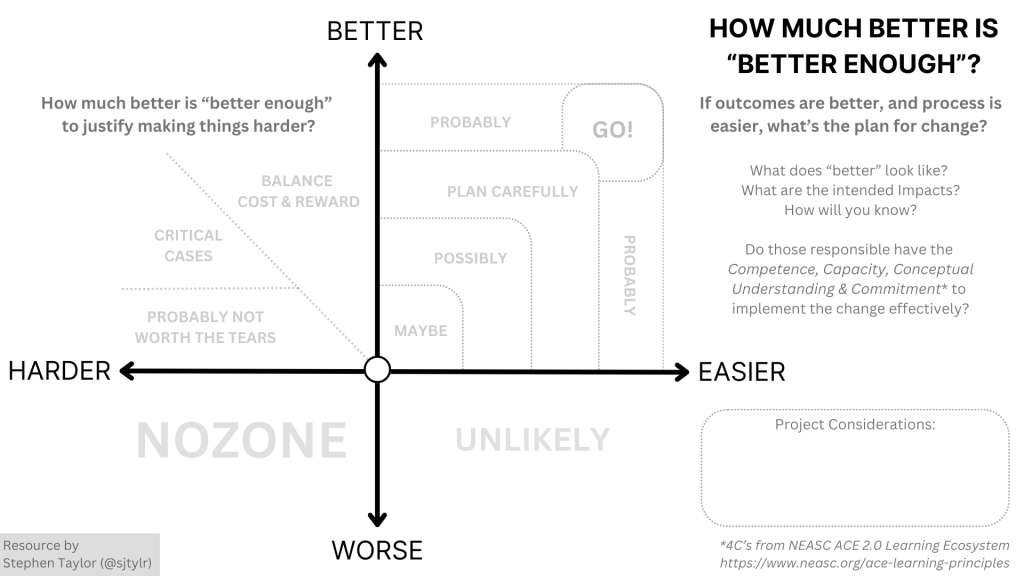
HMBIBE (pronounced Hmm…Bibeh) presents four quadrants, built on a philosophy of trying to make it easier to do better things (2019). Within each quadrant are some considerations for change:

Questions to Consider Before HMBIBE-ing:
- For whom is is it supposed to be easier and/or better? Consider taking a Circle of Viewpoints on the proposal.
- Is this change actually possible? Who will implement it?
- Has someone thought carefully about what the change involves?
- Is the change mission-aligned and in keeping with the school ethos and direction?
The HMBIBE Zones
Harder & Worse: The NoZone. Schools don’t have time for this.
Easier & Worse: Unlikely. There might be occasional cases where quality of outcome can be sacrificed for ease of process. Carefully consider who this impacts and what quality sacrifices you’re willing to accept.
Better & Harder: How Much “Better” is “Better Enough”? These zones are complex, and the positive outcomes of change need to be really well justified and communicated. Change that makes things harder for marginal quality gain is probably not worth it, but there might be special cases.
Mission-critical change that makes things harder but significantly better (or safer, more compliant/secure), will require real expertise in leadership, implementation, investment and management. Other projects that increase difficulty with increasing gains in quality would need to be very carefully considered. In all projects on this side, consider the strength of your school culture and potential implications of making the change.
In all change in this zone, what do we need to do get it to move over to the “easier” side?
Better & Easier: Fifty Shades of Yay! Deciding to invest in these projects is balance between “better”, “easier” and the resources needed to be successful. Marginal gains projects in the Maybe, Possibly & Plan Carefully zones might be worth it if there aren’t other competing priorities, or if they can be entrusted to others with high capacity to pull it off. Who is the who else? Who needs an opportunity that delegation or contributive leadership could afford them to grow and show what they can do? Who will support them? The Probably zones promise great gains in “better” or “easier”, so who will take them forwards?
The Go! Zone is for those quick fixes, or initiatives that are much easier and much better, or for significant projects that will result in things being both much easier and much better for everyone impacted. Where could you flick a switch and improve things? If it’s a bigger project, what is the vision and when will it pay off?
considerations & resources in change management
There are millions of education and corporate books about change out there and if you’re reading this, you’ve probably read them. Here are some connections I find useful:
NEASC’s 4C’s Model: Competence, Capacity, Conceptual Understanding & Commitment (from the ACE 2.0 Learning Ecosystem) are useful guiding questions for implementing change, aligned with vision and intended impacts. Does whoever needs to implement the change have all four of these in high resource?
Are you ready to ride The Implementation Dip (Fullan) as change inevitably leads to a temporary slip in quality and increase in effort? Is the payoff going to be worth it and what do you have in place to get that rollercoaster back up the climb? How do you move at the Speed of Trust (Covey)?
Can you take a Past-Present-Future view of the change, making explicit the connections to what has come before, where we are and where we are going? Education is desperate for rebranding old ideas or forgetting prior initiatives; educators see through this quickly.
On the subject of the time-traveling leader, how can Empathy For Your Future Self (Hershfeld, Paul) be used to get things going? What do you need to get done now so that future you can be successful? Imagine you’re presenting, launching or justifying the change – what do you need to know and have prepared so that future you can feel confident and communicate credibility?
Consider a Pre-Mortem (Gary Klein) to think through what could go wrong before you start – and then what mitigations you can have in place before you start. If that gets you pessimistic, have a go at a SOAR (strengths, opportunities, aspirations, results) model of appreciative inquiry (Stavros, Cooperrider, Kelley).
Aim for 80:20 (Pareto) in terms of success. Perfect is the enemy of done, but 80% there makes success visible… so the remaining 20% of people or success criteria can follow. How can you leverage Early Adopters & First Followers (Sivers) to make progress visible?
Can it be simpler? Consider Thoughtful Reduction (Maeda) to trim the excess. What’s clear in your mind might not be clear in others’, and we all know that Clear is Kind, Unclear is Unkind (Brown). This might also help mitigate the Expert Blindspot (Dunning-Kruger) where those with mastery of the concept forget the gaps that novices, or those new to an idea/project, need to cross in order to be successful.
You might complement this with Visualisation, representing the goal graphically. Note that visualisations are a synthesis of complex thinking, not a proxy for it (behind every nice graphic is a fab spreadsheet or dull document…). Also consider effective Wayfinding and documentation in a project. Where is it shared? Where is it documented? How can people find it easily to keep on moving?
How can your design for Agency Over Autonomy towards shared success? Where autonomy is about “I’ll do my thing my way,” agency is about Voice, Choice & Ownership (IBO), towards shared goals.
Consider Opportunity Cost (von Wieser). What are the tradeoffs of taking on a project in terms of what other impacts or implications are present? What other projects or current practices cannot happen as a result of the trade-off in resources/capacity/time? Is the school OK with these opportunity costs?
Be Water, My Friend (Bruce Lee). It won’t always go according to plan, so be formless and follow the flow to end destination. If the vision is clear enough, the project will take a right form in the end and the journey will shape us.
[Bonus – Thanks to Tricia Friedman for sharing Liz + Molly’s Uncertain Tolerance; this might be useful in assessing yourself or a team.]
Whatever change you’re involved in this school year, I wish you best!

 Wayfinder Learning Lab - Stephen Taylor
Thank-you for your comments.