Long time no post, and this one’s a bit of an epic. Life has been busy, and so much has continued to develop in GenAI in Education.
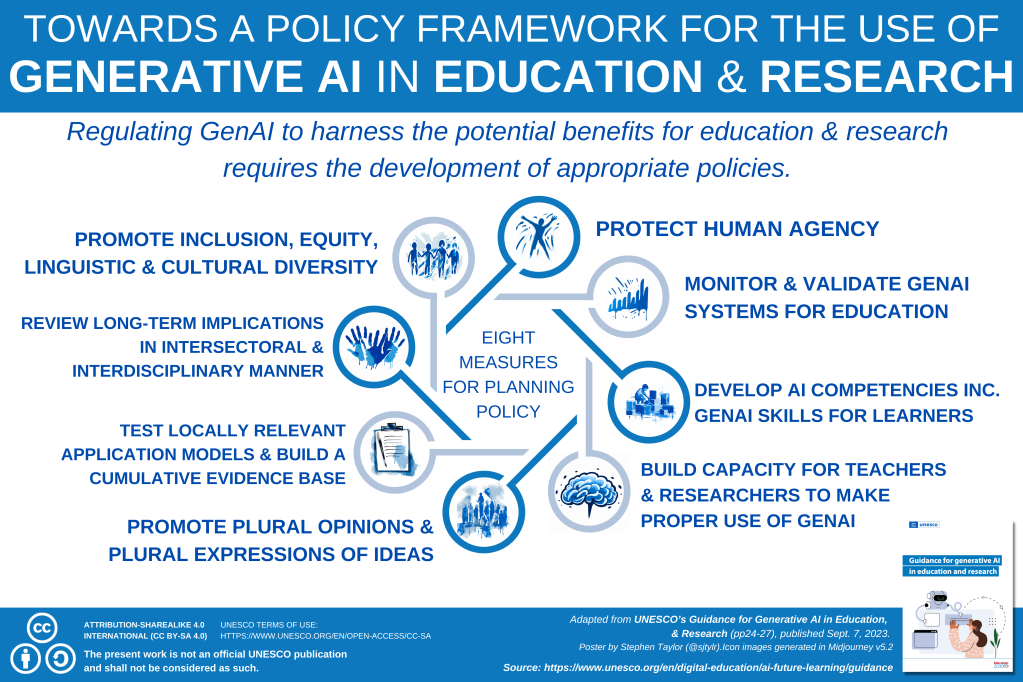
For the first couple of EdD units with the University of Bath, I focused on GenAI, centring my research on ethical frameworks in AIEd and the recommendations of UNESCO. In 2022-23, I completed Learning Pedagogy & Diversity, taking a Bernsteinian view of the pedagogic device, control, power relations and framing in relation to nascent AIEd frameworks. It used works in progress from UNESCO, but was completed before UNESCO’s Guidance on GenAI in Education & Research was published.
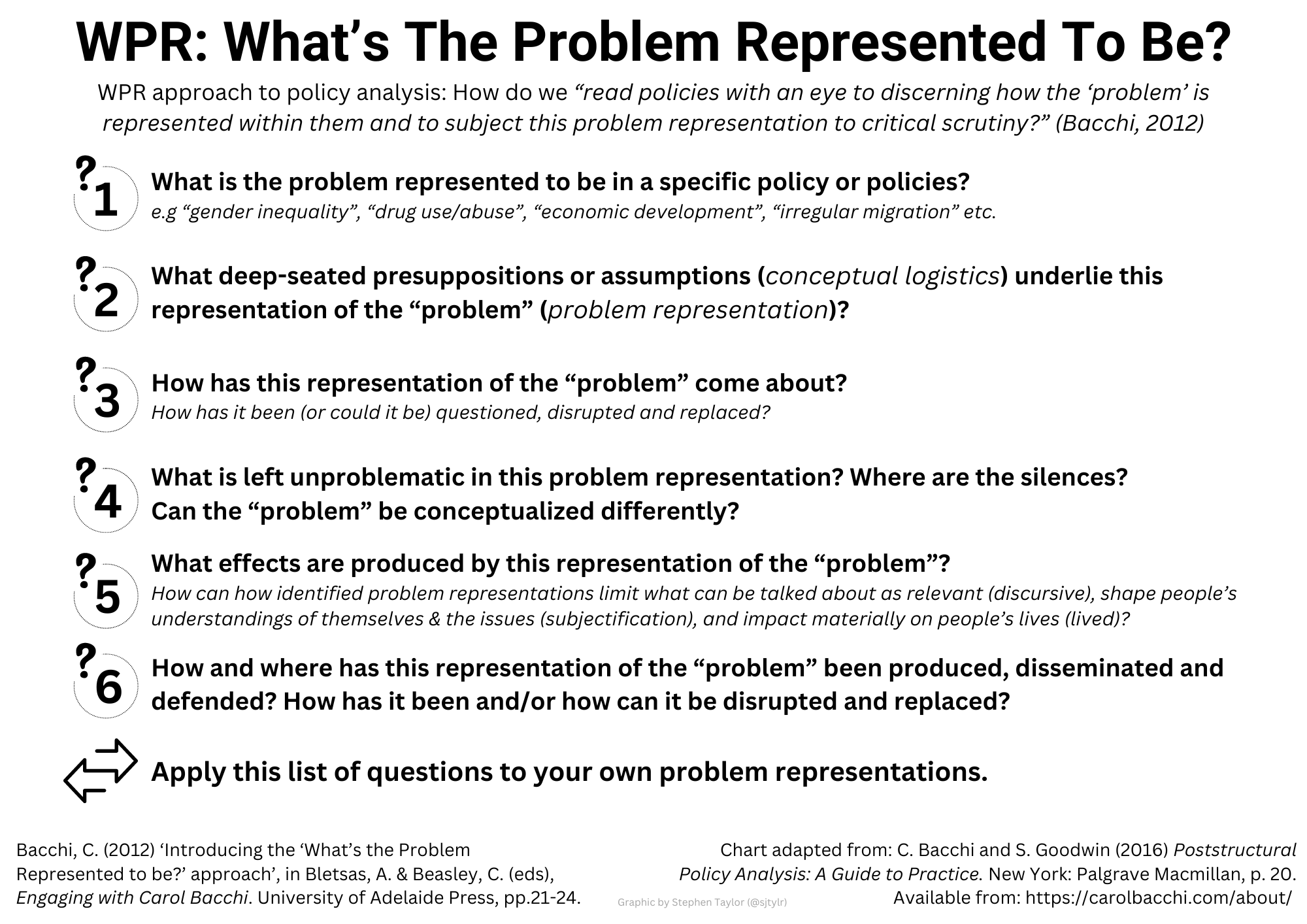
In 2023-24, through the EdD unit on Policy and with the publication of UNESCO’s Guidance on Generative AI in Education & Research, I picked up the thread, applying an interpretation of Bacchi & Goodwin’s “What’s the Problem Represented to be?“ (WPR) framework for analysis of the guidance as policy as discourse. This was a really interesting challenge with such a dynamic field and a wide-ranging document, but I enjoyed it.
I held off on sharing it, partly because of nerves and partly because the work referenced the draft AI competency frameworks for GenAI. The published versions of these have been released as part of this week’s 2024 Digital Learning Week in Paris:
If you are interested in Policy development and analysis, WPR is a great tool for thinking through the “text as discourse” and can be applied to adapted to pretty much anything. Here’s an adapted graphic:
OK, Here’s the paper, if you need a snooze:
Huge thanks to Prof. Hugh Lauder for the support and supervision of this unit.
For a more accessible summary, focused on implications for international schools, I have a post and International School Magazine article here, and made the graphic below:

So What’s Next?
Interestingly, in working with a lot of international school leaders recently, the initial panic/hype over GenAI seems to have calmed. We’re getting more guidance from our agencies (see the IB’s new resource here), and there are more education-aligned tools. At our school, we’ll keep researching, learning, innovating and reflecting but really what set us in good stead is culture. There are a few posts about that on here, and the general thinking of (If You) USEME-AI from Dec’22 is still relevant. We are really fortunate to have a fantastic EdTech & Libraries team, open-minded teachers, supportive parents and students that are interested in making the most of their learning.
In terms of the EdD work, I’m pivoting my research to work on Impact in international schools, in terms of long-term transformative change, with a focus on our deep work towards Profiles of Alumni and alternative pathways to student success. Momentum behind this work is really growing, as more organisations align, refine and there is still so much to research, study and implement. Better get typing…
Wishing you all a great new academic year!


 Wayfinder Learning Lab - Stephen Taylor
Leave a reply to AI Competencies for Educational Leadership – Wayfinder Learning Lab – Stephen Taylor Cancel reply