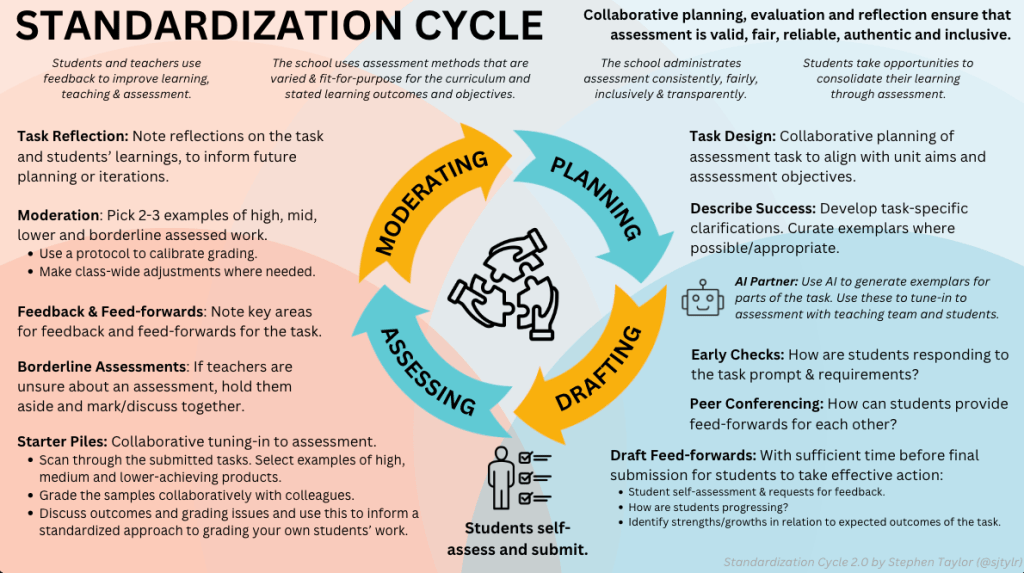
Blowing the dust off an old resource as I’ve been contacted a few times about this recently, and it is due an update. Back in 2017, I posted a Standardization Cycle for use in MYP-DP schools, to support collaborative assessment processes. The “problem” was the conflation of moderation with standardization, and the intention was to outline processes that can align collaborative planning, teaching and assessment, to avoid issues that arise in moderation events. For schools and teams that have made the shift, I’ve heard positive feedback.
Since the updated IB 2020 Standards & Practices (and approaches to teaching & assessment), the emergence of AI and the ongoing challenges of assessment at scale, this resource provides some more suggestions and structures.
Two key understandings:
- Standardization is an ongoing collaborative process. Moderation is a component of this process. Moderation by itself is not an effective form of standardization, and can lead to tension or conflict in a teaching team, or inconsistency in assessment across groups in a cohort.
- The final outcome of an assessment cycle should be assessment that is valid, fair, reliable and authentic, to support students’ growth and ownership of their learning. A collaborative cycle centres the process, maintaining the focus on their development, rather than a downstream defense of individual grading practices.
The IB Approaches to Assessment
From the 2020 S&P’s, these Approaches are required in all IB programmes:
- Students and teachers use feedback to improve learning, teaching & assessment.
- The school uses assessment methods that are varied & fit-for-purpose for the curriculum and stated learning outcomes and objectives.
- The school administrates assessment consistently, fairly, inclusively & transparently.
- Students take opportunities to consolidate their learning through assessment.
Standardization Cycle 2.0 Outline & Guiding Questions
Here is the working version 2.0. Click here to go full-screen.
Why Take This Approach?
Anyone who has been in a “spicy” moderation meeting will know how challenging a defense of assessment can be, especially if people have spent many hours on a huge pile of work. Collaborative planning is an expectation IB programmes, and standardization cycle can provide a structure for collaboration – especially in teams that are not used to ongoing collaboration. Assessment is a common goal and outcome; we can use this to help facilitate collaboration around concrete outcomes.
Is this more work?
It doesn’t need to be. It can be healthier work than conflict mediation around defense of final assessment. In teams with an established collaborative planning culture it is not more work, just a structure to focus collaboration. Using the Cultures of Thinking force of Time (“invest time to make time”) can help situate where we want our collective efforts to be placed.
How can this promote agency and academic integrity?
Academic integrity issues often arise in the “invisible middle” between setting an assignment and getting a final product. In the age of GenAI, it is even easier to generate passable final products for most subjects in a short space of time than it used to be. A collaborative cycle that includes checks in the drafting phases can allow for more student agency in their topics/approaches, more visibility of students’ thinking in action, and adjustment of the task/assessment process in real time.
How can this promote student ownership?
Remembering that assidere, the root of assessment, literally means ‘to sit with’, a collaborative cycle should include the students and colleagues in the whole process. Assessment is not something ‘done to students’, but a process that includes students in taking ownership of their own growth. This shift from assessment of learning to assessment as learning can de-stress the process if handled collaboratively and compassionately.
What is the role of feedback and feed-forwards?
Effective feedback is timely, actionable, goal-oriented and student-owned (Wiggins, 2012). When students need to wait for a delayed feedback after a long process of grading and moderation, its impact is reduced. Students should know the bulk of their own feed-forwards by the time the final product is submitted. See this post for more ideas on feedback and feed-forwards, adapted from Hattie & Timperley’s levels.
What roles can AI play in the process?
Now we have effective AI tools to support teaching and learning, a few simple tricks can support a standardization cycle:
- Quick generation of exemplars of parts of a task can be used as early standardization models in the task design stage. How might the team evaluate the exemplar based on some of the descriptors? Are we all seeing it the same way? This can be useful in a first-time task with no pre-existing student examples.
- AI dogfooding* can be used to determine the new baseline for assessment taks. Take 15mins and a couple of tools to try out the task. If students are using AI (intentionally or otherwise), this can help visualise where the new starting point for success exists.
- Peer, self and AI feedback in the process. Although not perfect, careful prompts aligning sections of work with associated descriptors might provide some tuning-in feedback on the work in process.
- Synthesising whole-class feedback. Commentary feedback to the whole class can be anonymised and synthesised for themes and examples using qualitative content analysis prompts in GPT tools.
Right, that’ll do for now.
* Adapted from Dogfooding – see Cult of Pedagogy.


 Wayfinder Learning Lab - Stephen Taylor
Thank-you for your comments.