Hot on the heels of the pandemic, 2023 has been the year of GenerativeAI (GenAI) in Education since the explosion of AI-enhanced tools following the release of OpenAI’s ChatGPT in November 2022.
The educational impacts of GenAI are still to be fully understood, and over the past year schools, organisations, governments and international organisations have been trying to learn, adapt and regulate – all whilst trying to keep up with perhaps the most volatile disruption in education since the internet. The September 2023 release of UNESCO’s Guide to Generative AI in Education & Research is the first comprehensive, international set of guidelines that might be used as a common ground for international schools as they lean-in to the GenAI revolution.
tL;dR Summary
If you only read one thing as your international school adapts to GenAI, make it the UNESCO guide. Consider your learning culture and ensure adaptation is in alignment with school values and local context, with ethics, safety and inclusion as driving forces of your strategy.
- A shorter version of this post was published in the Winter 2023 edition of International Schools Magazine (pp4-7).
- Sept’24: This post shares one of my recent EdD assignments on analysing UNESCO’s Guide using a What’s the Problem Represented To Be? (WPR) Framework.
Related:
- Leon Furze has an excellent summary of the Guide for the Australian context, that unpacks the sections clearly and with useful links.
- Ecolint Geneva has recently released a summary policy on GenAI, based on the Guide.
- Jeremie Rostan has a useful post connected to the Guide, on adaptive questions.
- In Dec 2022, I created (If You) USEME-AI as a suggested frame for discussions and planning around GenAI in schools, making connections through Creating Cultures of Thinking.
- The International Baccalaureate Organisation’s statement on GenAI is here.
- If you want to continue the conversation, I have posted this on LinkedIN here.
A little welcome stunt: Using HeyGen Labs multilingual translator, here’s a little video that transitions between languages.
In A Web Of Noise, Here’s A Signal
Introduced as part of UNESCO’s 2023 Digital Learning Week in Paris, the Guide builds on years of research and development by UNESCO, including guidance for policy makers and a release on ChatGPT in Higher Education. The Guide is:
“UNESCO’s first global guidance on GenAI in education (that) aims to support countries to implement immediate actions, plan long-term policies and develop human capacity to ensure a human-centred vision of these new technologies.”
Although aimed at national policy levels, the Guide is a concise and practical 48 pages of content and I recommend it as the starting point for anyone learning about or making decisions on GenAI in international schools. The avalanche of resources, posts, books and perspectives on GenAI in education can be overwhelming and disjointed – a possible source of anxiety for busy educators – and the Guide serves as a great source for framing discussions and decisions, whilst presenting the key issues related to GenAI.
GenAI tip: Chat with the Guide, using ChatPDF.
Why Is This Useful For International Schools?
Many international schools serve diverse populations and are staffed by teachers from a range of educational backgrounds and philosophies. Mission-driven international schools also tend to subscribe to the values and guidance of agencies such as their accrediting bodies and the UN’s Rights of the Child and Sustainable Development Goals (SDG4 is references repeatedly in the Guide). UNESCO’s Guide is therefore likely to have a strong resonance with an international school, and this moment provides the opportunity to reflect on the school’s practical alignment with these principles and guidance.
In educational terms, to what extent are we really walking the talk of our missions, as we adapt to GenAI? How are we using our status of privilege, with the capacity and resourcing to explore innovation, to share our development for the benefit of others in education?
In Policy terms, how does this work inform your interconnected ecosystem of policies, including academic integrity, assessment, inclusion and educational technology? Do you need a specific GenAI policy, or do you need to ensure that these policies make appropriate adaptations for GenAI?
Reading The Guide Through A Learning Culture Lense
Culture beats technology. In preparation for reading and working with the Guide, it will be helpful to have a clear understanding of your school or context’s driving forces of learning culture: your mission, core values, definition of learning, approaches to teaching and learning, direction, non-negotiable policies and stances of your accrediting agencies.
The impacts of GenAI will be felt very differently between schools that are progressive or traditional, so, consider the following questions in light of the opportunities and threats GenAI poses in your school:
- What are some strengths of our learning culture, and how can these be leveraged to adapt to GenAI?
- What are some limitations of our learning culture in light of GenAI? How much influence do we have over these, and therefore what are the boundaries on adaptation we need to consider?
- Do we see this moment as one to reflect on our learning culture and direction and to what extent does GenAI accelerate or influence our development?
- What stances and supports are in place from our accrediting agencies?*
For a solid resource beyond technology, consider diving deeper into the Creating Cultures of Thinking books by Ron Ritchhart and Mark Church; these can help set the stage for meaningful adaptation.
What’s In The Guide?
The Guide takes a cautious, optimistic and practical approach, recognising the potential and risks of GenAI:
“This Guidance (…) aims to support the planning of appropriate regulations, policies, and human capacity development programmes, to ensure that GenAI becomes a tool that genuinely benefits and empowers teachers, learners and researchers.” (p7)
Its six chapters take the reader on a succinct journey to where we currently are with GenAI in education and research, unpacking practical and ethical issues, and making some projections for the future:
- What is GenAI & how does it work?
- Controversies & Implications for Education
- Regulating GenAI in Education
- Towards a Policy Framework for Education & Research
- Facilitating Creative Use of GenAI in Education & Research
- GenAI & the Future of Education & Research
Throughout the Guide, links, tools and examples are provided, which can help schools make connections with their current and planned practices. In summary:
- Chapter 1 explains clearly how current leading GenAI text and image models work, defines key terms, and gives guidance on effective prompting and use of GenAI tools, concluding with recommendations for the development of EdGPT.
- Chapter 2 gets right into the ethical issues of GenAI, including: worsening digital poverty (exacerbating inequalities); outpacing national regulation adaptation (creating new issues faster than agencies can adapt); using content without consent (datafication, intellectual property); unexplainable models used to generate outputs (the ‘black box’); AI-generated content pollluting the internet; lack of understanding of the real world (hallucination/confabulation, misinformation); reducing diversity of opinions and further marginalising already marginalised voices; and generating deeper deepfakes (an issue that is already emerging as a risk to children and identity).
- Chapter 3 offers concrete suggestions on regulation of GenAI, including a human-centred approach to GenAI; regulating GenAI in education (inc. GDPR, ethics, copyright, competencies); and key elements of regulating GenAI (inc. governments, GenAI tools providers, institutional and individual users).
- Chapters 4 & 5 might be the most directly adaptable by international schools, elaborated below.
- Chapter 6 projects the future of GenAI in education and research, including: uncharted ethical issues; copyright & intellectual property; sources of content & learning; homogenization & diversity; rethinking assessment & learning outcomes; and thinking processes.
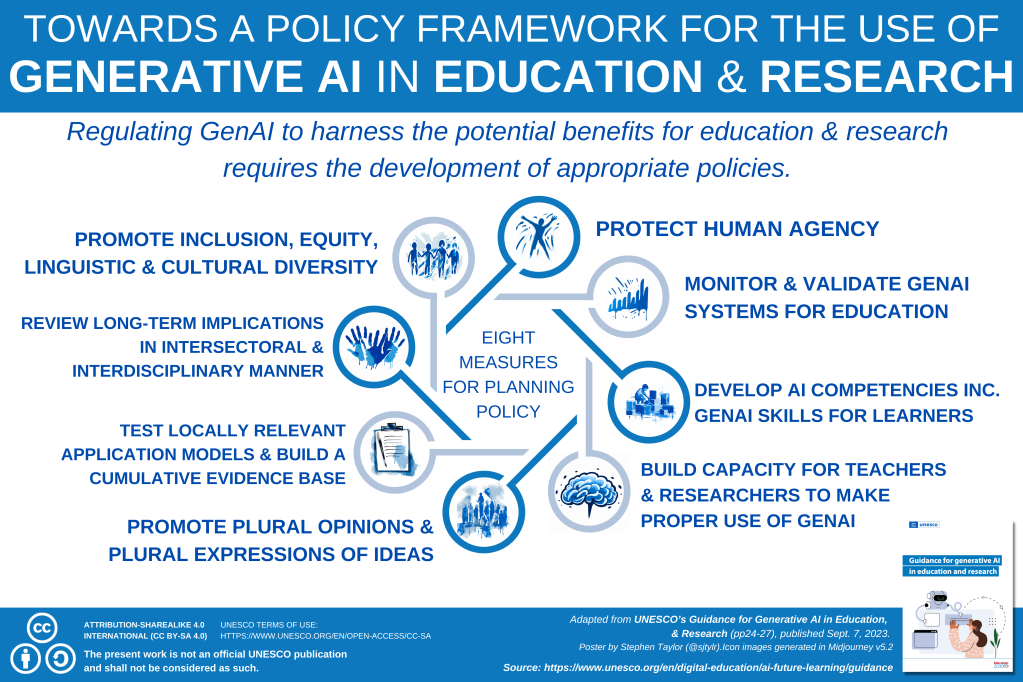
Towards A Policy Framework For GenAI In Education & Research
International schools might find this section useful as a framework for considering different elements of their adaptation/adoption strategy for GenAI.
There is a lot to digest, and as you read it, consider the following questions in light of your school’s learning culture:
- What are our school’s strengths with this domain, notwithstanding GenAI? If GenAI wasn’t ‘a thing’, to what extent would we be living these ideals?
- Which domains are we exploring or working on?
- Which domains are we not working on? What do we need to do about this?
Under the heading of each, I present a reflective question on how this might translate to general practices in international schools.
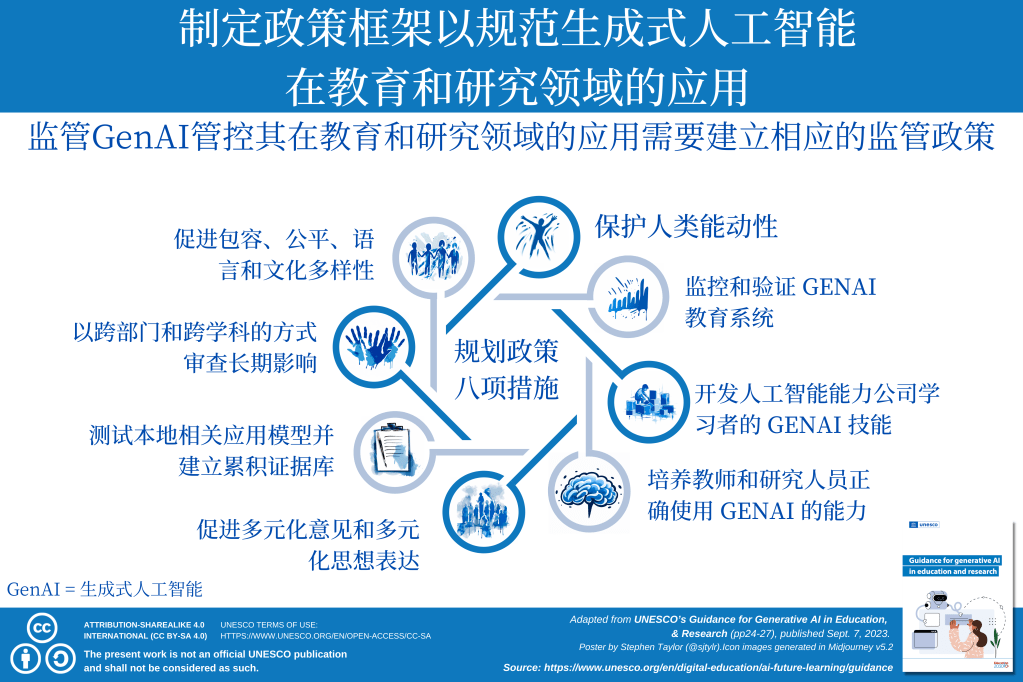
Graphics adapted by Stephen from UNESCO’s Guide, created in Canva, with MidJourney icons. Swipe for translation in Chinese (it was almost perfect, and just needed a minor correction).
4.1 Promote inclusion, equity, linguistic & cultural diversity
Reflect: How does our school promote inclusion, equity, linguistic & cultural diversty?
Many international schools have seen recent moves towards DEIJ/I-DEAS initiatives, purposeful inclusion and consideration of multilingualism & intercultural understanding, as they (rightfully) interrogate their status and practices in order to align missions with action.
Unconsidered use of GenAI could risk this fragile work through unknowingly (or ignorantly) promoting tools that exacerbate bias, exclusion, inequality of access or misinformation. Most models at the moment take an active effort to prompt for diverse representation, and we should find use-cases that actively seek to support inclusion.
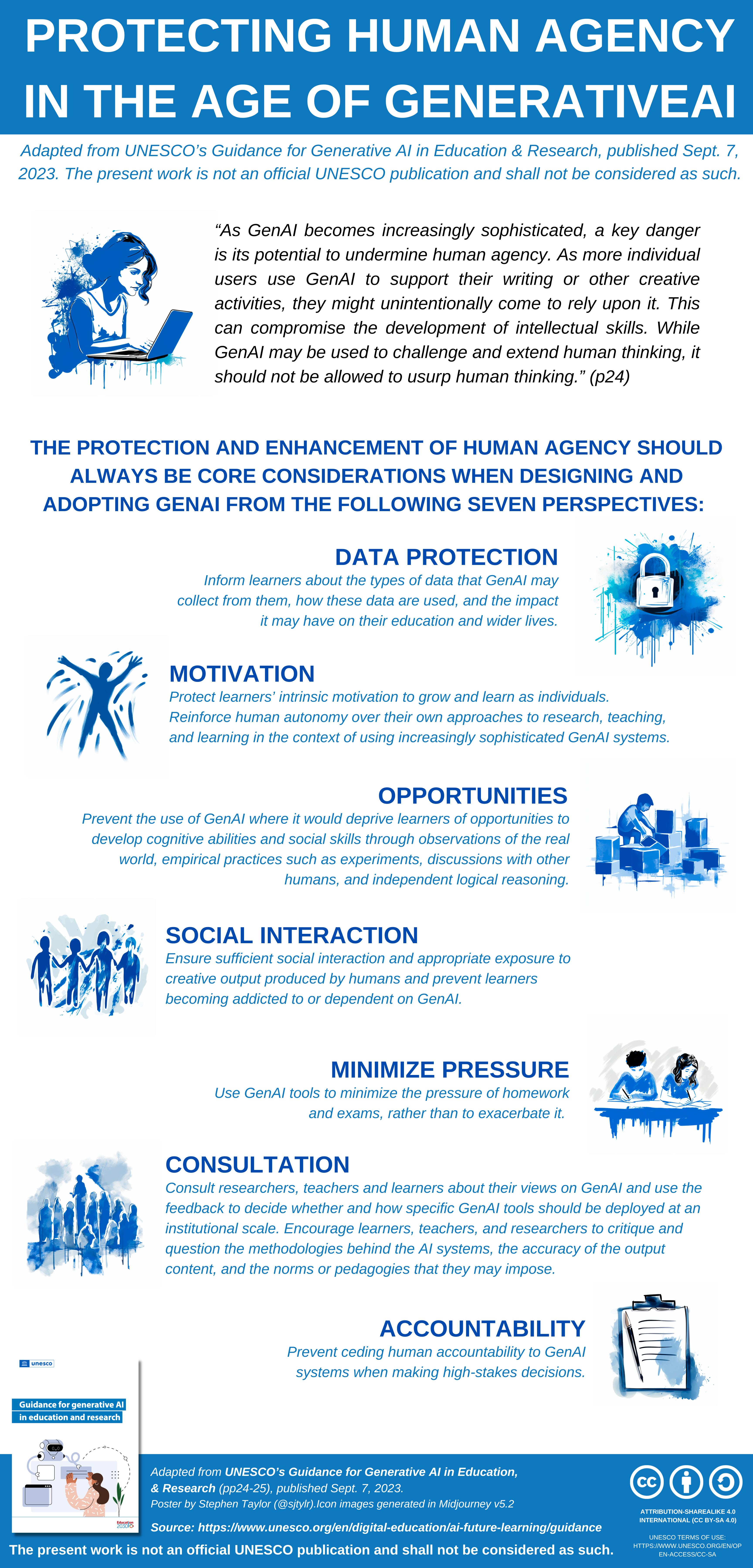
4.2 Protecting human agency
Reflect: How does our school promote learner and teacher agency?
Clear parallels can be drawn here between human agency as a whole, and learner agency within our schools, and I’ve summarised this section into a graphic below. With learning as a human endeavour, we need to ensure that our learners are informed, empowered and supported in their use of GenAI, without risking their intrinsic motivation to learn, or increasing academic stressors. In parallel with students, the agency of educators should be protected, resisting the urge to outsource professional thinking to GenAI models.
For example, AI-detectors are unreliable and potentially harmful (particularly to students whose first language is not English) – where do we re-humanise learning design, empower more social interaction drafting, feedback and engagement in our approaches? Where do we ensure the human-in-the-loop approaches to AI development are mirrored in emphasising the uniquely human elements that make teaching and learning in our schools special?
4.3 Monitor & validate GenAI systems for education
Reflect: How does our school monitor & validate tools and systems?
Through adopting an ‘ethics-by-design’ (p25) approach, this section provides useful guidance for schools on choosing, using and evaluating tools that are suitable for the context, including validation, consent, data use, age-appropriateness, safety and alignment with the school’s values. This should equally be applied to all edtech strategy – to what extent does GenAI give pause for thought on preceding implementations of educational technologies?
4.4 Develop AI competencies, including GenAI-related skills for learners
Reflect: How does our school develop competencies and skills in our learners? How do these align with our guiding statements?
Developing future-ready learners through competencies is ongoing work in many international schools, with explorations of competency-based pathways (such as the Mastery Transcript), or the application of skills frameworks such as the IB Approaches to Learning or the ISTE Standards.
GenAI necessitates reflection on these approaches through considering the impacts of GenAI on future career trajectories in terms of implications on well-established careers and the emergence of new opportunities. UNESCO itself is working on a GenAI competency framework, a draft of which can be found here for consideration and feedback.
As we approach this with students, how do we ensure we are educating for an informed and hopeful future, where our learners can exert a positive influence, rather than a fear of future unknowns?
4.5 Build capacity for teachers and researchers to make proper use of GenAI
Reflect: How does our school build capacity and competence through meaningful professional development?
International schools are generally well-provisioned for high-quality professional learning and dynamic development of approaches to teaching, and GenAI will pull some of this into focus. The pace of change in this field will make it challenging for schools or development providers to keep up, and a focus on general principles, agency, safety and ethics rather than individual tools (which come and go in this volatile marketplace), might set stronger foundations in alignment with learning cultures.
A one-size-fits-all approach may not be suitable for educators, so use-cases of value to wider (or personalised) pedagogic professional learning goals might yield more effective adoption and adaptation. No-one can lead alone in this field, and schools will need to leverage internal and external expertise, support innovation and development and make effective use of professional learning networks.
4.6 Promote plural opinions and plural expressions of ideas
Reflect: How does our school seek and make use of diverse voices and perspectives?
This section dives deeper into the critical information and media literacies related to GenAI inputs and outputs. Users need to understand that current models reinforce dominant perspectives and can produce misinformation. As such, experimentation, iteration and evaluation of tools and outputs should be cautiously and safely encouraged.
It can be challenging to visualise the biases in GenAI systems, though the interrogation of image generators can be a worthwhile demonstration. See HuggingFace’s average diffusion faces as an example.
4.7 Test locally relevant application models and build a cumulative evidence base
Reflect: Do we know the local rules and recommendations on edtech? How do we gather evidence of impact of our choices, in our context?
The temptation to adopt tools unsuited to the local context can be strong, in light of their perceived power to make processes more efficient. Edtech leaders in international schools play a critical role in evaluating tools that are effective, safe and in alignment with local regulations, whilst putting pressure on providers to ensure their models are safe, free from biases and harm and mitigate for environmental and social impacts. Some quick questions to challenge the edtech marketers:
- How are you ensuring data privacy?
- How are you ensuring unbiased outputs?
- How are you ensuring safety and representation in balance with generating income?
4.8 Review long-term implications in intersectoral & interdisciplinary manner
Reflect: How do we make use of local and international partnerships in our research and development as a school?
The scale and pace of development of these tools far outstrips the capacity for any single international school to effectively review the long-term implications of GenAI.
Accrediting agencies and professional organisations must play a more active role in connecting schools, universities, industries, and professional organisations to ensure scaleable, synchronised and reliable evaluation and development of systems and approaches to support schools.
Facilitating Creative Use Of GenAI In Education And Research
This chapter takes the previous chapters and provides concrete guidance on how GenAI can be used in ways that are directly relevant to international schools. It is clear and concise enough to not need to replicate here, with sections including:
- A ‘human-centred and pedagogically-appropriate interaction’ approach, promoting effectiveness, agency and human interaction.
- Co-designing the use of GenAI in education and research through leveraging GenAI for: research; teaching; personalised tutoring/coaching; inquiry & project-based learning; and support for learners with additional needs (inc. learning support and multilingual leaders).
This is one area where we are already seeing useful and practical examples provided by educators and teams across international schools.
In Conclusion
Effective adaptation to GenAI is going to take a global team effort between international schools, their agencies, organisations such as UNESCO and industry. Research and development around GenAI in schools will require significant investment in time and resources, beyond the reach of most schools, but wholly achievable through collaboration. In the meantime, as education tries to keep pace with this powerful disruptive force, UNESCO’s guidance provides a useful reference for international schools as they align their approaches with their learning cultures and values.
UNESCO AI Competencies for Students: Hexagonal Thinking Workshop Cards
These are designed to help with teachers and students as they apply the competencies to their work. Print on A3, double-sided.
*Leveraging the 4Cs of NEASC’s ACE 2.0 Learning Ecosystem as we adapt to GenAI
At WAB, we are a NEASC ACE 2.0 school, on the IB-NEASC Collaborative Learning Protocol (CLP) and CIS Pathway 2 Deep Dive pathways to school reflection and improvement. The slides below suggest connections between NEASC’s 4C model (commitment, conceptual understanding, competence & capacity), in terms of how they might support school reflection on GenAI. The second slide presents a SOAR reflection on the ACE 2.0 Learning Principles. Click here for full-screen.
On Sept 29, I joined a panel for NEASC on GenAI in Education. Session resources are here, with the recording here, and a curation I prepared for the session here.
Stephen is Director of Innovation in Learning & Teaching at the Western Academy of Beijing and an EdD student at the University of Bath, currently focusing on GenAI in education. To find out more about WAB, visit our news page. To connect with Stephen, please use LinkedIN.
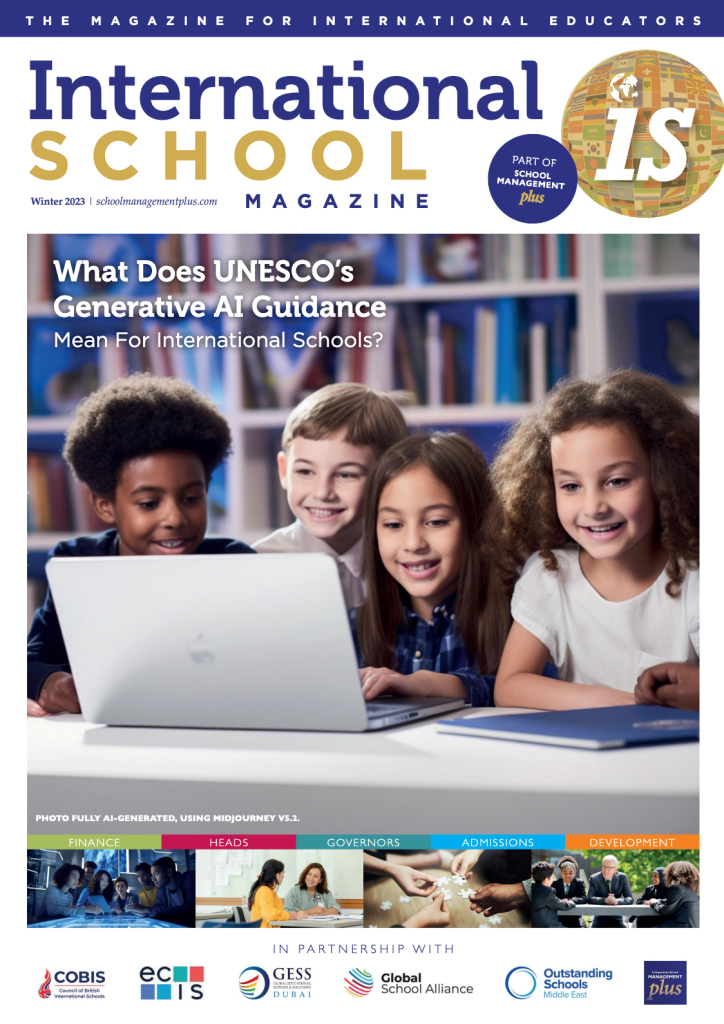
A shorter version of this piece was published in the Winter 2023 edition of International School Magazine (pp4-7). It is free and online.


 Wayfinder Learning Lab - Stephen Taylor
Thank-you for your comments.