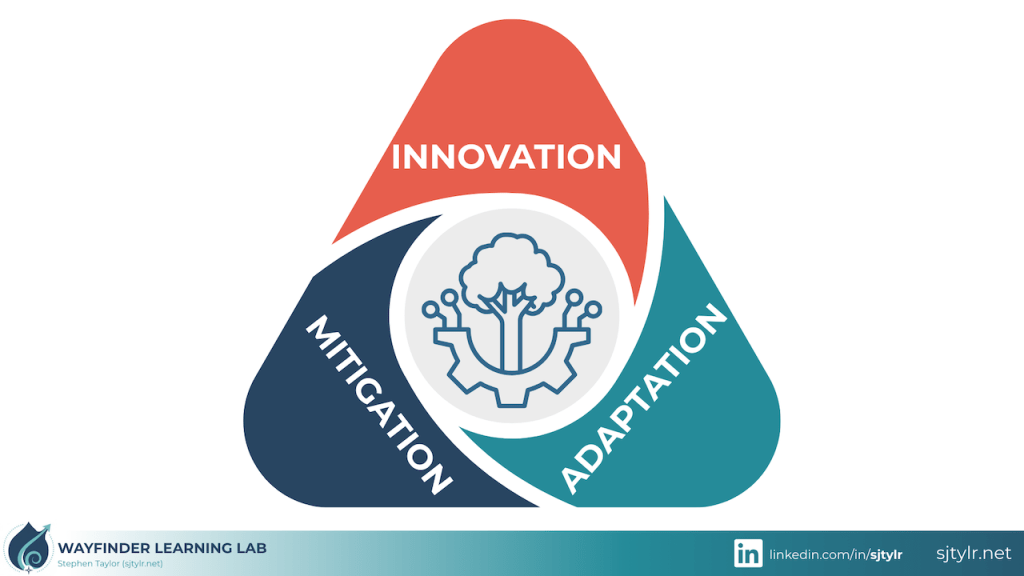
Over the last few years, I’ve been using the concepts of “Mitigation, Adaptation & Innovation” in response to GenAI in Education. This post goes back to Climate Action roots, to unpack the idea further. Key resources for this are Klaus Eisenack & Rebecca Stecker’s 2011 paper A framework for analyzing climate change adaptations as actions (DOI: 10.1007/s11027-011-9323-9) and the 2014 Denton et. al IPCC chapter Climate-Resilient Pathways: Adaptation, Mitigation, and Sustainable Development (link here).
Why The Connection?
The concepts of mitigation and adaptation are easy to grasp and commonly used in a range of IB courses, projects and global citizenship. AI represents a global change, permeating culture, community and systems; a clean analogue to the challenges posed by climate and environmental change. In each case, the causes of the change are distant from those most affected, yet the effects are felt in diverse and often challenging ways. Just as environmental change continues apace, there is no slowing of the AI space race. We need to mitigate, adapt and innovate at the system, school and classroom levels in international educaton.
And of course, the irony of applying a climate action framework to a contributor to climate change is not lost on me…
In this post I use AI to reflect all types of AI in education: generative and all the rest. AIEd refers to the field of studies and work in AI in Education.
What Can We Learn From Climate Adaptations?
Let’s start with some definitions, adapted from Eisenack & Stecker and IPCC.
- Mitigation: Risk reductions at source or enhancing the “sinks” of harm.
- Adaptation: The process of adjustment to actual or expected harms. This breaks down into incremental adaptation (maintaining the essence or integrity of the system), and transformational adaptation (fundamentally altering the system to lead to long-term climate resilience).
Shifting the lense to our schools, or classrooms, we can adapt these definitions to reflect AIEd, focusing on the areas over which we have control:
- Mitigation: Reducing potential harms to agency, integrity, equity and safeguarding. For example: Ensuring the integrity of AI-vulnerable high-stakes assessments that we cannot change, but need to deal with.
- Adaptation: Purposeful modification of existing systems, tools, processes, pedagogies, curriculum etc. in response to the presence, opportunities and threats posed by AI. For example: incorporating new tools or assessment methods where we have the flexibility to do so.
- Innovation (more analagous with transformational adaptation in climate action): Fundamentally co-creating optimistic and innovative approaches to teaching and learning that were previously impossible (or unlikely) before AI. For example: heavily personalised pathways, AI-enabled courses or projects, a full shift to mastery and competency-based assessment.
A teacher might be wrestling with more than one level at the same time. For example, protecting the integrity of students’ original thinking and evidence of learning for terminal IB assessments in one room, whilst adapting (or even innovating) with classes that have much more flexibility. Despite the promises of AI to streamline workloads, existing in multiple states may compound the technostress of the role.
It may be helpful then to recognise and lean in to possible actions and barriers at each level, considering that multiple responses are valid and:
- Alignment with school culture, policy and practice are essential.
- Ongoing, intentional and iterative support is necessary.
Consider these possible definitions, actions and potential barriers:
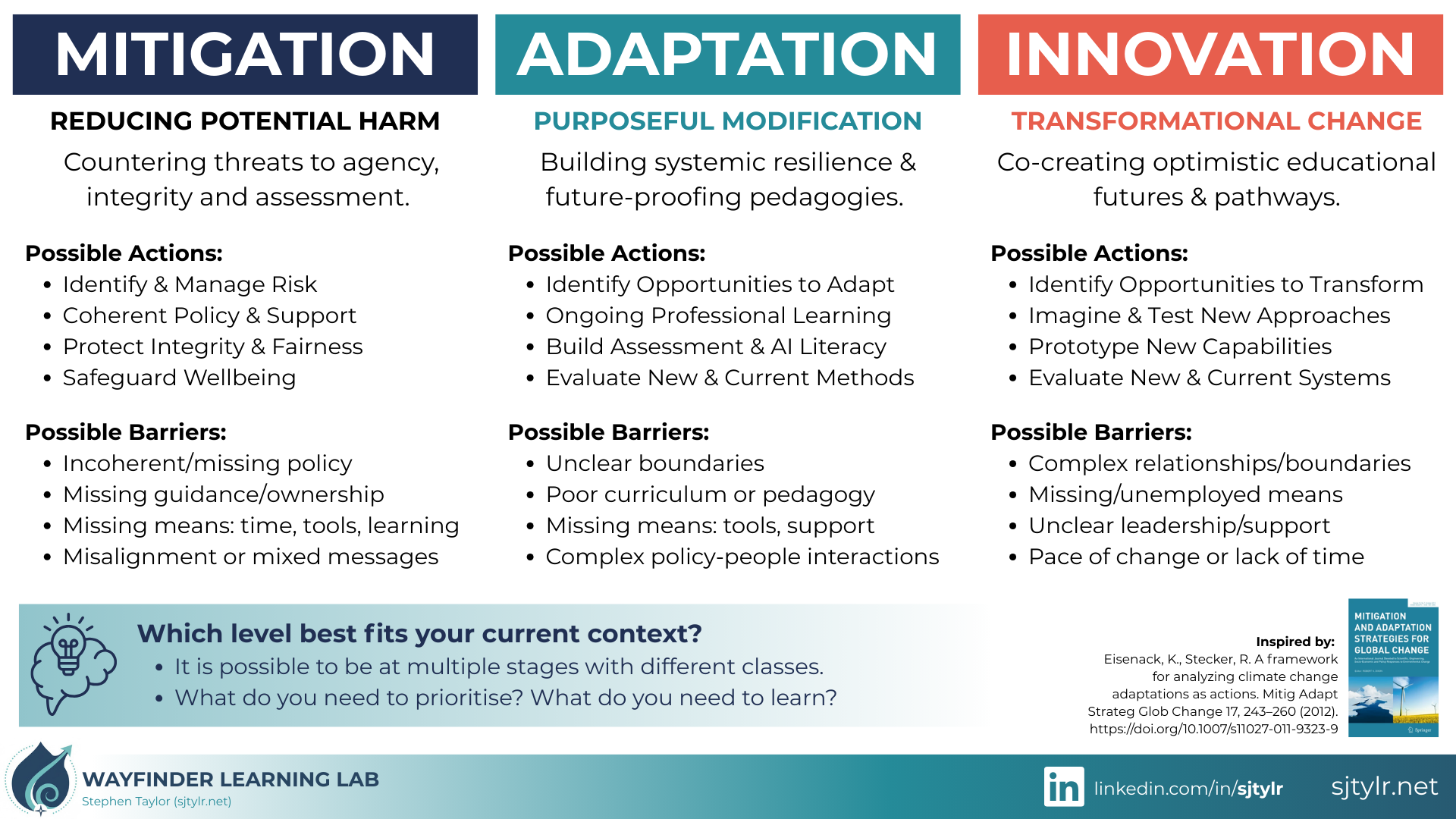
When you place your learning situation on this scale, what do you need to have in place? Who will support? What systems and structures (including policy, guidance, materials, examples) will help with your transition?
With mitigation, we are typically bounded by external forces. With adaptation, we have room to move within our context. With innovation, we have the freedom to explore, create and iterate towards transformative outcomes.
Mitigation examples might include: more interactive assessment practices; move to more closed-environment assessment; enhanced academic integrity training and support; clear examples of boundary situations. What else would you consider?
Adaptation examples might include: including safe use of AI in research processes, with transparency and training; AI-enhanced assessment (such as tutor bots, generating questions); critical literacy training on AI-generated outputs; discussion of ethical considerations of AI (environmental, social, bias, deepfakes, homogenisation etc); “think-first” AI-supplemented routines that ensure learners think deeply before using and critically evaluating AI-generated extensions or alternate perspectives; student+AI generated self-feedback for improvement. What else would you consider?
Innovation examples might include: completely redesigning a course that learns about, with and through AI (transparently) throughout the process; developing AI and coding-based apps and devices in design challenges; analysing huge datasets for in-depth inquiry with AI; developing mastery portfolios with ongoing interaction and support, to change the way we collect and value evidence of learning; heavily personalised pathways for learning; industry connections through internships and mentorships in the AI/tech space; deeper exploration of “hard AI” in working towards solutions to global or local problems. What else would you consider?
Learning for Hope and Agency is Key
AI is here to stay and it is already impacting our work and the future pathways of our learners. How we respond is up to us. If nothing else: please centre human (learner) agency in the design of what comes next. What can create a sense of power, optimism and rational hope as we chart the next steps?
Stop here if you’ve had enough, but if you want to go further…
Getting Theoretical: Mapping The System
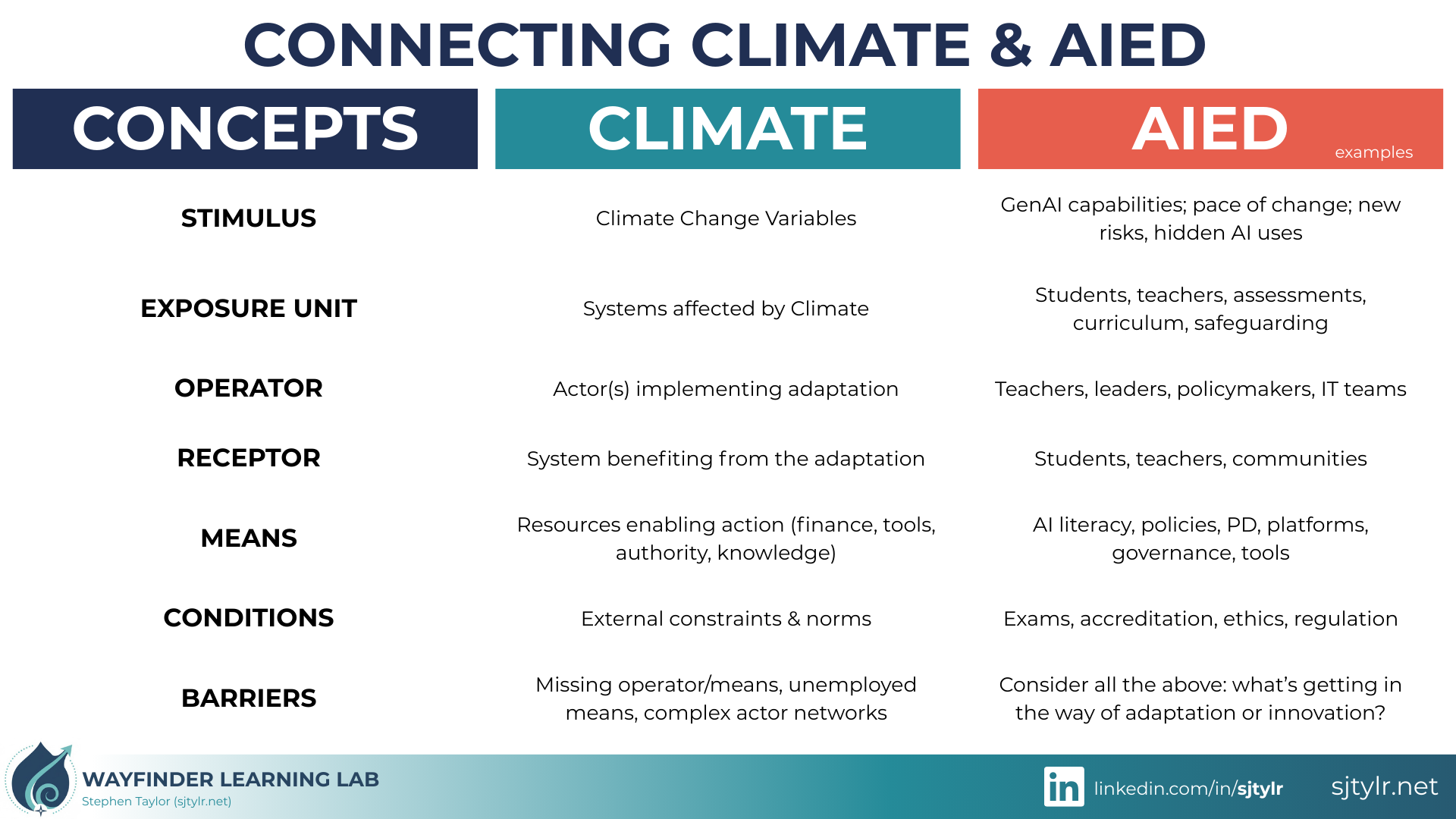
Eisenack & Stecker’s model gives some useful definition to the system, to help break down what is happening (or could happen) and where. I’ve added a column for equivalencies with AIEd.
Immediately, my mind is drawn to Activity Theory, and Engeström’s visualisation of the activity system. Gustaffson et. al. (2023) have an example of using AT in disaster response here, where Uden & Ching (2024), propose and ecosystem view of AIEd through AT here.
A loose attempt to map the two is here:
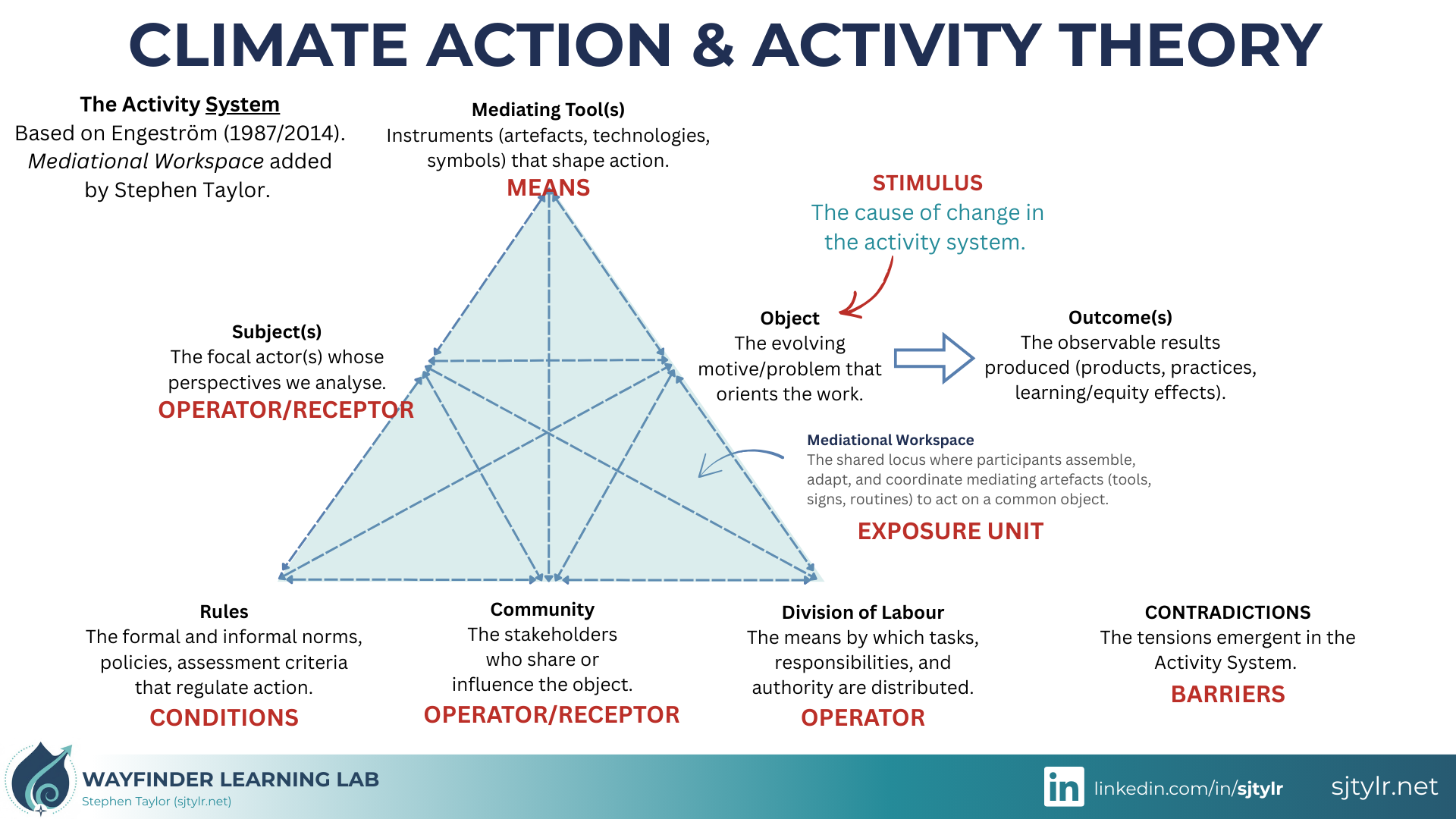
Both tools surface the complex interactions that AI can have across an (activity) system, and both could be used in considering the mapping of influences of or mitigations, adaptations and innovations to AI in the school context. Where activity theory surfaces contradictions of engines of change, climate adaptation helps identify barriers to making that change effective.
Which means there’s more to consider about mitigation, adaptation and innovation…
Mitigation:
In an ideal “fit” between climate action and AIEd, schools and school systems would have more control and influence over the cause of change: AI development. Beyond what we allow through our doors and the lobbying influences of regulators, this is unlikely, so here we are. By shifting the framing of mitigation to that which is within our control, we can centre the threats and challenges posed by AI, and how to counter them. Using the concepts above (stimulus, exposure unit etc) or activity theory, or just by using Circle of Viewpoints or making a list of what we need to protect, we can get this done.
Where mitigation in the climate sense is essential for long-term sustainability (and regeneration), it is not the ideal long-term solution as defined here for AIEd. But in this extended period of transition, as we wait for assessment systems and external forces to align, it is an important part of our strategy.
Adaptation:
Adaptation is not as simple as making a change and hoping it works. Eisenack & Stecker and the IPCC make some useful distinctions between forms of adaptation. Again, shared here with an equivalent column of AIEd examples:
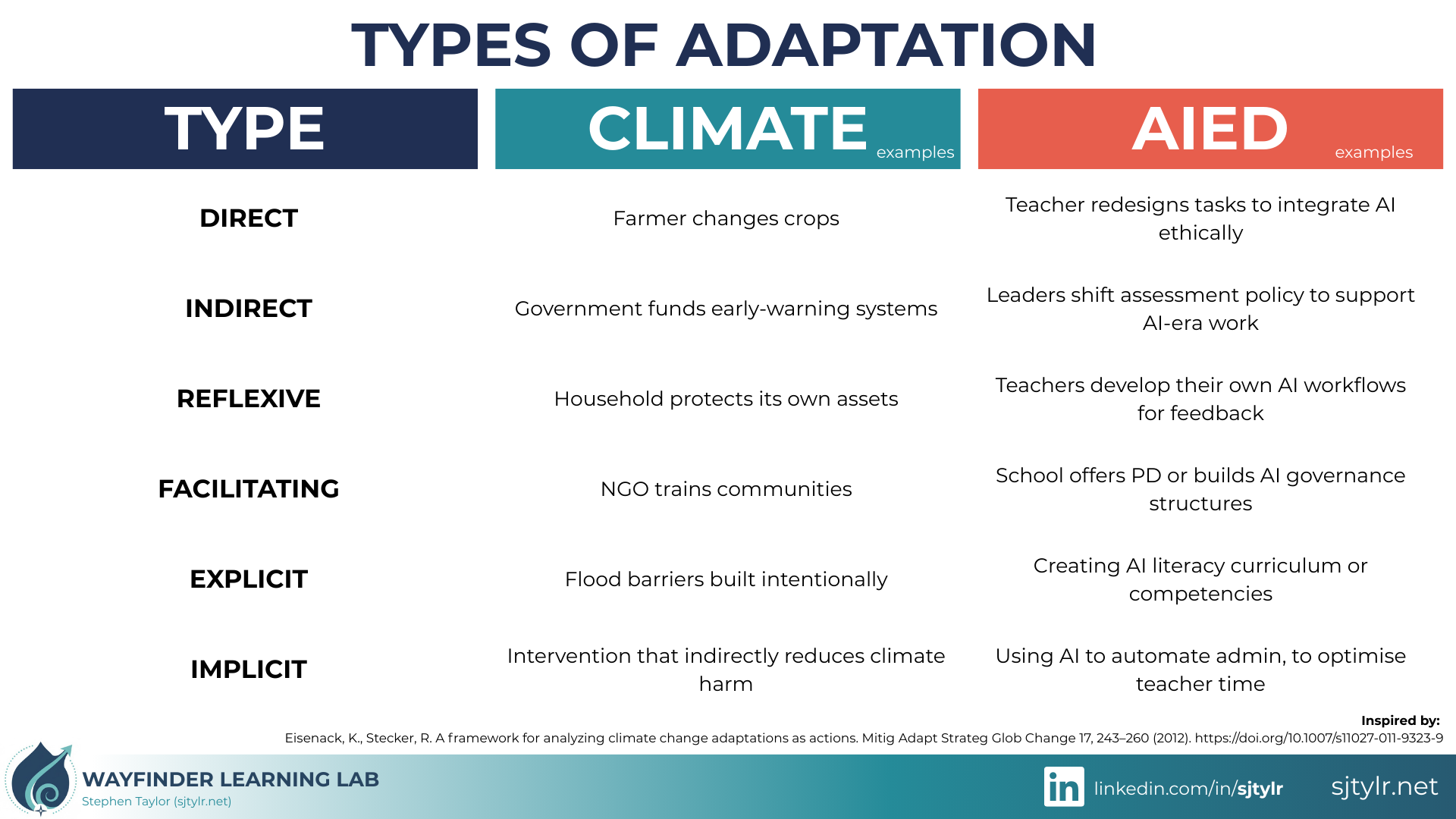
When you read this table, think about all the different roles people play within adaptation of learning systems. Who has the power? Who needs to hold the boundaries? In what ways have the adaptions you’ve made personally reflected the types of adaptation listed? Where does the support come from? How do we ensure our teams have the means they need to make it work, and champion their iteration, successes and shared learning?
Innovation & Transformational Change
This definition of transformational change (innovation) from the IPCC is really useful:
“Transformational change is a fundamental change in a system, its nature, and/or its location that can occur in human institutions, technological and biological systems, and elsewhere. It most often happens in responding to significantly disruptive events or concerns about them. For climate-resilient pathways for development, transformations in social processes may be required to get voluntary social agreement to undertake transformational adaptations that avoid serious disruptions of sustainable development.” (IPCC, p. 1107).
- How would you adapt this to think about the potential for transformational change in your own school community and ecosystem?
- How would you map the relationships and needs for it to be successful?
- Where will you take this next?
In the coming years, as AI becomes more agentic and a rising tide of educational innovation starts to lift the ships, we will see more and more great examples.
When we move beyond fear and into a space of true agency, we can make a successful, hopeful transition… leading to sustainable resilience in our education systems.
References
Eisenack, K. and Stecker, R., 2012. A framework for analyzing climate change adaptations as actions. Mitigation and adaptation strategies for global change [Online], 17(3), pp.243–260. Available from: https://doi.org/10.1007/s11027-011-9323-9
Sköld Gustafsson, V., Andersson Granberg, T., Pilemalm, S. and Waldemarsson, M., 2024. Identifying decision support needs for emergency response to multiple natural hazards: an activity theory approach. Natural hazards (Dordrecht, Netherlands) [Online], 120(3), pp.2777–2802. Available from: https://doi.org/10.1007/s11069-023-06305-2
IPCC. 2024. Climate-Resilient Pathways: Adaptation, Mitigation, and Sustainable Development — IPCC [Online]. Available from: https://www.ipcc.ch/report/ar5/wg2/climate-resilient-pathways-adaptation-mitigation-and-sustainable-development/
Taylor, S. 2022. (If You) USEME-AI. https://sjtylr.net/if-you-useme-ai/ (introduces mitigation, adaptation, innovation).
Uden, L. and Ching, G.S., 2024. Activity theory-based ecosystem for artificial intelligence in education (AIED). International Journal of Research Studies in Education [Online]. Available from: https://doi.org/10.5861/ijrse.2024.24000.


 Wayfinder Learning Lab - Stephen Taylor
Thank-you for your comments.